The Small Asteroids Near Earth Are Darker Than They Look

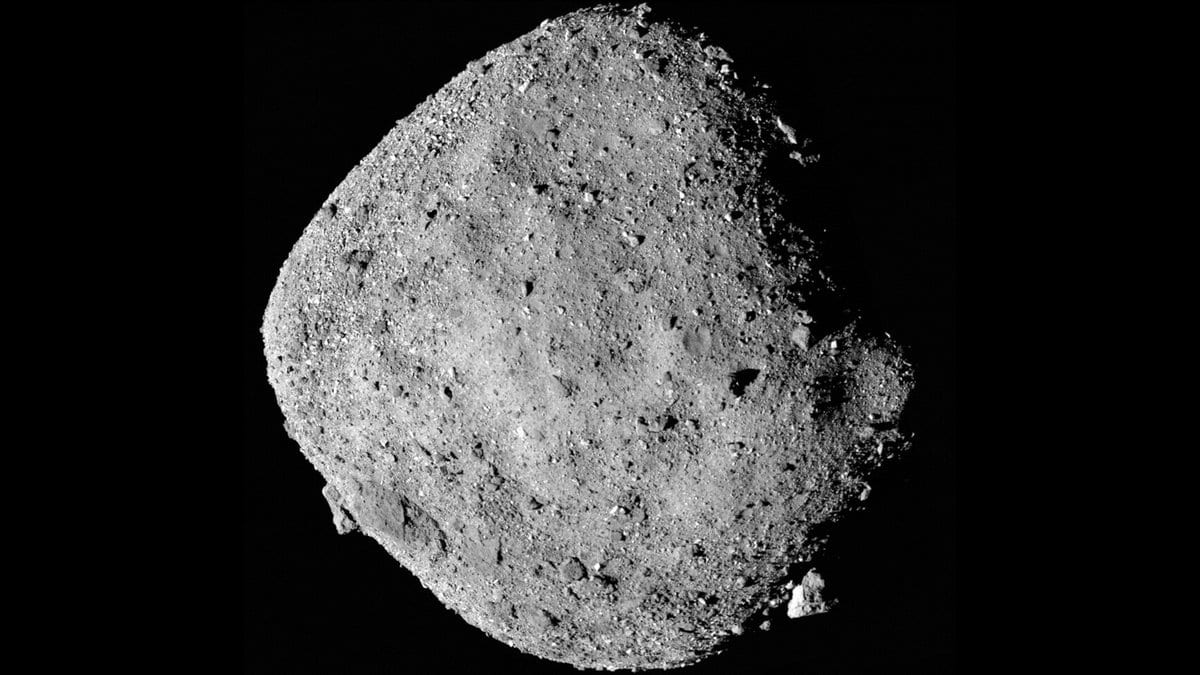
Pull open the drawers of a large meteorite collection and one kind of rock keeps turning up: the gray, stony ordinary chondrite. The dark, crumbly carbonaceous meteorites (the ones that carry water and organic molecules, and that planetary scientists most want to study) make up only about 4 percent of witnessed falls. Whether that scarcity describes the solar system, or only describes the trip through Earth's atmosphere, has been an open question for as long as anyone has kept count.
A survey accepted by The Planetary Science Journal supplies the measurement that argument has been missing: a census of the small asteroids themselves. It is accepted rather than published: the journal version has not appeared, and the paper is out as an arXiv posting in its accepted form. Andy J. López-Oquendo of NASA's Goddard Space Flight Center and David Trilling of Northern Arizona University, with colleagues, spent nine years chasing freshly discovered near-Earth objects with the UKIRT telescope on Maunakea. They filed observing requests within days of a discovery and caught each rock in the short window before it faded. The campaign produced firm compositional classifications for 122 objects between 5 and 150 meters across, with a median of 60, the size range that feeds Earth's meteors and meteorites.
In the raw tally the two dominant groups came out almost even: about 40 percent stony S-complex bodies, and about 44 percent in the dark carbonaceous-and-metallic group the authors label C/X, with a scattering of rarer types. That near-even split is not this survey's alone. A robotic rapid-response program at the South African Astronomical Observatory, working at visible wavelengths on a different set of asteroids, reported the same roughly one-to-one ratio earlier this year.
The small ones are not simply scaled-down versions of the big ones. Among kilometer-sized near-Earth asteroids the stony fraction is closer to 70 percent, so the stony share appears to thin out as objects get smaller.
A dark asteroid and a stony one of the same size are not equally easy to catch. A carbon-rich surface reflects little of the sunlight that falls on it, and a stony surface reflects a good deal more, so at any telescope's limiting magnitude it is the dark bodies that drop out of the sample first. The bias runs a second time through discovery itself. Surveys preferentially find objects on orbits that keep them close to Earth, while primitive material tends to arrive from the middle and outer main belt on paths that bring it near only briefly.
Correcting for that is the actual work of the paper, and it is worth being exact about what "debiased" means here. Nobody went back and observed more dark asteroids. The team took the observed ratio and rescaled it, using the reflectivity typical of each class and the rate at which asteroid numbers rise as size falls, a first-order correction borrowed from earlier near-Earth object surveys. Run through it, the stony fraction drops to 23 percent and the C/X fraction climbs to 67. The sky the survey saw is about half stony; the sky it infers is not.
The second pair of numbers is an inference rather than a direct measurement. The correction is first-order; it treats every object in the C/X group as genuinely dark; it assumes all compositional types share one size distribution. They also leave the orbital bias out of the arithmetic entirely, which means the real dark fraction would be higher still rather than lower. And the debiased result has not been reproduced anywhere else. The South African program measured what it saw and did not correct it.
Set the corrected census beside those museum drawers and the two do not match. By the corrected count most of what is out there should be carbonaceous; only a small fraction of what is collected is. Comparing the two, the authors calculate that carbonaceous material entering the atmosphere is reduced by at least a factor of 15 relative to the number of samples eventually recovered — finding, in their words, that a substantial fraction of carbonaceous material likely does not survive atmospheric entry.
That fragile carbonaceous material struggles to reach the ground is long established. It has low tensile strength and can break up at very low dynamic pressures high in the air. A Nature Astronomy study led by Patrick Shober found that heat weakens fragile meteoroids in space before entry, particularly those on orbits that pass close to the Sun. What that account has lacked is a number at the other end of it: how much carbonaceous material is up there to be filtered in the first place. A debiased taxonomic survey is one way to supply it.
The practical consequences point in two directions. Sample-return missions exist partly because the atmosphere is such an unreliable courier: much of the carbonaceous material now sitting in laboratories was fetched by spacecraft rather than picked up off the ground. If the small-asteroid population really is dominated by primitive bodies, the case for going to get more of it strengthens. For planetary defense the reading is less comfortable. Hazard models built on a stony-dominated population may be built on the wrong rock, since a weak body breaks up differently on the way in. This paper, though, measures composition, not strength, and does not test that.
More data is coming either way. The Vera C. Rubin Observatory and NASA's NEO Surveyor will multiply the number of known small near-Earth objects, and the paper's closing recommendation is aimed squarely at that flood. A larger catalog characterized the same biased way would still describe the sky telescopes can see rather than the sky that is there. What the authors want is surveys that record their pointing history and measure their own detection efficiency, so the correction can be done properly instead of approximated.
Sources
- arXivPreprint