The Wave Down a Fish's Body, Not Its Length, Sets How Fast It Swims

In 1958 a zoologist at Cambridge put dace, trout and goldfish through an apparatus built to record a fish swimming continuously, and counted tail beats. Richard Bainbridge came away with a line tidy enough for a textbook. Past about five beats a second, a fish's speed climbed in step with its tail, and how much each beat bought depended on how long the fish was.
The line held. It has since been confirmed in animals that resemble each other hardly at all, from eels to tuna. What it never acquired was a reason. Dimensional arguments explained why the relationship should come out straight for fish big enough and quick enough that the water's stickiness barely counts, but the relationship itself stayed empirical, fitted to recorded swimming rather than predicted from anything. The two quantities that define it had no account at all: the distance a fish covers in a single beat, and the beat rate below which it is supposed to stop moving forward.
A paper published Oct. 16, 2026, in the Proceedings of the National Academy of Sciences supplies one. The derivation is the work of Jung-Hee Seo and Rajat Mittal, mechanical engineers at Johns Hopkins University. Their co-authors are at the University of California, Irvine, and at the Scripps Institution of Oceanography in San Diego. Their route goes through the water. Set the thrust a beating tail fin makes against the drag the water exerts on the body, require the two to balance, and solve for speed.
Both halves of that balance are specific. The thrust is credited to a leading-edge vortex, the spinning water that forms along the front edge of the fin. The drag is credited to the boundary layer, the thin skin of water a swimming body drags along with it. Neither ingredient is new on its own; what is new is the explicit expression for speed that falls out of pitting one against the other, written in terms of how the body's centerline moves and what shape the body has.
The first thing the formula says concerns stride length, the distance a fish travels in one beat of its tail. In the model its maximum is set by two quantities: the length of the wave traveling down the body, and the timing of the tail against that wave. Body length is not one of them. Bainbridge divided by body length, as comparative work has done ever since. His 1958 paper in the Journal of Experimental Biology put the speed of a fish at V = ¼ L(3f − 4), with L the body's length and f the beats per second.
Body length is the ruler the field normalizes by, the way speeds get quoted in body lengths per second so a sardine can be set beside a tuna. Bainbridge's own measurements gave it a physical warrant: the amplitude of the tail beat topped out near a fifth of the body's length in every fish he tested. But what sets the maximum distance per beat, in the new account, is the wave rather than the ruler.
The second thing is stranger. Read literally, Bainbridge's line has a floor built into it: speed falls to zero near 1.3 beats a second, and below that the arithmetic goes negative, though his fit was made at the faster beat rates. The new derivation needs no floor. It requires no minimum beat rate for forward motion at all. That is a result about what the physics demands, not a recording of a fish ambling along at a beat a second.
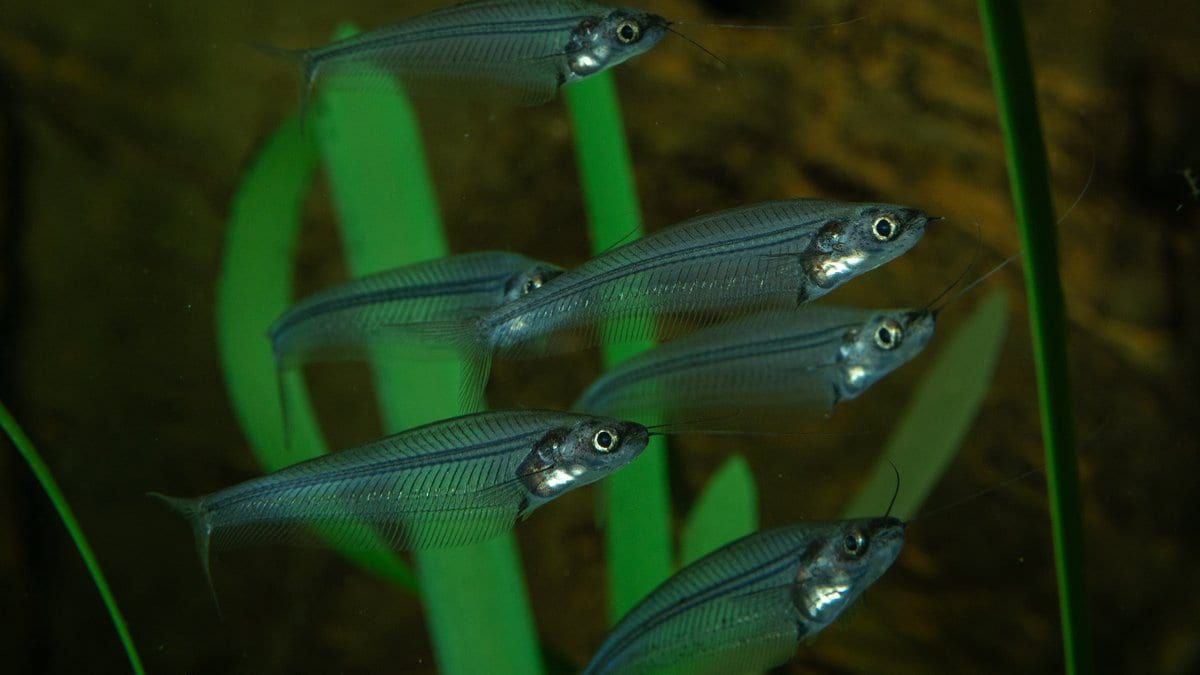
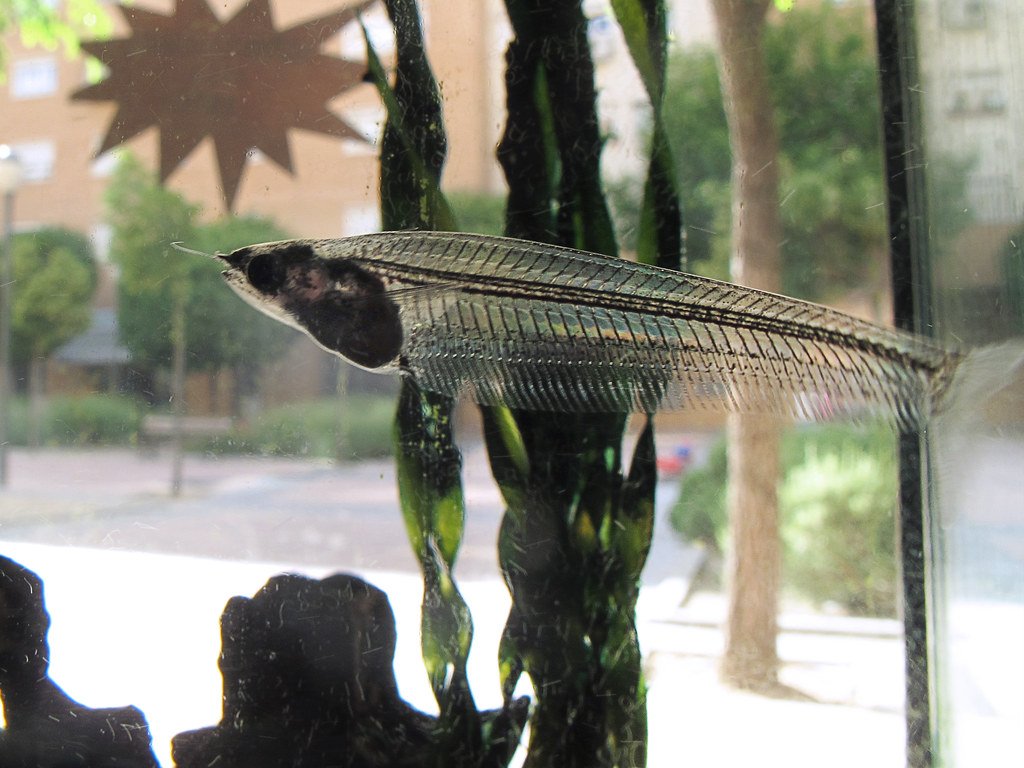
Three checks follow. The formula reproduces measurements of glass catfish swimming freely, simulations already published, and Bainbridge's original data. Then the harder one. Without being recalibrated, the formula was turned on independent simulations covering wide variations in wavelength, tail timing and body shape. It came within ten percent of their results. That ten percent is the authors' own measure of their model against data they did not produce.
The consequence the authors reach for is in engineering. A swimming machine has usually been made faster by driving its tail harder. In this account the variable that sets performance, in fish and in machines modeled on them alike, is the waveform of the body rather than the frequency it is driven at: what shape of wave travels down it, and how the tail is timed against it.
None of this makes Bainbridge wrong. His straight line survives in the new formulation as one limiting case of a more general relationship between a body's shape, the wave it sends down itself and the speed that results. What has changed is what the line is made of. For 68 years it was a fit to recorded fish. It is now an answer to thrust and drag.