An Asteroid's Last Salty Water Left Its Nitrogen Behind in the Clay

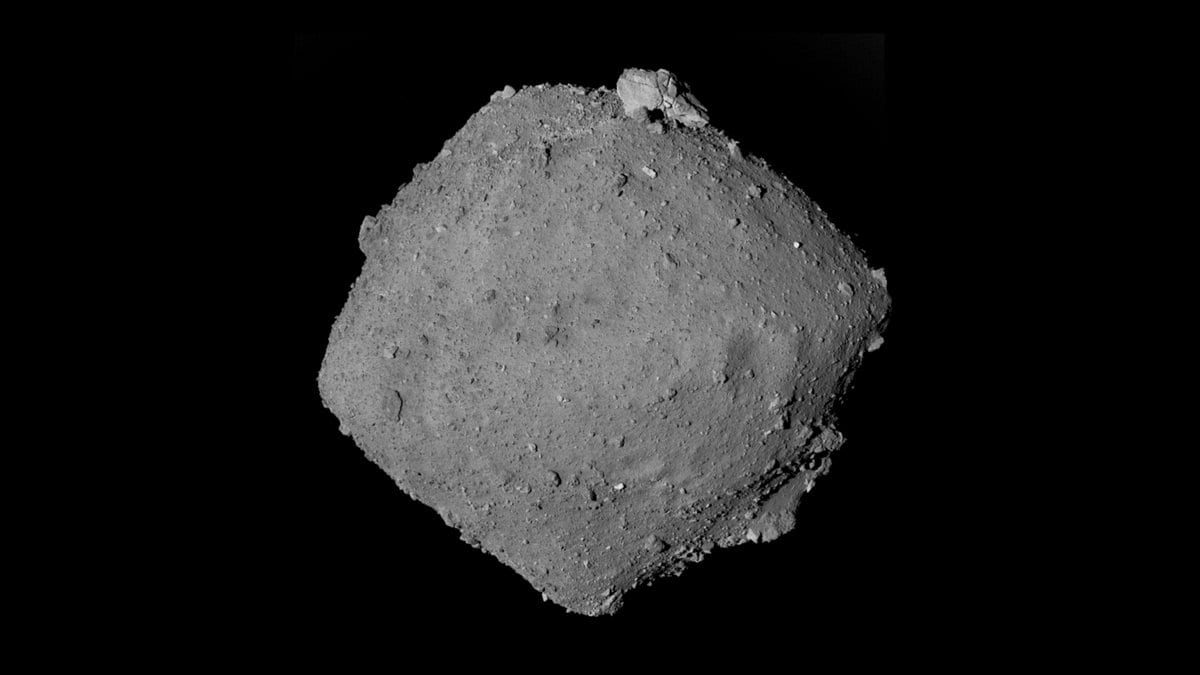
More than four and a half billion years ago, a lump of ice and dust in the outer Solar System got warm enough to melt inside. Water seeped through the rock, dissolved what it could, and eventually ran out. The last of it would not have been water so much as brine: salty, concentrated, and going nowhere. Toru Matsumoto and his colleagues at Kyoto University think they have found what that final puddle left behind.
What it left behind, they report in Nature Astronomy, is nitrogen: the hardest of life's raw ingredients to trace in the rocky material that built the planets. Nitrogen prefers to be a gas. Ammonia, its most reactive common form, boils off easily and is scarce in meteorites, which leaves an awkward gap between the ammonia-rich ices seen in comets and the nitrogen chemistry that had to be available on the young Earth.
The work was done on two grains, cataloged as C0071 and C0369, from the roughly 5.4 grams of asteroid Ryugu that JAXA's Hayabusa2 mission brought home and keeps in curation. Infrared spectroscopy read the vibrations of their chemical bonds. X-ray absorption spectroscopy, done at a synchrotron, picked out the precise chemical state of the nitrogen atoms. An electron microscope then looked at slices cut thin enough to see through.
Three nitrogen-bearing things turned up. Ammonium, ammonia that has picked up an extra proton and become an ion, sat in the interlayer spaces of the clay minerals, or phyllosilicates, that make up most of the grain. Molecules carrying a carbon-nitrogen triple bond were mixed in among them. And sodium nitrate appeared as tiny crystals of nitratine, identified from their diffraction pattern, sitting inside sodium carbonate, the salt sold on Earth as washing soda.
The nitrogen is not spread evenly through the grains. Across the clay matrix the spectra do not all look alike: some regions match ammonium, others match sodium nitrate, and others show no nitrogen feature at all. The triple-bonded molecules appear in one of the two grains and not in the other. And nitrogen turned up in one more form: molecular nitrogen gas, the kind that makes up most of the air we breathe, trapped inside a magnesium-sodium phosphate.
The arrangement is what the paper is built on. All of it sits beside sodium carbonate, the same mineral Matsumoto's group reported on Ryugu in 2024 and read as the leftovers of very salty water. Carbonate of that kind crystallizes when a brine is nearly gone. Finding the nitrogen in the same place points to it being concentrated and captured at that moment, as the last salty water disappeared, rather than escaping as gas. The paper says probably, and the hedge is doing real work: the association in space is what was measured, the sequence in time is what has been read from it.
From there the authors suggest a longer story. Reactive ammonia and the triple-bonded molecules were built into the parent body as it formed and stayed available until the water activity stopped, giving the rock a nitrogen supply that lasted rather than a single pulse. A drying brine also concentrates whatever is dissolved in it, and the team notes that this should favor reactions in which molecules join by shedding water, the step that turns small organic molecules into larger ones. The paper frames each of those as a suggestion.
The detection itself does not rest on this one team. In May, an independent group led from the Institut d'Astrophysique Spatiale near Paris published its own survey in Nature Communications, using a different instrument. MicrOmega is a hyperspectral microscope that works on samples still sealed inside their preservation chambers, never exposed to air. It found ammonium-bearing clay grains, typically a few hundred micrometers across, in 13 regions of the Ryugu collection and in 12 regions of the Bennu samples returned by NASA's OSIRIS-REx. Different team, different technique, a second asteroid, the same mineral.
That group reads the pattern as evidence that ammonium locked into clay was an efficient way to carry nitrogen inward and deliver it to the terrestrial planets. What it does not corroborate is the timing: the link to the last brines, the sodium nitrate and the triple-bonded species belong to the Kyoto study alone.
That points somewhere specific to look next. Ceres has shown a signature of ammonium-bearing clays since NASA's Dawn spacecraft mapped it a decade ago, and it is both salty and still icy, which Ryugu's parent body has not been for a very long time. The authors suggest the same chemistry could be running beneath its surface today, wherever ice volcanism drives briny material upward and concentrates it.
The paper went through peer review with its reviewers named and their reports published alongside it, which is not the default. The numbers behind every figure sit in JAXA's public archive, so anyone who wants to fit the spectra differently can start today.
Sources
- Nature AstronomyPeer-reviewed
- www.nature.com