Little Red Dots May Be Thinning out Because Their Surroundings Turned Ordinary

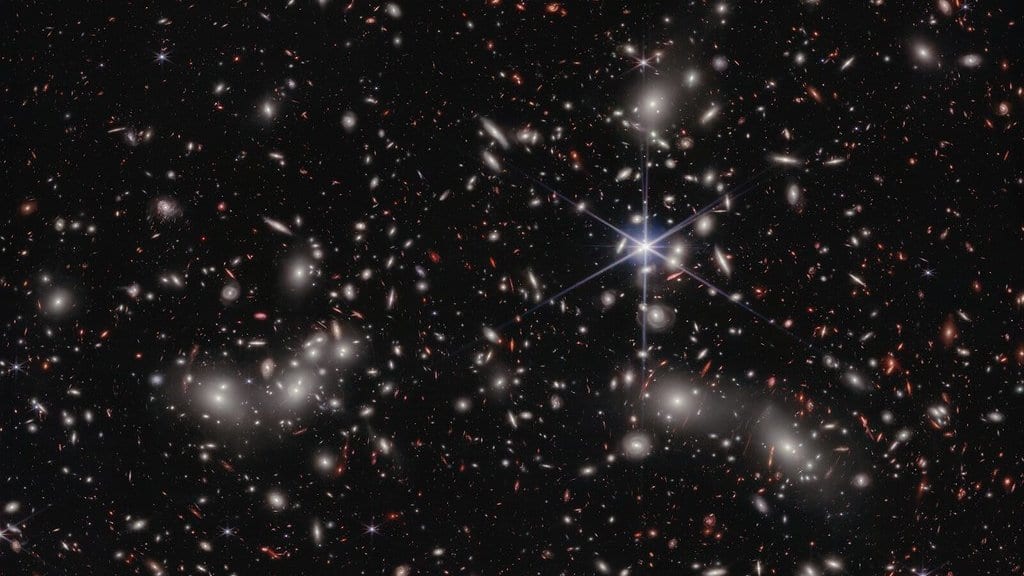
Aim the James Webb Space Telescope at a deep enough patch of sky and tiny, intensely red specks emerge from the noise, most numerous in the earliest parts of the universe. Look at the same kind of sky nearer the present day and they are nearly gone. Astronomers have debated what the specks are since the telescope's first deep images. The other half of the puzzle has drawn less attention: wherever they came from, where did they go?
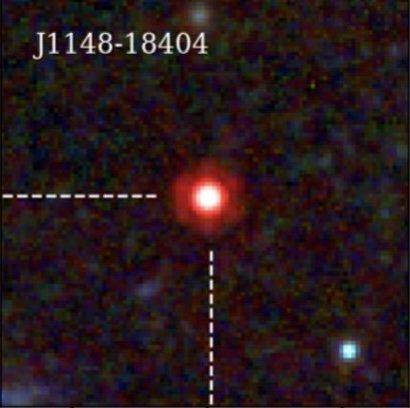
A study published Oct. 8 in Nature Astronomy takes that second question on. Chenxuan Zhang, Jian-Min Wang and three colleagues studied the environments of 98 little red dots, using spectra to determine their distances across redshifts 3 to 7. Their finding is that the dots occupy different environments at different epochs.
Most work on the dots has focused on what they are. A few have turned up in apparent pairs, and simulations have offered an explanation for the class as a whole. Interpretations in the literature range from a black hole feeding behind a screen of dust to a star-forming galaxy embedded in extremely dense gas, and the field has not settled the question. This study asks something else: not what a dot is, but what kind of place it occupies.
Redshift is the astronomer's clock: a higher number means an earlier epoch. At redshifts above 4, the team reports, the dots occupy underdense regions, where galaxy numbers are below average. By redshift 3.5, that pattern has changed, and the dots occupy environments more typical of ordinary galaxies.
The dark matter follows the same arc. Galaxies reside in halos of dark matter, whose masses can be estimated from how strongly a population of objects clusters with surrounding galaxies. Using this method, the team finds that the dots' halos grow rapidly. At redshift 7.5, their masses are no greater than about 10^10.1 solar masses, or roughly 13 billion solar masses. By redshift 3.5, they reach about 10^11.3 solar masses, comparable to the halo masses of ordinary galaxies at that epoch. The earlier value is an upper limit, not a precise measurement, so the actual increase could be even greater.
One further step, and the paper explicitly marks it as an inference. Applying an empirical relation between halo mass and stellar mass, the team finds that at the highest redshifts, the dots host black holes that are too massive relative to their galaxies. At later times, they approach the black hole-to-stellar-mass relation observed in the nearby universe. The stellar masses are inferred by extrapolating an assumed relation to the early universe, not measured directly.
Zhang and colleagues do not claim to have closed the case. The parallel shift in environment and halo mass toward more typical values provides, they write, a "plausible explanation" for the dots' decline at later epochs, "even though the underlying small-scale physical mechanisms remain elusive." The population's decline now has a possible explanation, but the physical processes driving it remain unknown.
The halo-mass estimates behind this explanation are contested. In September 2025, in the same journal, Jan-Torge Schindler and colleagues reported a single little red dot at redshift 7.3 that did not occupy an underdense environment. It lay in a group of eight galaxies, and from the clustering of those neighbors, the team inferred a lower limit on its dark matter halo mass of about 10^12 solar masses, or 1 trillion solar masses.
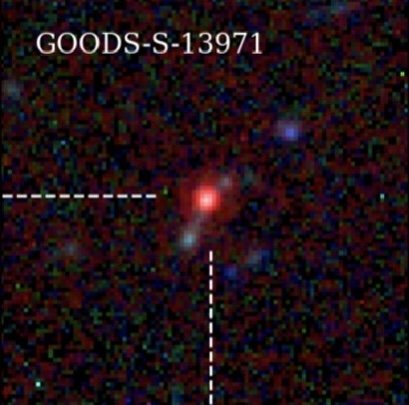
That lower limit is nearly two orders of magnitude above the upper limit the new survey places on little red dots at a similar cosmic epoch. The two estimates are not directly equivalent: Schindler's team inferred the halo mass of one object from its neighboring galaxies and reported a minimum, while the new survey analyzes a population and reports an upper limit. Both studies are peer-reviewed, and their results differ on a basic question: whether little red dots in the early universe occupy the massive halos associated with quasar formation or much less massive ones.
The data are publicly available, which could help other researchers test the result. The dots come from JWST programs: JADES, PRIMER, CEERS and UNCOVER. The comparison galaxies come from the DESI and SDSS surveys, and the paper identifies the code used in the analysis as publicly available. Other researchers can use the same catalogs to attempt to reproduce the results.
An upper limit for a population and a lower limit for one object can both be correct and still leave the question open. Resolving the tension will require more individual halo-mass estimates for little red dots at the earliest epochs, where this survey provides an upper limit rather than a precise value. Until then, the scarcity of little red dots in the later universe has a plausible explanation, but no established physical mechanism.