A Glow 'Forbidden' by Symmetry, Seen at Last in a Shock Wave

Three protons sharing two electrons in a perfect equilateral triangle: H₃⁺ is about as simple as a molecular ion gets, and it is what starts nearly everything else. A cosmic ray strips an electron from a hydrogen molecule, producing H₂⁺. That ion reacts with another hydrogen molecule to form H₃⁺, which spends its life passing a proton to other molecules, setting off the chemistry of a cold interstellar cloud. But a perfect triangle has no heavy side and no light one, no lopsided pull of charge, and so no ordinary way to shed energy as it tumbles. On paper, a spinning H₃⁺ ion is silent.
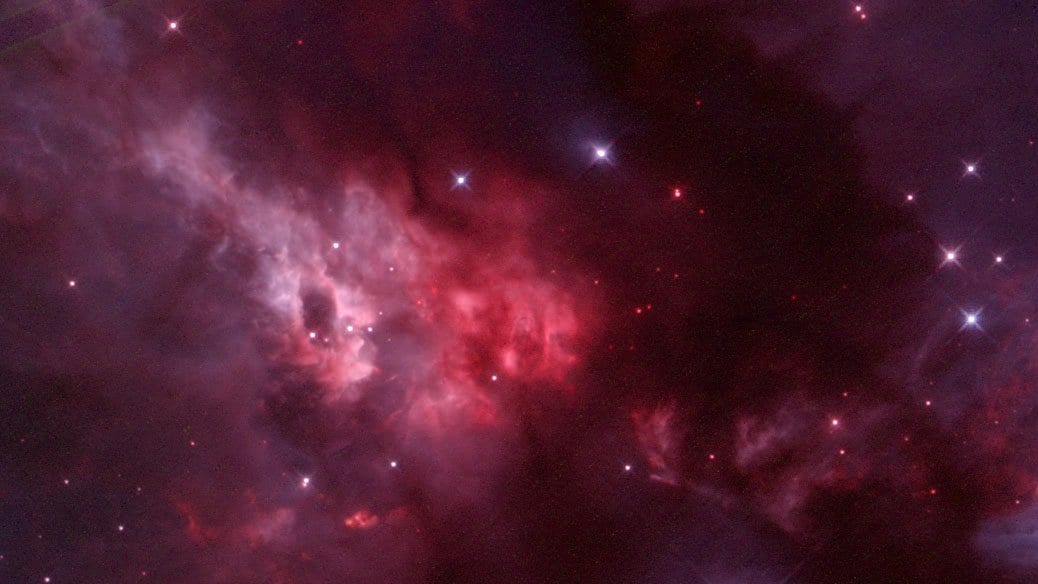
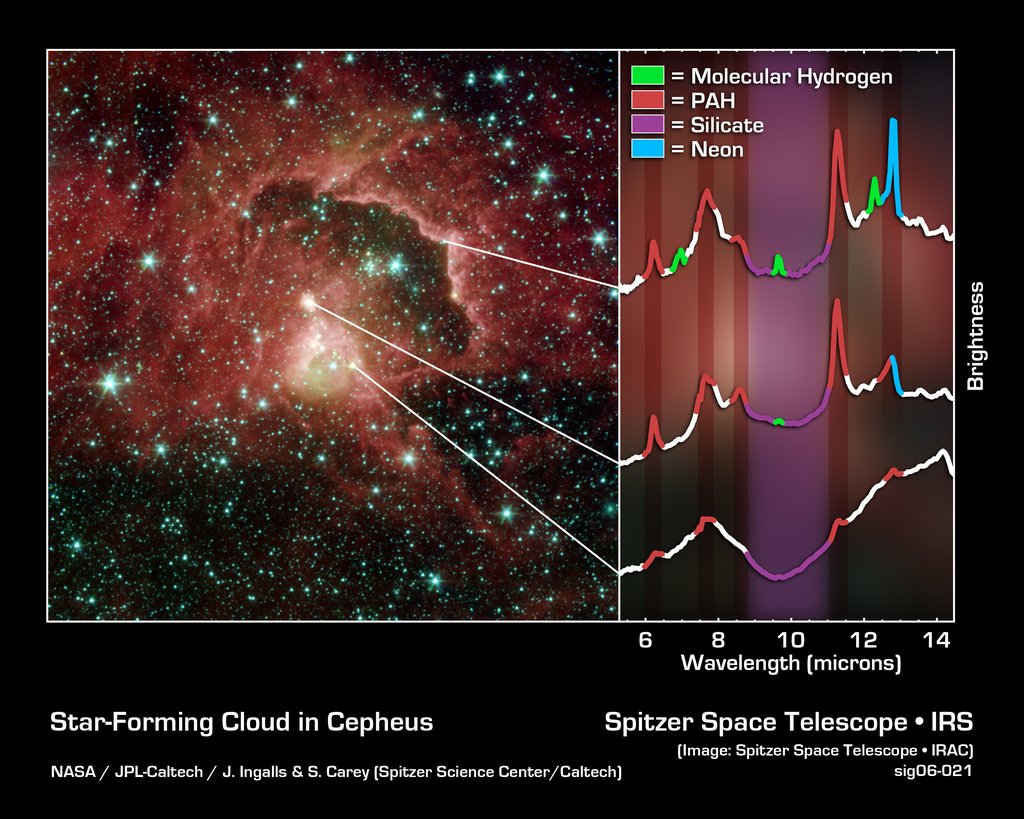
It is not quite silent, because it is not quite a triangle. Spin it fast enough and centrifugal distortion pulls it out of shape, leaving the ion with a faint, fleeting imbalance of charge that permits a handful of very weak transitions, the kind spectroscopists call forbidden. They fall in the mid-infrared. Four astronomers now report that the James Webb Space Telescope has detected 26 of those forbidden lines toward HH 168, a Herbig-Haro object in Cepheus A West. The lines were detected above 5σ in at least one of two observed fields. It is the first time the forbidden rotational spectrum of H₃⁺ has been recorded in either a laboratory or an astronomical source.
The paper was posted to arXiv on Nov. 6 and has been accepted for publication in The Astrophysical Journal Letters; the published journal version is not yet available. Its authors are David A. Neufeld of Johns Hopkins University, Joel D. Green and Paule Sonnentrucker at the Space Telescope Science Institute, and Dan M. Watson of the University of Rochester. The observations were taken on Aug. 1 with the Mid-Infrared Instrument (MIRI) aboard Webb, using its Medium Resolution Spectrometer.
The ion itself is not new, and the distinction is the whole of the claim. Its vibrational bands, the lines it emits when the triangle flexes rather than merely turns, have been observed for decades. They show up in absorption against background starlight and in emission from the aurorae of the giant planets, most recently at Neptune. What nobody had seen was the pure rotational spectrum, the glow from the tumbling alone. Pan and Oka calculated those lines in 1986 and noted that they offered "an alternative possibility of detecting interstellar" H₃⁺. Then four decades went by. A search in Jupiter's aurora came up empty; the most recent attempt, toward a disk in Orion, produced only an upper limit.
Twenty-six lines, and several ways to check them
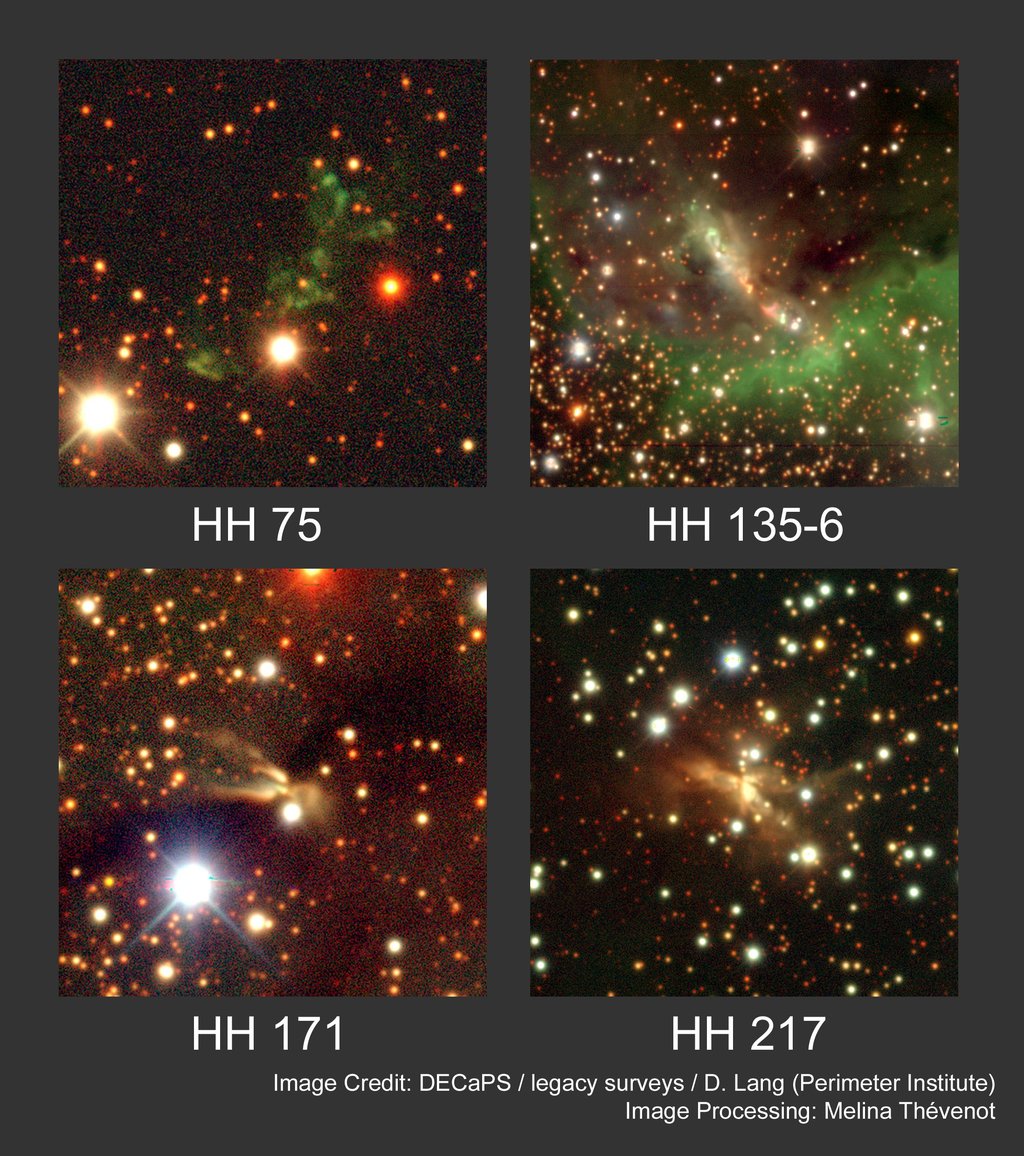
HH 168, the object they pointed at, made it possible. It is a Herbig-Haro object, a knot of gas lit where a young star's jet rams the cloud around it, about 2,300 light-years away in the western part of Cepheus A. It also sits far from the embedded protostars whose warmth crowds a mid-infrared spectrum with molecular features, so its own spectrum is bare enough for faint lines to stand clear. The strongest of the forbidden lines is detected at a significance of 72σ in one field and 49σ in the other.
Then there are the maps. MIRI records an image at every wavelength, so the team could ask not just whether the lines are there but where. Pixel by pixel, the brightest H₃⁺ line follows the hot shocked hydrogen at a correlation of 0.97 in one field and 0.87 in the other, where 1.0 would be a perfect match. A stack of 29 H₃⁺ lines gives similarly strong correlations, 0.94 and 0.83, respectively. The velocities agree too. Set that map against the ionized gas in the same field, against iron, neon and recombining atomic hydrogen, and the correlation falls to 0.11 or less in magnitude, and is negative in the other field. The authors write that the H₃⁺ map is "unmistakably that of the hot molecular gas, not of the ionic or atomic emission in the same field." Eighteen of the 26 lines show up in both fields.
Fit all 26 lines with a single temperature and the answer is about 730 K. That number describes the fit, not the gas. The level populations are not thermal: a collision kicks the ion up and it radiates straight back down before the next one arrives, so the fitted figure cannot rise above roughly 1,100 K however hot the surroundings are. Two models of collisional excitation and an independent test based on the ions' radiative lifetimes all point to gas temperatures above 2,000 K.
The shock that fits the glow does not fit the hydrogen
Where the glow comes from is the unsettled part, and the authors say so first. They ran two standard pictures of a shock wave moving through molecular gas. A C-type shock, cushioned by a magnetic field so the gas is squeezed rather than struck, fits the hydrogen lines best but underpredicts the H₃⁺ emission by a factor of five or six. A dissociative J-type shock, an abrupt front that breaks molecules apart, comes within about a factor of 1.5 of the observed emission. But it runs at twice the speed the shock code's own documentation covers, and the paper says it "lies outside the range for which the shock code has been validated". It also leaves out the shock's own ultraviolet light, so the authors call its predictions suggestive only. Both models give a flatter spread of line strengths than the data show, and the magnetic field strength they assume throughout is, they say plainly, an assumption. The paper picks neither shock.
What the lines can do, and what they cannot do yet
The same spectrum was already sitting in the Webb archive. Going back to short archival MIRI observations of HH 211, an outflow driven by a much younger and lighter star, the team recovered the strongest line and two others. That is the same four people, the same instrument and the same line list, so it confirms nothing independently. Its value is different: HH 211 has almost none of the highly ionized gas that HH 168 has, and the forbidden glow is there anyway.
The abstract's last line calls the lines a new probe of the ionization in shocked molecular gas. That is a prospect, not a tool in hand. Reading an ionization rate off the line strengths would mean knowing how hard a hydrogen molecule kicks a fast-spinning H₃⁺ ion at energies close to what it takes to break the ion apart, and nobody has computed those rates. Most of the ion also sits in levels that emit nothing at all, which is why the authors put it plainly: "the total column density is uncertain by about three orders of magnitude", a factor of around a thousand.
What is in hand is the glow itself, and a reason to expect it elsewhere. The Webb data are public at the Mikulski Archive for Space Telescopes. The forbidden lines should turn up wherever hot molecular hydrogen is bright and the infrared background is dim, conditions found around many young stars. They will not be easy to detect: even here, the strongest of the 26 carries about one three-hundredth of the light in the hydrogen line beside it.
Sources
- arXivPreprint
- STScI/MAST
- arXivPreprint
- The Astrophysical Journal
- Nature Astronomy