Simulation Offers an Explanation for JWST's Mysterious Little Red Dots
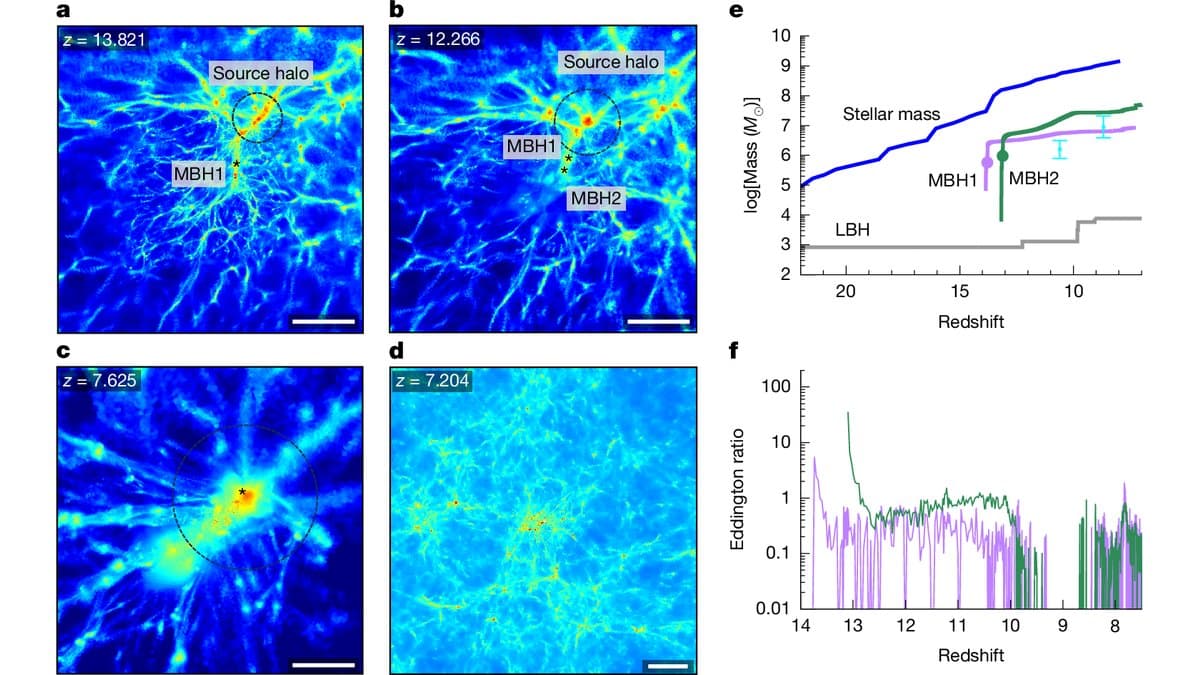
Cosmological simulations published Sept. 16 in Nature propose that JWST's so-called Little Red Dots are an early, short-lived phase in the formation of supermassive black holes, one explanation among several still under debate for these puzzling early-universe objects.
The simulations, presented in the paper by Sunmyon Chon, Volker Springel and colleagues, offer a candidate explanation for what JWST has observed rather than a settled answer: the origin of the Little Red Dots remains actively contested.
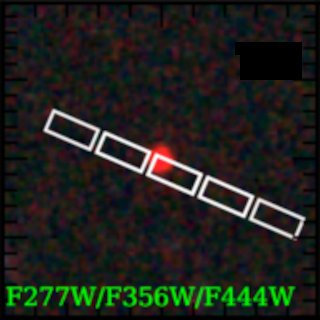
JWST has detected compact, reddish point sources at redshifts above z = 4–6 that carry black hole masses well above the normal ratio to their host galaxies. Standard cosmological models do not reproduce them. The new simulations, run with the AREPO moving-mesh code, follow gas clouds in overdense protocluster regions bathed in intense far-ultraviolet radiation from nearby star-forming galaxies. Under those conditions star formation is suppressed and the cloud collapses instead into a supermassive star, which then falls into a black hole with a mass on the order of 10⁶ solar masses, roughly ten times larger than standard direct-collapse models predict.
The simulated black holes then undergo a brief phase of super-Eddington accretion, growing to about 3 × 10⁷ solar masses by z ≈ 8. Dense, optically thick disks that form around them produce broad hydrogen-alpha emission and red spectral continua that are comparable to the signatures observed in Little Red Dots. The authors describe the result as the first simulation to unify the Little Red Dots with a single heavy-seed formation pathway that also connects them to the overmassive quasars JWST has detected at later epochs.
Earlier proposed pathways, direct-collapse black holes and remnants of the first-generation Population III stars, relied on idealized conditions and had not been followed self-consistently in a full cosmological simulation, the paper notes. The new simulation shows Population III remnants (about 800 solar masses) remain far smaller than the heavy seeds because shallow gravitational potential in their host halos cannot sustain the accretion rates needed for rapid growth.