Astronomers Find Four Candidate Pairs of JWST's 'Little Red Dots'
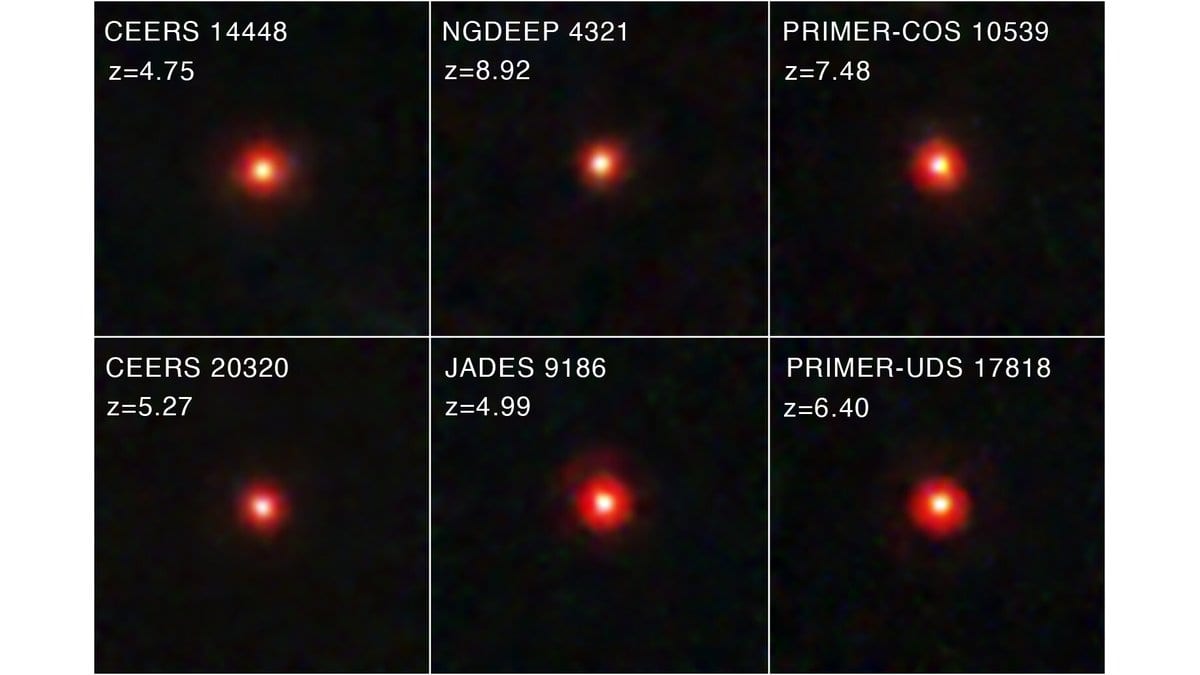
Astronomers have identified four candidate pairs of "little red dots" in the James Webb Space Telescope's COSMOS-Web survey, and follow-up spectroscopy places both members of two of those pairs at the same distance, according to a paper published Aug. 31 in Publications of the Astronomical Society of Japan.
Little red dots are compact, very red objects that JWST has turned up in large numbers in the early universe. Takumi S. Tanaka of the University of Tokyo's Kavli Institute for the Physics and Mathematics of the Universe and colleagues describe them as an abundant high-redshift population "considered to be an early growth phase" of supermassive black holes.
Using pixel-by-pixel color selection and relaxed compactness criteria, the team identified four dual candidates with projected separations of 0.2 to 1.2 arcseconds. Comparing existing samples with mock data, the authors report those separations are unlikely to result from chance alignments of objects at different distances.
Two of the four systems are covered by COSMOS-3D slitless spectroscopy, and each object in those two pairs shows a single emission line at the same observed wavelength. Assuming that line is hydrogen's H-alpha, based on its high equivalent width and broad profile, the authors derive redshifts of z = 5.822 and z = 5.464 for the two pairs — consistent with the estimates from imaging — and projected separations of 1.64 and 7.36 kiloparsecs.
On that basis, the paper reports that the angular auto-correlation function of little red dots, a measure of how often they are found at a given separation, shows an excess of roughly 50 times at sub-arcsecond, kiloparsec separations, compared with an extrapolation of the power law that measure follows at 10 to 100 arcseconds.
The authors write that their sample is "likely to represent precursors of mergers" between little red dots, and that such mergers "may be one of the mechanisms" driving the rapid growth of supermassive black holes early on.
Sources
- doi.orgPeer-reviewed