Strong Evidence, but Not Yet an Observation, for Entangled Z Bosons

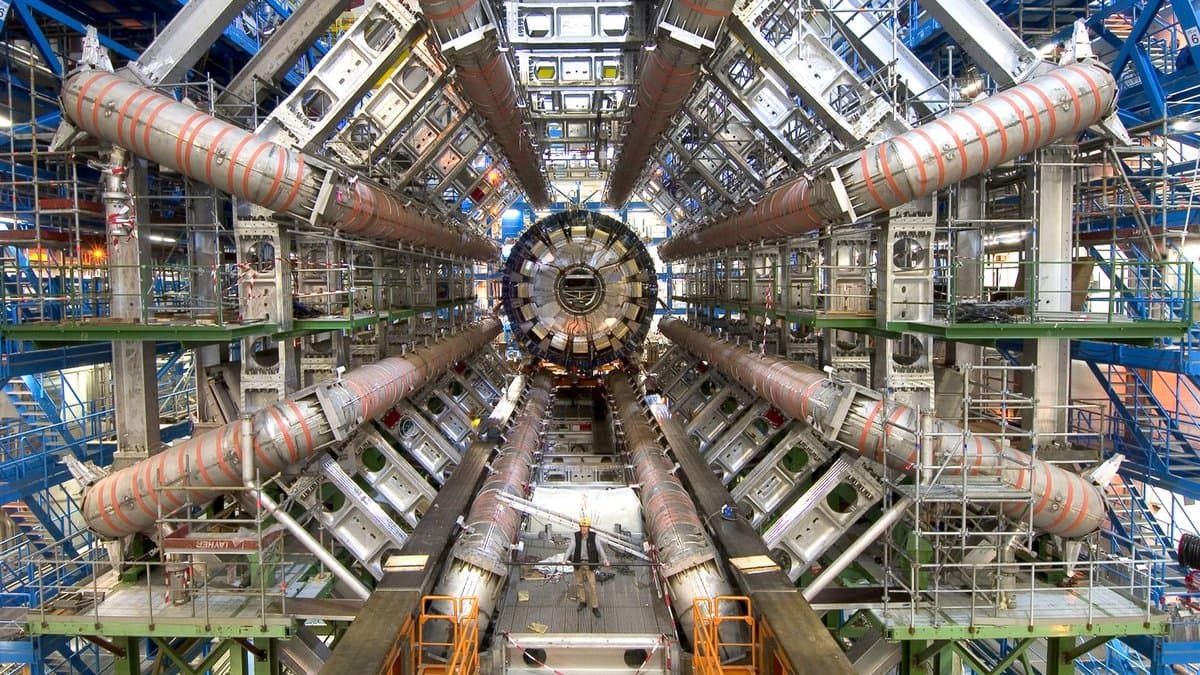
A single experiment can be unlucky. A statistical wobble shaped like a discovery is the oldest hazard in particle physics, and the field's reflex, when one detector reports something strange, is to ask what the other one saw.
The strange thing here is what a Higgs boson leaves behind when it dies. A Higgs is unstable, and one of the ways it can come apart is into a pair of Z bosons, the carriers of the weak nuclear force. Each Z boson can sit in one of three spin states, a three-way quantum unit physicists call a qutrit. Because the Higgs itself has no spin, the two spins have to add to nothing: if one Z turns up as +1, the other must be −1. Measuring one does not only tell you about that one. It fixes the other, however far away it has gone.
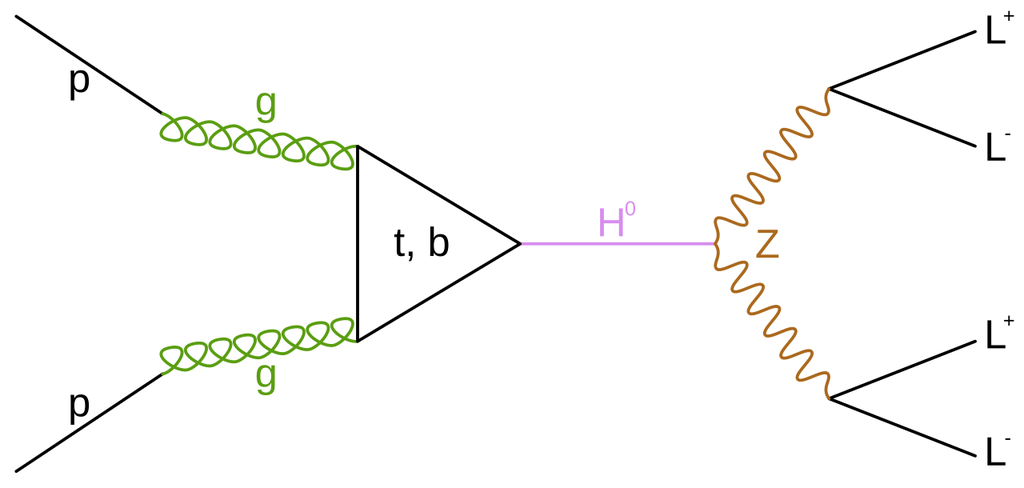
The ATLAS Collaboration reported the first measurements of that link in a Letter published Sept. 11 in Physical Review Letters. Its direct measurement of two angular quantities agrees with the Standard Model, though the uncertainties are still wide next to the values themselves. The sharper result came from a second test, which uses the full pattern of angles at which the leptons fly out and leans on several Standard Model assumptions about how the particles decay. That test disfavors the alternative, that the two Z bosons are simply independent of each other, at 4.7 standard deviations, against 4.9 expected.
In particle physics three standard deviations earns the word evidence, and five earns the word observation, the threshold the field treats as a discovery. ATLAS stops at strong evidence, and so does CERN. The contrast is recent. When the two collaborations looked for entanglement between top quarks, the heaviest particles known, they cleared that bar.
Taken alone, the ATLAS measurement was one detector's answer to the question. CMS had been working the same decay with a different machine, a different dataset and a different set of tools.
Neither detector can measure a Z boson's spin directly. What each can catch is the pair of electrons or the pair of muons that a Z boson decays into, and the angles at which they fly out. CMS's own account of the analysis sets out how those angles become a measurement.
"We cannot measure the spin polarization of the Z bosons directly," said Zhiyuan Huang, a graduate student at Johns Hopkins University and a data analyst with the CMS experiment. "But by studying the angles at which the leptons from the Z boson decay emerge, we can reconstruct their average spin polarization states, or the polarization density matrix."
The CMS work turns one of the detector's own confusions into a result. When both Z bosons decay into the same kind of lepton, electrons or muons, nothing in the data says which one belonged to which; two pairings fit equally well. "This permutation of identical leptons is another manifestation of entanglement," said Nicholas Pinto, another graduate student at Johns Hopkins University. The ambiguity is not a nuisance to be cleaned up; it is the linkage showing through.
There is a further limit on what either experiment can claim. The classic way to rule out a mundane explanation, that the particles carried their answers with them all along, is a Bell test, and a Bell test needs the spins measured directly. Neither collaboration can do that here. CMS's briefing describes its result as the first clear evidence that the Z boson pair forms a single entangled system. That is a narrower claim than a Bell test would settle.
The two results do not stand on the same footing. ATLAS published a peer-reviewed Letter. CMS's document is a Physics Analysis Summary, the collaboration's own preliminary release of a result. It has not been through peer review, and it puts no significance figure on the entanglement claim at all.
Nor did the second answer arrive after the first. The CMS summary is dated Nov. 28, 2025, and the collaboration presented it in March 2026 at the Moriond conference, months before the ATLAS Letter was published. What happened on Sept. 17 is that CERN set the two analyses side by side in a single announcement.
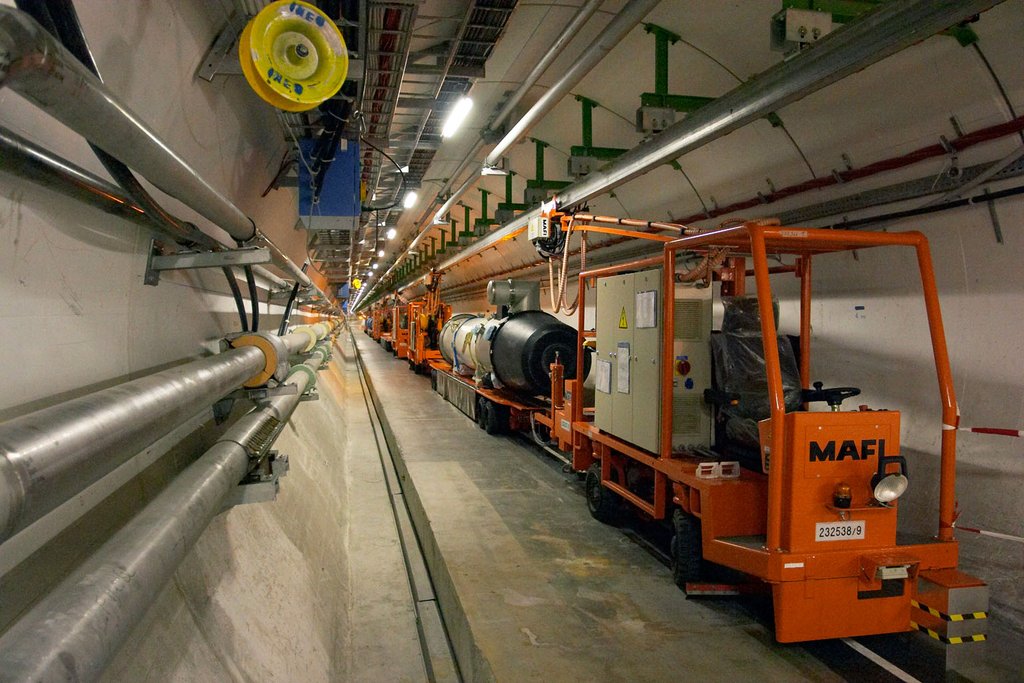
None of this is entanglement for its own sake. Almost everything known about the effect comes from low-energy systems, photons and atoms. The LHC offers the opposite: the heaviest particles the machine can make, gone almost as soon as they exist. CERN's announcement argues that entanglement at those energies gives physicists an extra probe of the Higgs boson and how it interacts with other particles. The CMS analysis does that in passing, measuring eight of the Higgs boson's couplings to the force-carrying particles at once.
"The Higgs boson is our microscope into the unknown: tiny deviations in its behavior could reveal whole new layers of physics," said Jeffrey Davis, a postdoctoral fellow at Johns Hopkins. Turning that evidence into an observation is mostly a question of how many Higgs bosons anyone has to look at, and the High-Luminosity LHC, the upgrade now being built into the machine, is designed to deliver far more of them.