Physicists Watch Electrons Cross a Superconducting Junction Without Bouncing Back
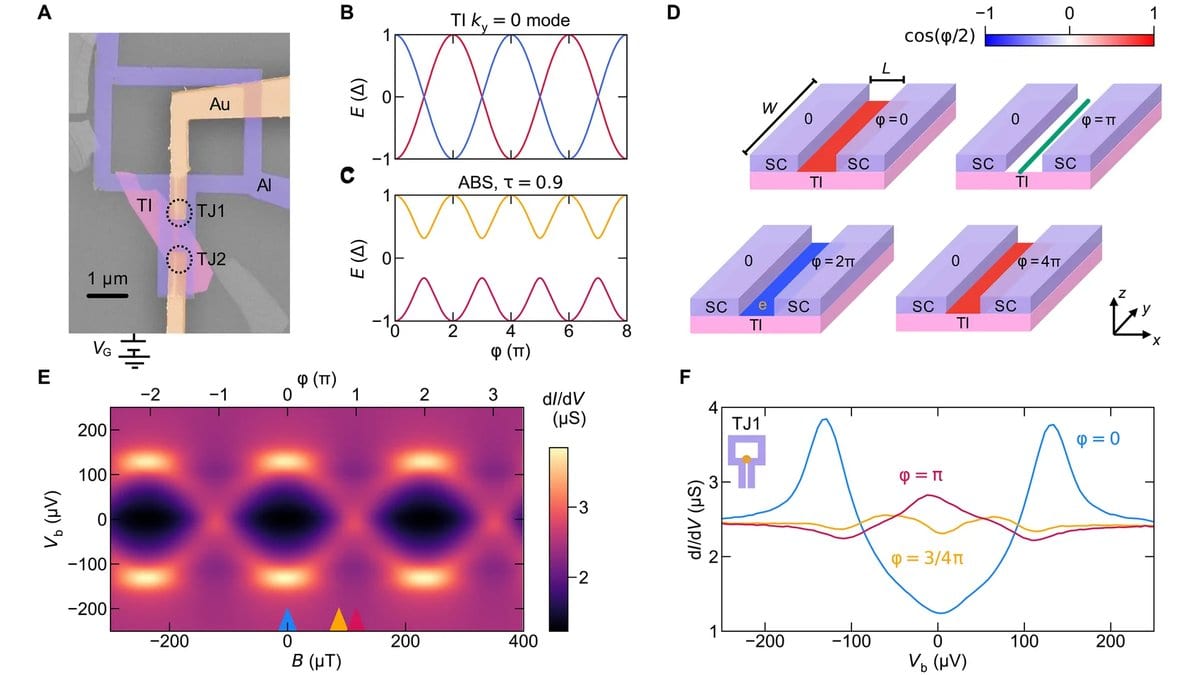
Physicists at the University of Cologne report they have measured electron states that cross a junction between two superconductors with almost no reflection, in a device built on a topological insulator, a crystal that carries current only along its outer surface. Such states, called Andreev modes, were predicted for this kind of junction in 2008. The paper says they had not been confirmed in a topological insulator before.
The measurement appears in a paper published Oct. 30, 2026, in Science Advances. Their interest is in what the proposal by Fu and Kane says should follow from such states: a route to Majorana zero modes, which the paper calls a promising candidate for topological quantum computing. The experiment is a transport measurement, not a qubit.
Jakob Schluck, Ella Nikodem and colleagues, with senior author Yoichi Ando at Cologne and theory from RWTH Aachen University, built the device from a thin aluminum film laid across an exfoliated flake of the insulating crystal BiSbTeSe2, leaving a junction about 50 nm long. An aluminum loop lets a magnetic field set the phase difference across that junction, and two gold contacts read the states underneath at about 50 mK. The energy gap they measure closes into a single broad peak at the phase difference the theory points to. The pattern repeats as the field is raised, and it held across the full range of back-gate voltages. The authors read that stability as support for a surface origin.
What the measurement cannot do is tell a perfect channel from a very good one. They put their energy resolution at about 30 μeV, enough to make any channel transmitting 95% or more of what hits it look gapless, and they call the topological reading "plausible but not inevitable," setting out ordinary explanations that would produce similar spectra. The paper states that the spin arrangement of that surface state "would make this a topological phase transition accompanied by a parity change, which remains to be confirmed by future experiments."
The authors also estimate what a device would need to hold a protected Majorana mode: niobium electrodes, which tolerate higher magnetic fields than aluminum, a field near 100 mT, and the surface electrons held at a moderate energy, which they say keeps the mode from spreading out. Their data and code are posted on Zenodo.
Sources
- Science AdvancesPeer-reviewed