Scientists Find a Way to See Where Hydrogen Hides Inside Metal
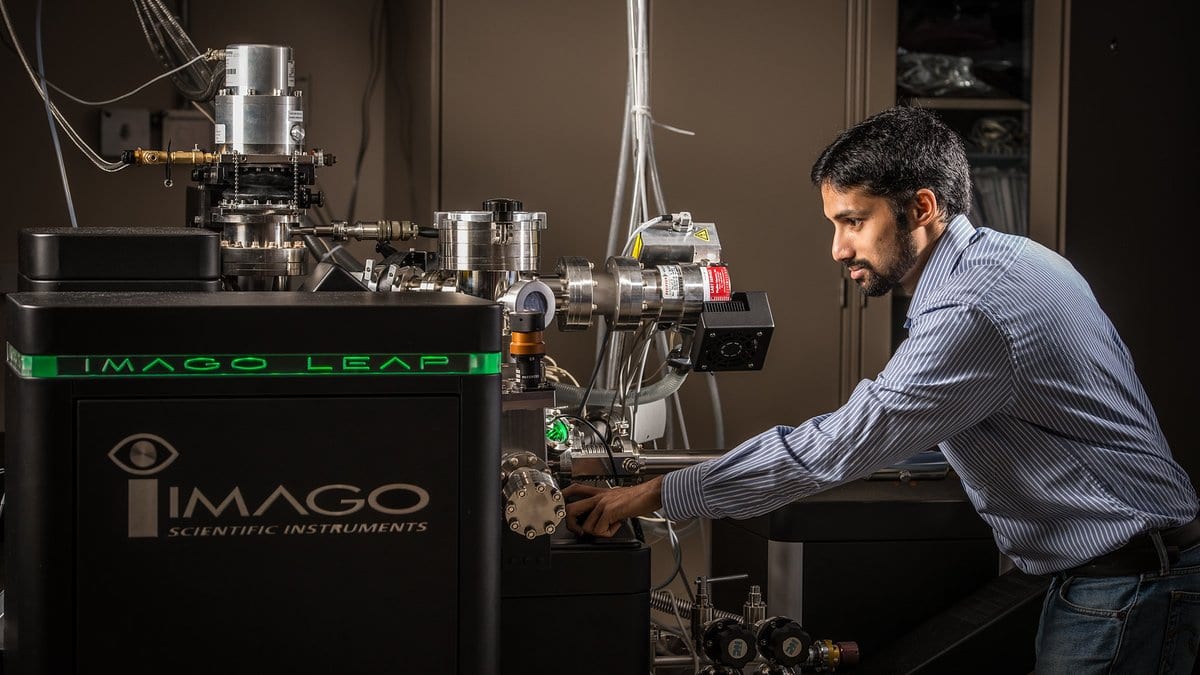
Atom probe tomography, a technique that maps a sample one atom at a time, can tell hydrogen dissolved in the gaps of a metal's crystal apart from hydrogen trapped at the metal's defects, according to a collaboration led from the University of Science and Technology Beijing and the University of Sydney. The work was published Nov. 4, 2026, in Nature. It measures deuterium, a heavier form of hydrogen, as a stand-in because an atom probe cannot separate ordinary hydrogen in a sample from the hydrogen already sitting in its own vacuum chamber.
Hydrogen makes high-strength alloys brittle, which is the authors' stated reason for the work. They write in the paper that the tanks and pipes a hydrogen fuel industry would need cannot be designed well without knowing where in a metal the hydrogen sits, and that hydrogen bound into hydrides or caught at defects was already visible to the technique while dissolved hydrogen, dilute and quick to escape, was not.
In an equal mix of cobalt, chromium, nickel, iron and manganese, the team measured deuterium at 1.3% of all atoms, scattered at random through the crystal, which is the pattern dissolved atoms should give. In a cobalt-chromium-nickel alloy aged to grow nickel-aluminum-titanium particles inside it, the deuterium gathered in the particles instead. In a 3D-printed Inconel 718 nickel superalloy carrying two kinds of particle, it gathered in one kind and barely registered in the other.
The authors report that each pattern follows their own calculations of which phase should hold hydrogen most tightly, and that a small contribution from vacancies and similar traps cannot be fully excluded. All three materials are laboratory alloys rather than the steels now used in hydrogen pipelines.
The paper is titled "Towards observing interstitial hydrogen in solution in metal lattices," and its own framing is whether the two populations can be told apart rather than a finished method. Its Methods section records eight usable frozen datasets out of 68 attempts. The paper is open access and its source data is posted on GitHub.
Sources
- NaturePeer-reviewed