Particles From Higgs Decays Show Signs of Quantum Entanglement
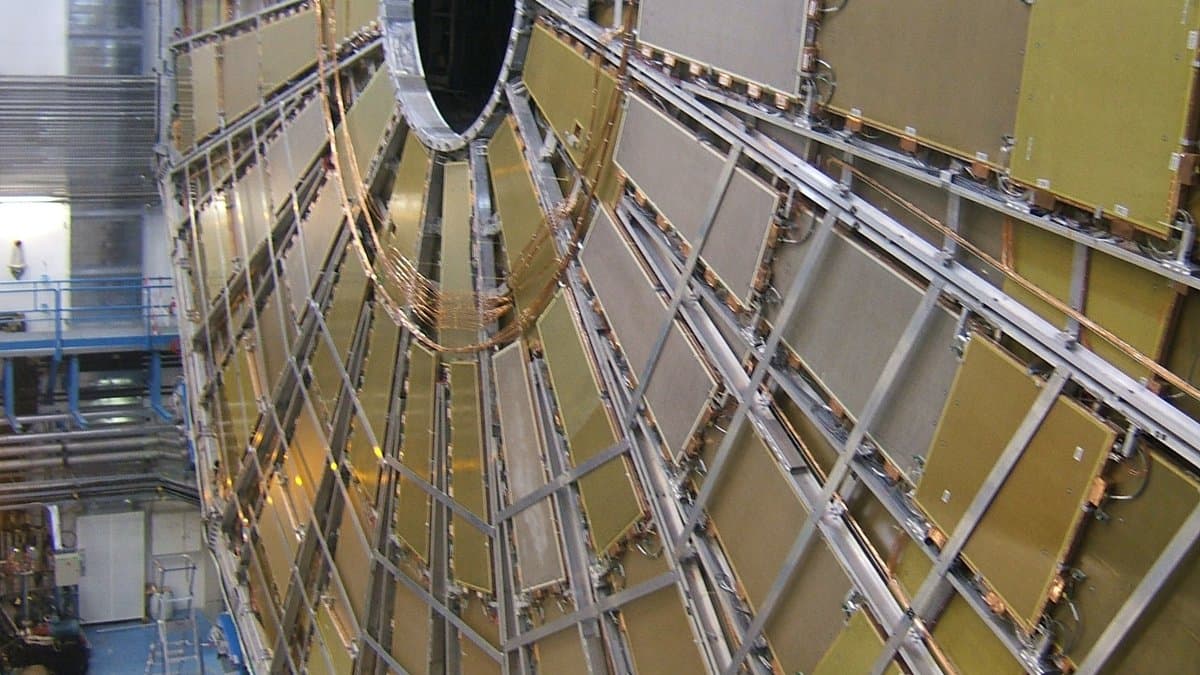
The ATLAS collaboration at CERN's Large Hadron Collider has tested whether pairs of Z bosons produced when a Higgs boson decays are quantum-mechanically linked, and reports that the data fit poorly if the two particles are treated as independent. Physical Review Letters published the measurement on September 11, 2026.
Entanglement, in which two particles can only be described together and never one at a time, is usually demonstrated with light or with atoms at low energies. The collaboration says these are the first measurements of entanglement between the spins of Z boson pairs, and calls the result strong evidence of entanglement between massive particles at the electroweak scale, the energy range where the Higgs and Z bosons exist.
The measurement uses proton-proton collisions recorded by the ATLAS detector at collision energies of 13 and 13.6 TeV. It follows Higgs bosons that decay into two Z bosons, which in turn decay into four electrons or muons, a heavier relative of the electron. The angles at which those four particles emerge carry information about the bosons' spins.
A test using the full angular distribution of those four tracks disfavored the separable-state description, in which each boson's spin stands on its own, at 4.7 standard deviations, against 4.9 expected if the Standard Model is right. The collaboration says the test relies on several Standard Model assumptions about how the bosons decay. That number compares two accounts of the same data: it says how poorly the unentangled account fits, not how likely entanglement is.
The collaboration also measured two angular quantities directly, both consistent with Standard Model predictions, and describes the full-distribution test as substantially more sensitive to quantum correlations.
Sources
- Peer-reviewedPhysical Review Letters