Hubble Caught the Wind From a Shredded Star Before the Flare Peaked

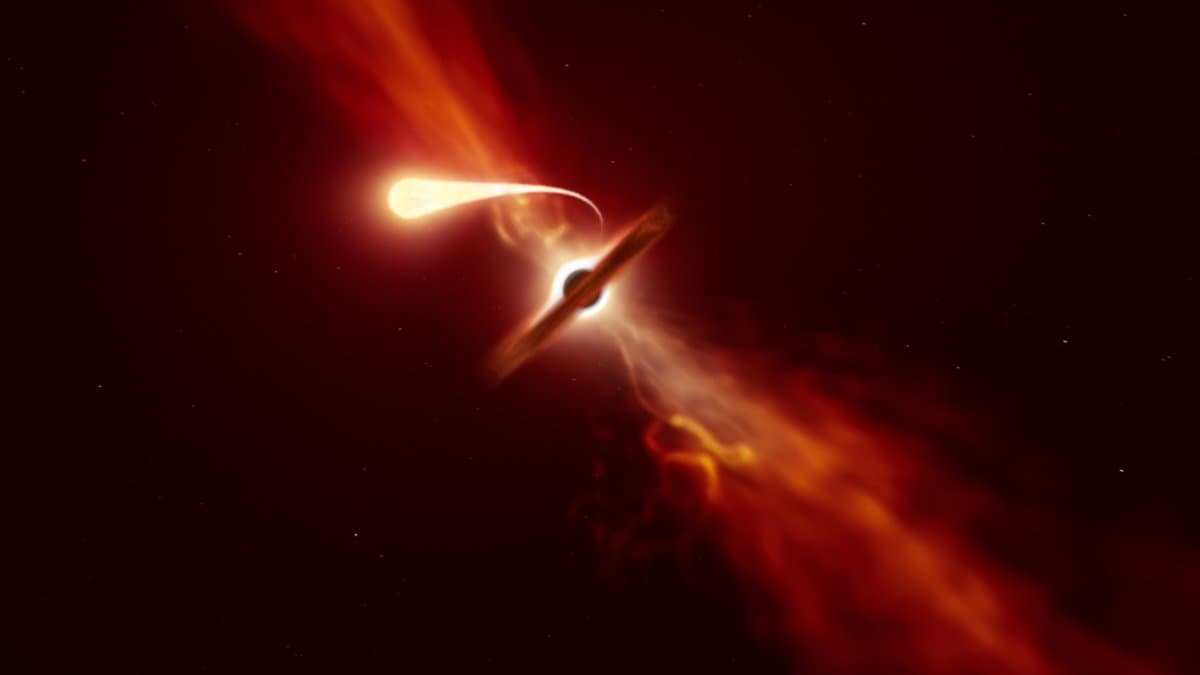
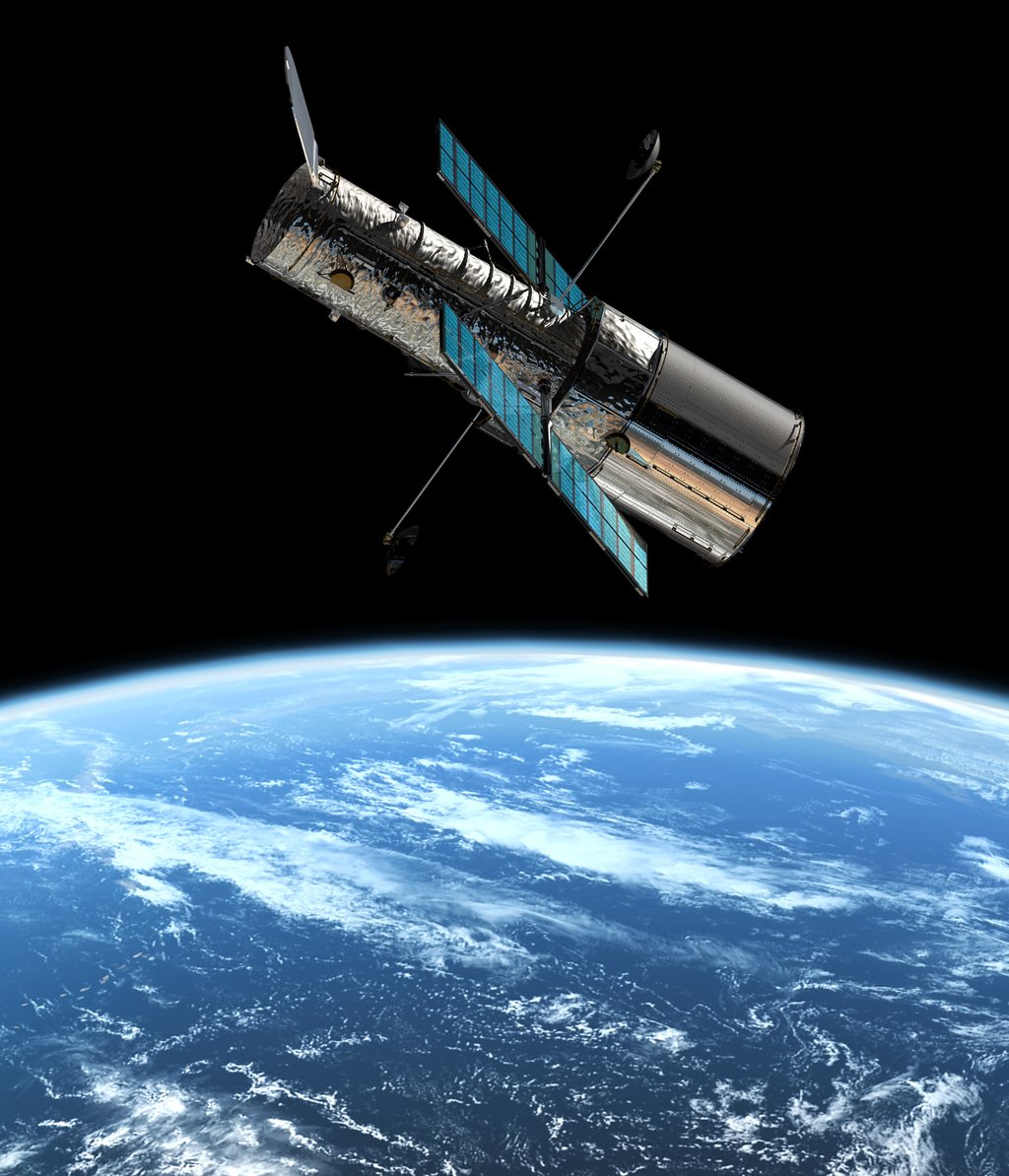
On Nov. 7, 2025, the Hubble Space Telescope spent two orbits pointed at a galaxy about 190 million light-years away. A star there had drifted too close to the black hole at the galaxy's center and was coming apart. The flare it made was still brightening and would not peak for another 20 days. That gap is the point of a paper posted on Sept. 23 by Erica Hammerstein of the University of California, Berkeley, and her colleagues: the ultraviolet spectrum Hubble took that night shows the black hole was already driving gas outward at roughly 10,000 kilometers per second.
When a star passes close enough to a massive black hole, the difference in pull across its body tears it apart. Astronomers call this a tidal disruption event, and they have found a few dozen, mostly as blue flares in survey images. What is still argued over is where the flare's light comes from. One picture has the shredded star's own streams of debris crashing into each other. Another has gas settling onto a newly formed disk, whose harsh radiation is absorbed and re-emitted by a thick wind blowing off it. The two disagree about when a wind should appear, and the second mostly expects it after the flare peaks, once material has begun falling in.
So the value of getting Hubble on target early was the timing, not the speed. Fast winds are old news here. Ultraviolet spectra taken after peak have shown gas leaving other disrupted stars at roughly 5,000 to 15,000 kilometers per second, and in one event the measured range ran from a few hundred kilometers per second up to a fifth of the speed of light. What nobody had was a look before maximum light. The spectrum Hubble delivered is that look, and it is full of broad troughs where outflowing gas has swallowed light at particular wavelengths. The data are public in the Hubble archive. Every trough sits at a shorter wavelength than it should, by about the same amount, which is what a shell of material moving toward the observer does.
The team reports this as the earliest ultraviolet spectrum yet obtained for a newly discovered tidal disruption event. Hubble has caught the rise of such a flare before. It did so twice at a galaxy nucleus called ASASSN-14ko, which brightens over and over on a schedule and is read as a star being partly stripped on each close pass rather than destroyed outright. The paper names that exception in a footnote of its own.
Two of the absorption troughs have no accepted identity. The authors write that neither has been noted before in a disrupted star, which is a claim about a short list of such spectra rather than about ultraviolet astronomy in general; new species do keep appearing on that list. Neither is pinned down here. On velocity grounds alone the bluer trough would fit ionized helium, an identification that puts it at the same speed as everything else in the spectrum. Models of light passing through stellar debris point instead to iron for the bluer one and nitrogen for the redder. The paper sets out both readings and chooses neither.
The result with the longest reach is about arithmetic. Because most of these flares are studied through brightness measurements in the near ultraviolet and in visible light, their total energy output is usually worked out by fitting a single-temperature glow to those points. Hammerstein and colleagues fitted the same object several ways and found that the curve does not have that shape: from the far ultraviolet out to the infrared it falls away more gently than any single temperature allows. They interpret the mismatch as light from close in being absorbed and re-radiated by the outflow. The consequence they draw is blunt. Fitting a single-temperature glow to near-ultraviolet and visible brightness alone may underestimate the true energy output by a significant factor, about nine in this case.
Nine is a large factor for a quantity that feeds into estimates of how much of the star was actually consumed, and it comes from one event and one spectrum. A separate group led by Aysha Aamer, sharing no authors and no telescopes with this one, published an optical study of the same object and found a steady absorption component at about 3,900 kilometers per second in several hydrogen lines. That is independent evidence that this black hole is blowing a wind. It is not independent evidence for the pre-peak first, for the wind speed measured in the ultraviolet, or for the factor of nine, which rest on this single spectrum. The work is a preprint, submitted to The Astrophysical Journal Letters and not yet peer reviewed.
What made the observation possible was luck of a specific kind. The flare took about 60 days to rise, slow for its class, and its galaxy is among the nearest in which a star has been seen torn apart this way, close enough for Hubble to record a usable ultraviolet spectrum in two orbits. Neither condition is common, and ultraviolet spectroscopy is not something a survey telescope can do for itself. Two things would loosen that constraint: the Vera C. Rubin Observatory, which will catch nearby flares earlier in their rise, and an ultraviolet mission called UVEX, designed for exactly this sort of quick follow-up.