A Neutron Star's Size Held Still While the Uncertainty Halved

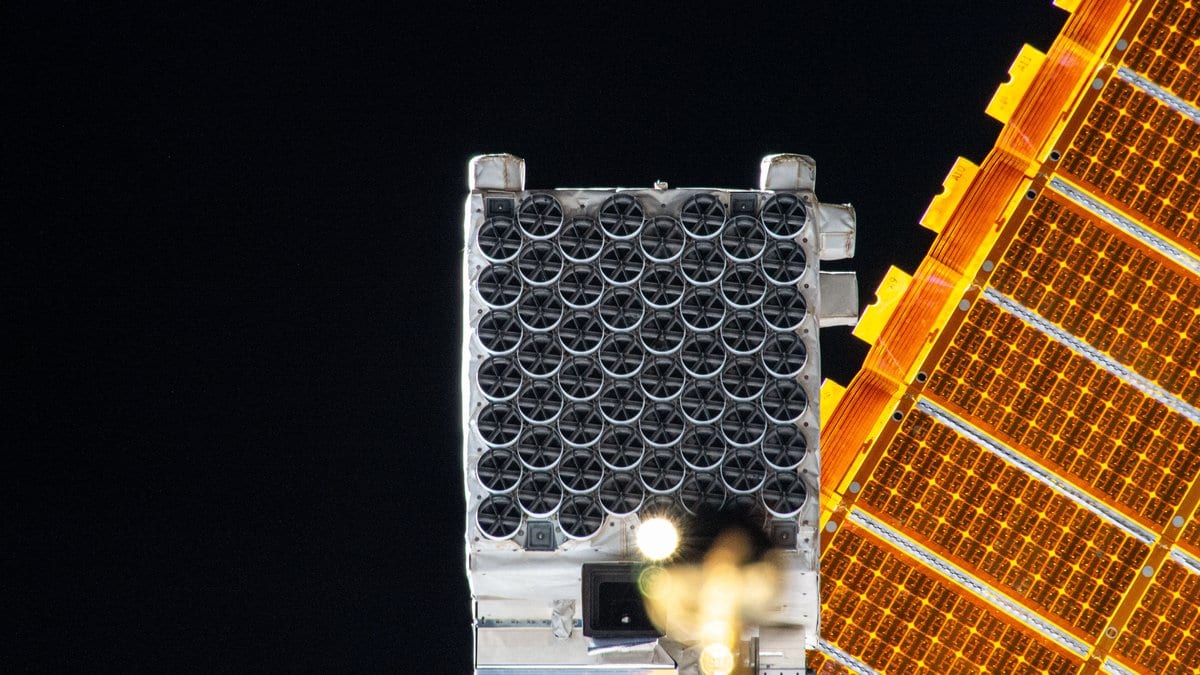
The nearest and brightest millisecond pulsar already had a measured size. In 2024, Devarshi Choudhury and colleagues modeled the X-ray pulses of PSR J0437-4715 using NICER, NASA's neutron-star telescope on the International Space Station, and put its equatorial radius at 11.36 kilometers. The result made the news in July 2024.
On Oct. 30, Pierre Stammler and his colleagues posted a preprint reporting new measurements of the same star: an equatorial radius of 11.35 kilometers and a mass of 1.377 solar masses. The radius is unchanged. What moved is the uncertainty: the new 68% interval is roughly half as wide as the earlier one. The paper has been submitted to The Astrophysical Journal Letters and has not been through peer review.
A tighter number is worth having because nobody can make this material in a laboratory. A neutron star compresses more than a Sun's worth of matter into something the size of a city, and the only way to learn how that matter resists being squeezed is to measure real stars and see which theories survive. Radius is the sensitive quantity: two stars of the same mass can differ by kilometers depending on how stiff their interiors are. Halving the uncertainty on one well-behaved star therefore does real work.
Each telescope was given a different job.
The sharpening was bought with broader wavelength coverage. Where the 2024 analysis used NICER's soft X-rays, the new work fits the pulsar's emission from the far ultraviolet to hard X-rays, giving each observatory a different job. Hubble's spectrograph measures the glow of the whole warm surface. NICER records the pulses from the hot spots.
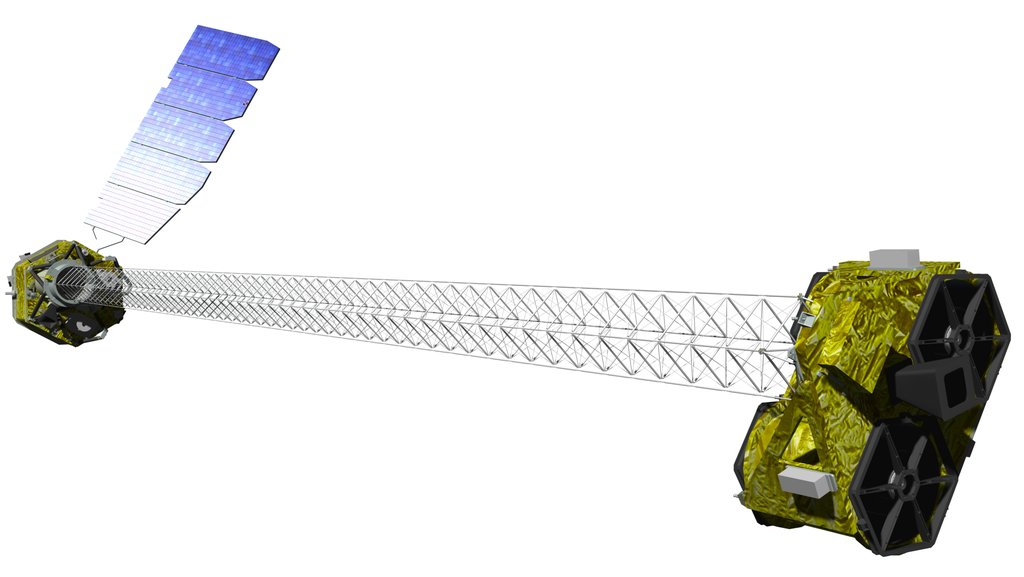
XMM-Newton provides X-ray spectra that help constrain the emission components and the NICER background. NuSTAR measures the harder, nonthermal X-ray tail.
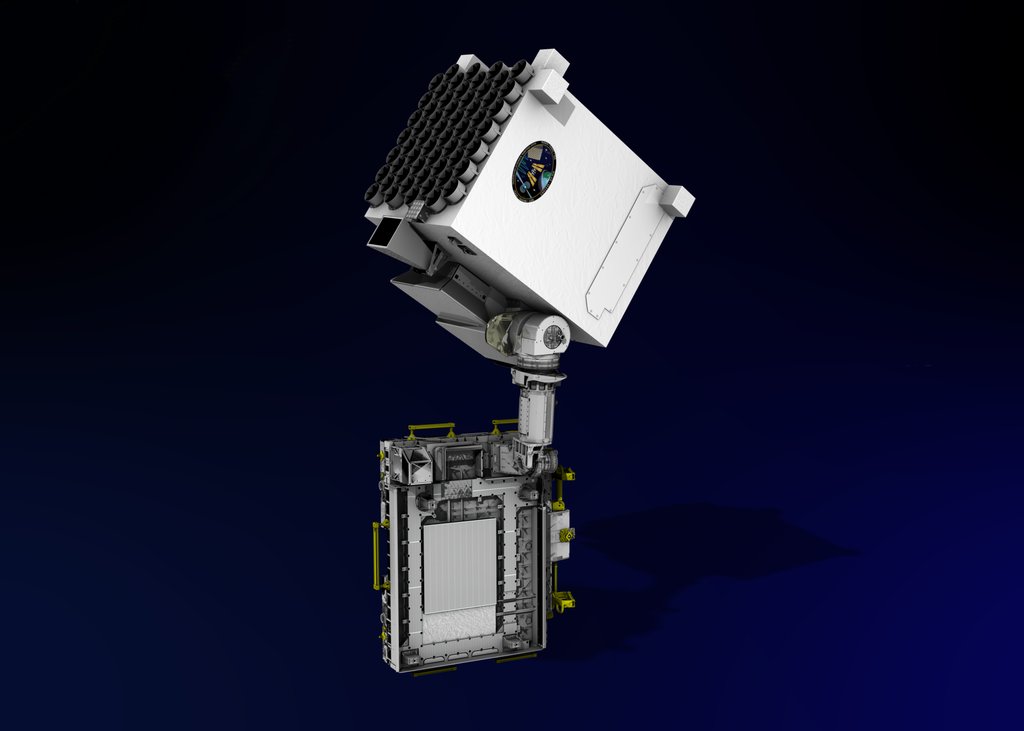
The NICER record itself grew by almost two years of observations, totaling 2.56 million seconds and ending in May 2023, the day before an optical light leak began to affect the instrument's soft X-ray band.
The model grew too. Adding a second hot spot with two temperatures, the star's warm surface and the harder nonthermal tail to the simplest version improved the statistical evidence by 164.6 in natural-log units, a decisive change by the usual Bayesian criteria. The final run cost 674,000 CPU hours.
The mass is not a free-standing X-ray result. It relies on radio timing measurements from the Parkes Pulsar Timing Array, which Daniel J. Reardon and colleagues used to constrain the pulsar's mass to 1.418 ± 0.044 solar masses. The new analysis uses that result as a prior, along with radio-derived constraints on the pulsar's distance and orbital inclination. Its best-fit mass is lower, at 1.377 solar masses. Those radio measurements, the authors write, "remain essential for providing constraints which make the model physically valid."
A faint tail of hard X-rays decides how big the star looks.
This is where it stops being tidy. Several analyses have now tried to infer this pulsar's size from its emission, and their answers spread over more than three kilometers. Liqiang Qi and colleagues, in a peer-reviewed paper published May 10, reported an equatorial radius of 13.25 kilometers, with an uncertainty interval narrower than the new one. Their analysis used XMM-Newton timing data to model the pulses, supplemented by Hubble ultraviolet and ROSAT observations, but no NICER data. Miller and colleagues, using the same NICER pulse data as the 2024 study, reported 14.12 kilometers. Their model included three hot spots and a nonthermal component whose brightness was not tightly constrained by the data. The new result is close to the 2024 measurement, but neither of the two other recent analyses reached a similar radius.
The preprint's explanation for the larger estimates centers on the faint nonthermal tail rather than the star itself. If a model allows that component to become too bright, or lacks hard X-ray data to constrain it, the tail can claim photons that would otherwise be attributed to the thermal emission from the surface. That reduces the inferred surface temperature and can push the radius upward. NuSTAR observes the pulsar from 3 to 16 keV, where the nonthermal component dominates, giving the team a way to constrain its brightness where it is strongest.
That argument is the new paper's own, and it has not yet been through peer review. The agreement with the 2024 result is not independent corroboration either: Devarshi Choudhury, Tuomo Salmi and Anna L. Watts are authors of both papers, and both analyses use the same inference framework on overlapping NICER data.
A sharper radius squeezes the theory, and only so far.
The reason to care about a few hundred meters is what happens when the measurement is folded into a model of how matter behaves at these densities, what physicists call the equation of state. The authors repeated an earlier inference of that kind, replacing the 2024 measurement with their own and changing nothing else. The analysis does not rely on this pulsar alone: it also incorporates other millisecond pulsars measured with NICER, the neutron star 47 Tuc X7 in a globular cluster, the merger events GW170817 and GW190425, and nuclear-theory calculations that constrain both the low-density and extreme-density regimes. With the tighter measurement in place, it predicts a radius below 12.0 kilometers for every neutron star above one solar mass, at the 68% credible level.
At the stricter 95% credible level, the exclusion does not hold, although the upper limit on the radius comes down by about 0.4 to 0.6 kilometers. The central values barely move. "The updated J0437 result therefore primarily tightens existing constraints rather than shifting them," the authors write. One thing did change shape: earlier versions of this inference left a stubborn second peak in probability near 12 kilometers, but with the tighter measurement, it disappears.
Whether the new number survives peer review and the next independent attempt to model the same star remains an open question. More hard X-ray observations are part of the answer the paper offers. Two future missions with higher sensitivity and lower background than NICER, the enhanced X-ray Timing and Polarimetry mission (eXTP) and NewAthena, could reduce mass-radius uncertainties for millisecond pulsars by a factor of two or more, depending on the source and observing time.