A Black Hole of a Few Thousand Suns Is Feeding in a Galaxy Being Swallowed

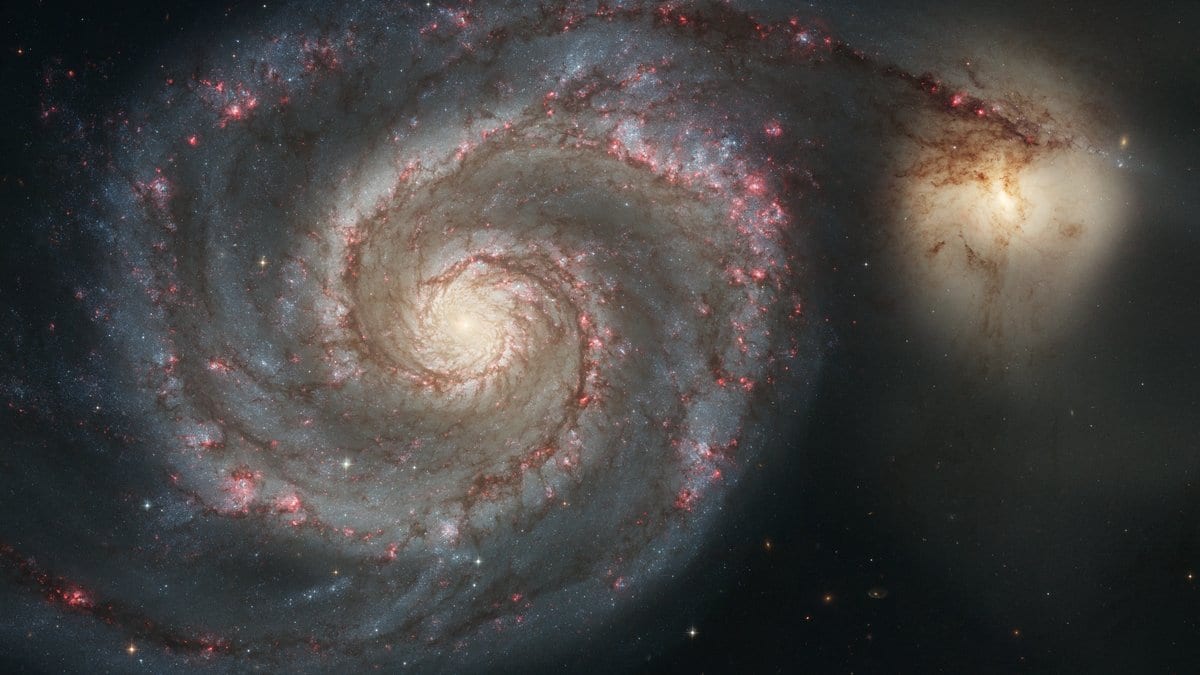
The Chandra X-ray Observatory pointed at one patch of sky more than a hundred separate times, chasing other targets entirely. Stacked together, they come to 6.6 million seconds of observing, a total measured in months rather than hours. Out of all of it, from one small smudge of a galaxy, the telescope collected thirty-one photons.
Those 31 photons are the whole case for what Marko Mićić of the University of Oklahoma and Julia St. Pierre of Central Connecticut State University report in a paper they titled "Feeding the Little Monster", accepted by The Astrophysical Journal: a black hole far too small for a galaxy's center and far too big to be a dead star, apparently feeding inside the smaller of two galaxies in the middle of a merger.
Black holes come in two well-populated sizes. The small ones are the corpses of massive stars, and astronomers find them routinely in X-ray binaries and in gravitational-wave signals. The giants are at the centers of large galaxies. Between about a hundred and a hundred thousand solar masses lies the intermediate range, and it is close to a blank. That blank is awkward, because the giants had to start somewhere, and whatever seeds they grew from should have passed through it.
The emptiness may be less about scarcity than about silence. Black holes this size are expected to exist in dwarf galaxies, where gas is thin and patchy, or in globular clusters, which hold essentially no gas at all. One with nothing to eat gives off nothing and stays invisible. Mergers change that. When a small galaxy falls toward a larger one, tides push gas inward. Simulations predict that the black hole in the smaller galaxy gets short bursts of heavy feeding at each close pass, enough to multiply its mass tenfold. The larger galaxy's own black hole barely notices.
The pair here was picked out of 3D-HST, a Hubble Space Telescope survey that measured redshifts across several deep fields. Both galaxies are at the same distance and are close enough together to be pulling on each other, and the light now arriving from them set out roughly two and a half billion years ago. One holds about ten times the stellar mass of the other, which is what makes this a minor merger rather than a collision of equals. The X-ray source is in the smaller one.
That is far too few for ordinary spectral fitting, so Mićić and St. Pierre worked backward. They measured how those counts were distributed across energy bands, simulated candidate spectra through Chandra's own instrument response, and kept only the models that reproduced both the distribution and the total brightness. Every photon arrived at the low-energy end. Nothing came in hard, and that absence is informative. In an ordinary feeding black hole, a hot cloud of electrons scatters disk light up into hard X-rays. Only when the disk is bright enough to cool that cloud away does the soft thermal glow become the whole spectrum.
For a disk like that, temperature and mass are tied together: at a given feeding rate, a heavier black hole makes a cooler disk. Putting the measured temperature and brightness through that standard relation gives 800 to 5,000 solar masses, taking in gas at a fifth to a half of the maximum rate its own radiation pressure allows. The mass comes from a model of the disk, not from watching anything orbit, which is what would settle it.
The obvious alternative is that this is not a middleweight black hole at all but an ordinary stellar-mass one shining unusually brightly, a class known as ultraluminous supersoft sources. The authors argue against that. This source is more luminous than such objects normally get, and its disk is warmer than any known example. It has also held a steady brightness across nearly two decades, where stellar-mass accretors typically swing by orders of magnitude over days to years. The small galaxy is also barely forming stars, which is where such objects come from, and the authors put the odds of finding one there by chance at about one in a hundred thousand. In their own summary, those alternatives are disfavored rather than excluded, which is why the object stands as a candidate.
That steadiness is doing double duty. Most soft X-ray candidates in this mass range have turned out to be flares, a star torn apart and then nothing, because globular clusters hold no gas to keep a black hole fed between meals. A source that has simply sat there through every observation looks more like continuous feeding, which is exactly what the merger picture predicts.
This is not the first candidate of its kind, and the nearest precedent belongs to the same lead author. In 2022, Mićić and colleagues reported an intermediate-mass black hole candidate in a dwarf galaxy of the Abell 85 cluster, found the same way: soft X-rays, no hard band, a host of similar size. What is new is the setting. A black hole putting on weight inside the galaxy that is being consumed is precisely where theory says the seeds of the giants should be growing. It also tells observers where to point next: at small galaxies caught in close interaction with a big one.
The paper has been accepted by The Astrophysical Journal after peer review and is not yet published.
Sources
- arXivPreprint