A Dwarf Planet Candidate Beyond Pluto, and What Would Confirm It


A point of light arrives with no size attached. What a telescope records is brightness, and brightness depends on two unknowns: how big the thing is and how much of the sunlight landing on it gets sent back.
On the evening of Oct. 13, Matthew Holman pushed a batch of survey data through a search code he had written with his colleague Kevin Napier. Holman, a senior astrophysicist at the Harvard & Smithsonian Center for Astrophysics, works on the software the NSF-DOE Vera C. Rubin Observatory uses to pick distant moving objects out of billions of separate detections. One of those points turned out to be moving, out beyond Pluto, and to be far brighter than its distance would suggest. "My first reaction was one of excited disbelief," Holman says.
The announcement came on Oct. 27 in three places at once. The International Astronomical Union's Minor Planet Center issued a Minor Planet Electronic Circular; Holman and Mario Jurić presented the results at a press conference at the Division for Planetary Sciences meeting in Spokane, Washington; and NSF NOIRLab put out a science release. The object has the provisional designation 2026 ED138, and it is a trans-Neptunian object: it orbits beyond Neptune. It is currently about 46 astronomical units from the Sun, or 46 times Earth's distance from the Sun. Its size is estimated to be between 600 and 1,500 kilometers, according to the release. The team estimated its size from its distance, brightness and surface reflectivity. No paper has been published yet, so the findings have not been peer reviewed.
The size is a range because the surface is unknown
That last ingredient is carrying more weight than it looks. Reflectivity, or albedo, cannot be read off a single moving dot; it has to be assumed, and the assumption sets the size. Brightness depends on reflectivity multiplied by the object's projected area, so an object assumed to be half as reflective has to be about 40% wider to send back the same light. That span is therefore not measurement scatter. It is the uncertainty left by not knowing what ED138's surface is made of. Out past Neptune, that is a wide question: some of these bodies are dark and carbon-rich; others are coated in ice that reflects most of the sunlight that reaches them.
Jurić, the University of Washington astronomer who leads Rubin's solar system team, took the middle of that range when he described the find to reporters. "Finding an object this big, roughly 1,000 kilometers across, is something that happens maybe once in a generation," he said in the university's account of the briefing. "It's the largest trans-Neptunian object found in about 20 years," he added. That figure is the midpoint of the range rather than a measured diameter, and the ranking is the discovery team's own.
The measurement that would settle it is not a matter of looking harder. Reflected sunlight and emitted heat respond to a dark surface in different ways. A dark body reflects little visible light, absorbs more sunlight and emits thermal radiation; a bright one generally reflects more sunlight and absorbs less. Measure both and the two unknowns can be separated, because reflectivity and size are no longer locked inside a single number. The release says as much: the analysis is preliminary, and "observations in the infrared are needed to constrain its exact size and confirm its nature as a dwarf planet."
Roundness is the key physical test here. To count as a dwarf planet, a body has to be massive enough for its own gravity to pull it into a nearly round shape, and nobody has measured ED138's shape. The expectation that it is round rests on the size estimate, because icy bodies that large are expected to be round. The shape test, in other words, sits downstream of the albedo assumption.
A tilt that had to be put there
The other number in the record says little about how big ED138 is and a good deal about where it has been. Its orbit is tilted almost 25 degrees out of the plane in which the planets orbit. Material that condenses out of a flat disc should begin on an orbit close to that plane, so an inclination that large points to some subsequent disturbance. The release reads it two ways at once. It classifies ED138 as a hot-classical trans-Neptunian object, where hot refers to orbital inclination and not temperature, and suggests that the body "was disturbed from its original orbit through gravitational interactions with Neptune."
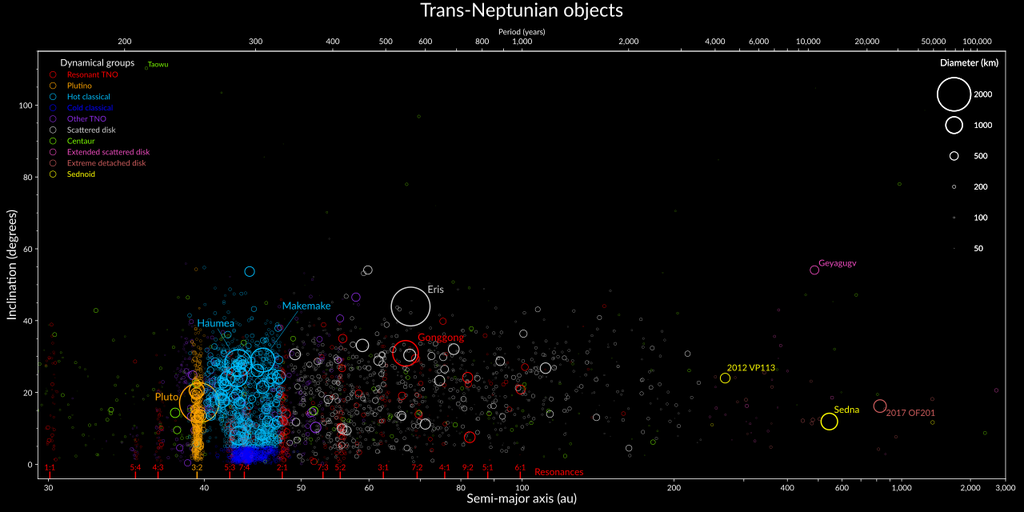
That is why these orbits get measured at all. The observatory's account says scientists study these bodies' sizes, compositions and orbits to work out how the solar system formed and how the giant planets migrated. ED138's tilt is one line in that record. It is a sentence about Neptune's past as much as about this body.
Finding it twice, a decade apart
Everything after Holman's detection was recovery work. Jurić went back through Rubin's catalogs and images and found more observations reaching back to March 2026. Archival frames from the Dark Energy Camera in Chile, identified by the Asteroid Institute's ADAM Precovery service, extended the record back to 2016. That is what precovery means: not a decade of watching ED138, but a decade of old images searched for it once there was something to search for. Those old frames had captured it, unrecognized at the time, near the plane of the Milky Way, where earlier searches had missed it among the crowded field of stars.
The gain is precision rather than history. A few months of observations pins an orbit loosely; more than ten years of them pins one tightly enough to tell another telescope where to point, which is what has to happen before anyone can make the infrared measurement. Jurić describes the new ability as being able to "search back months, and sometimes even decades, finding it in images where nobody knew to look."
ED138 is not meant to be a one-off. In April, before the Legacy Survey of Space and Time formally began, the Rubin team submitted observations of more than 11,000 newly identified asteroids to the Minor Planet Center. Roughly 380 of them were trans-Neptunian, and the team called the batch "the tip of the iceberg." "Rubin will image the whole southern sky again and again for ten years, so any others hiding in the places earlier surveys skipped are now within reach," Holman says.
If confirmed, ED138 would join the five dwarf planets the International Astronomical Union recognizes: Pluto, Ceres, Eris, Haumea and Makemake. What stands between the candidate and that list is infrared observation to constrain its size, and somebody now has to go and make it.