Physicists Read a Signal From a Magnet That Has No Magnetism to Show

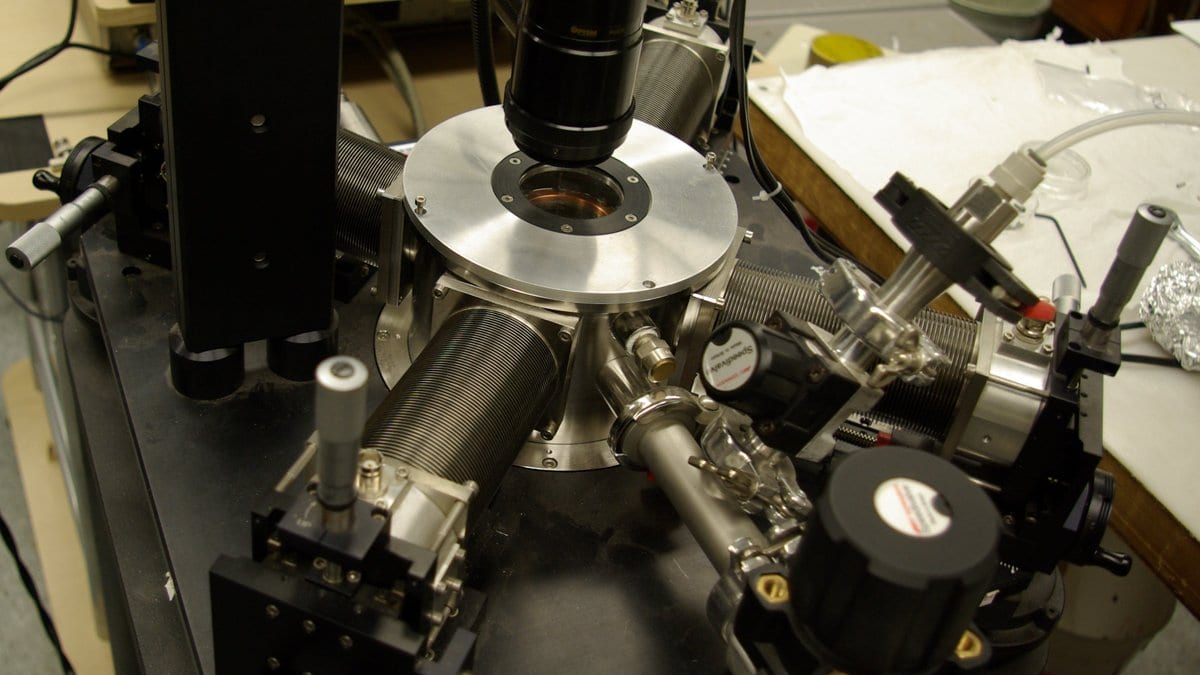
A hard drive works because a magnet cannot keep a secret. The atoms inside it line up, their magnetic moments add to a field that leans one way or the other, and a read head passing over the disk senses which way. Mn₅Si₃, a compound of manganese and silicon, keeps the secret: its moments cancel each other out, and from the outside there is nothing to see at all. On Oct. 28, 2026, a collaboration of two dozen physicists led from CIC nanoGUNE in San Sebastián, Spain, and the Institute of Physics of the Czech Academy of Sciences in Prague reported in Nature that they had gotten a signal out of it anyway.
Their device, described in the paper, is a lateral spin valve: a plain metal wire with a magnet at either end. One of those magnets is a thin film of Mn₅Si₃; the other, further along the wire, is an ordinary one and serves as the detector. Drive an electric current out of the film and into the wire, the authors report, and a spin current runs down it, a flow of aligned electron spins rather than of charge. The detector turns what arrives into a voltage.
What makes that more than a curiosity is what happened when the order inside the film was turned around. Mn₅Si₃ has two internal states, each with every magnetic moment flipped relative to the other, and the team moved the film between them using the strong magnetic fields available in its laboratory. The detected signal flipped too. In CIC nanoGUNE's announcement of the work, Jone Mencos, the paper's first author, said that correspondence is what rules out other effects in the device as the source of the voltage. The same behavior held with the current wired through the device in two different ways, which the paper calls a signature distinct from the two established routes to a spin current. One is an ordinary magnet, whose spins come out aligned because its magnetization is. The other is the spin Hall effect, which gets there through relativity in a heavy metal.
Why a magnet with nothing to show should produce a spin current at all is the part of this that is still being settled. The authors read it through altermagnetism, a third kind of magnetic order set out in 2022 by Libor Šmejkal, Jairo Sinova and Tomáš Jungwirth in Physical Review X. Like an antiferromagnet, in which neighboring moments point opposite ways, an altermagnet has no net magnetization. Unlike one, its moments sit in the crystal in a way that makes the two spin directions differ in energy, so a current through the material can come out with its spins aligned even though the material shows no field outside. "That magnetic order still has two possible states, but it is indistinguishable from outside because it generates no magnetic field at all: the information stays hidden inside the material," said Fèlix Casanova, who leads the nanodevices group at CIC nanoGUNE and is one of the paper's two corresponding authors.
Whether Mn₅Si₃ is one of those materials is a separate question, and the paper is careful with it. Its title calls Mn₅Si₃ a compensated magnet, not an altermagnet. The abstract says that symmetry analysis, first-principles calculations and modeling of the spin transport make the observations "consistent with the altermagnetic order of Mn₅Si₃," which is an argument from consistency rather than a direct look at how the moments sit. Two earlier studies, both with authors in common with this one, call the material an altermagnet candidate in their own titles: a spontaneous anomalous Hall response reported in Nature Communications in 2024, and an anomalous Nernst effect reported there in 2025. Šmejkal, Sinova and Jungwirth are co-authors here as well, so the identification and the theory it leans on come substantially from the same group of people.
"In the device we developed, the altermagnet and the detector are separated by barely 300 nanometers, about a hundredth of the thickness of a human hair," Mencos said in the same announcement, which CIC nanoGUNE issued in Spanish and the news agency SINC carried. That is the gap between the film and the thing reading it, not the size of anything. The quantitative claims in the paper are calculated rather than measured: the first-principles calculations give spin polarizations of 6.5–10% for Mn₅Si₃, which the authors call comparable to those of conventional ferromagnets, the everyday kind. Fitting a spin-transport model to the experiments puts the spin diffusion lengths, the distance over which the alignment survives, at 50–130 nm.
The conditions are laboratory conditions. The non-local measurements that carry the result were made at 100 K, far below room temperature, and the order was flipped with laboratory magnets rather than an electrical pulse. What the authors claim is correspondingly narrow: that their results are experimental evidence that a compensated magnet can generate spin currents controlled by its magnetic order, and that the altermagnetic properties of Mn₅Si₃ make spintronic behavior possible with no net magnetization. Nature published the reports of its two referees, Lingling Tao and Dahai Wei, alongside the paper, so the argument over that second half is on the record.
Casanova named what is missing. "The next challenge will be to reverse its magnetic order using low-power electrical pulses and to make these devices work at room temperature," he said.