A New Object Beyond Pluto May Be Big Enough to Be Round

The Vera C. Rubin Observatory in Chile has found a large object orbiting the Sun beyond Pluto, and the International Astronomical Union's Minor Planet Center announced it Oct. 27, 2026, as 2026 ED138, a dwarf planet candidate. The Rubin team's preliminary analysis, based on the object's distance, brightness and an assumed surface reflectivity, puts it between 600 and 1500 kilometers across.
NSF NOIRLab, which runs the observatory, says icy bodies this large are expected to be round, and roundness is the test for a dwarf planet. The release adds that ED138 had gone unnoticed because it sits close to the plane of the Milky Way, where most telescopes lose it among the background stars. Rubin's repeated scans of the whole southern sky, and algorithms that pick moving points of light out of millions, found it there.
Matthew Holman of the Center for Astrophysics, Harvard & Smithsonian found ED138 on Oct. 13, 2026, running Rubin data from earlier in the year through search code he wrote with CfA colleague Kevin Napier. "My first reaction was one of excited disbelief," Holman says in the release. Mario Jurić, Rubin's solar system lead scientist at the University of Washington, then turned up more detections in the observatory's catalogs and images. In all, Rubin's Simonyi Survey Telescope recorded ED138 30 times between March 4 and July 11, 2026. Archival Dark Energy Camera images, found through the Asteroid Institute's ADAM Precovery service, stretch the measured orbit back to 2016.
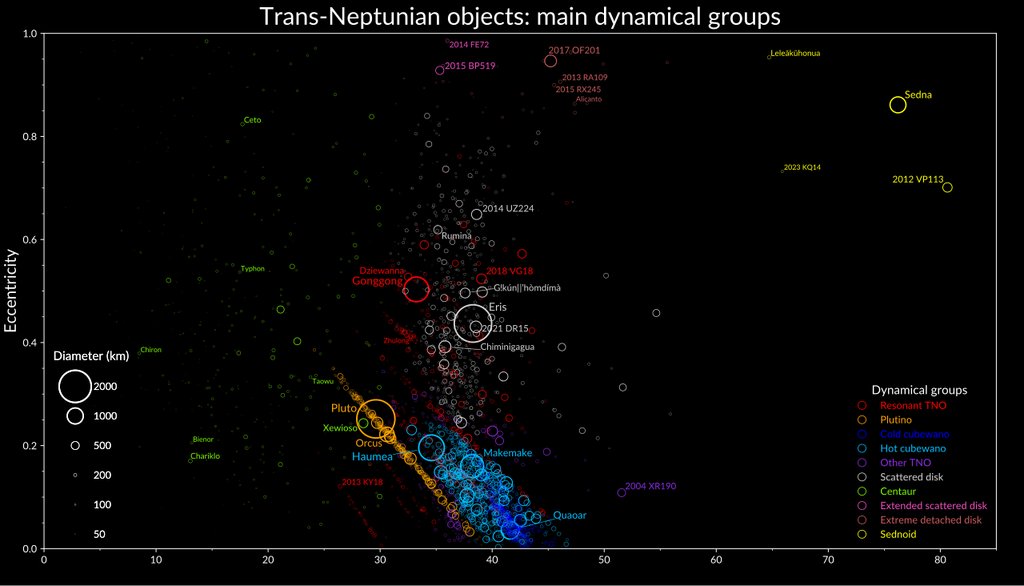
ED138 is currently about 46 times as far from the Sun as the Earth is, against about 40 for Pluto. It is cataloged as a trans-Neptunian object, a body orbiting beyond Neptune, and not as a dwarf planet. NOIRLab says infrared observations are needed to pin down the size and confirm what it is. The IAU recognizes five dwarf planets: Pluto, Ceres, Eris, Haumea and Makemake.
Rubin's images of ED138 are available to scientists with data rights to the survey, and anyone can follow the orbit on Orbitviewer, Rubin's public web app.