Farmed Oysters Scored Worse Than Wild Ones. Farmed Mussels Scored Better.

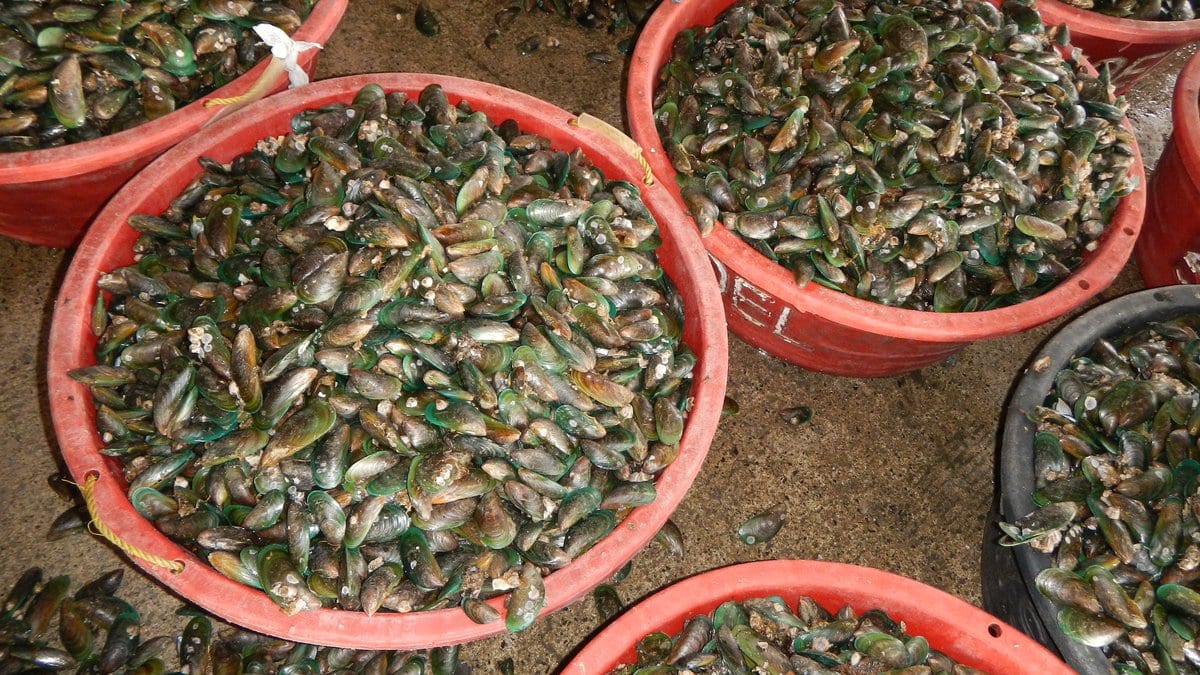
Rope, netting, floats: a shellfish farm is largely made of plastic, and the animals in it spend their whole lives touching the stuff. So the obvious guess is that a farmed oyster ends up with more plastic in its flesh than one pried off a wild shore. A team of eight put that guess to three mollusks on the Bay of Bengal coast. On the two species they compared farmed with wild, it held for one and reversed for the other.
The survey was led by Md Rakibul Hasan of the Institute for Marine and Antarctic Studies at the University of Tasmania, with M Belal Hossain of Noakhali Science and Technology University in Bangladesh and six colleagues. It was published online Oct. 28, 2026, in the peer-reviewed journal Marine Pollution Bulletin. They sampled three mollusks eaten along that coast: an oyster (Crassostrea madrasensis), the green mussel (Perna viridis) and the mangrove snail Telescopium telescopium, which is a snail and not one of the two-shelled bivalves. The oyster and the mussel feed by straining particles out of the water, which is also how they take plastic in. Plastic particles were in all three, at 0.68 to 1.12 of them per gram of soft tissue.
Hasan and colleagues score each group on an index of microplastic pollution, a number worked out from their own measurements rather than from anything seen happening to the animals; the higher the score, the worse the group did. The cultured oysters came out slightly above the wild ones, 18.6 against 16.1. The cultured green mussels came out at 7.1 against 17.7, less than half the wild figure. Farming, on this measure, did not decide the outcome.
The particles themselves looked much the same whichever animal they came out of. Between 77% and 94% were fibers, and most measured less than half a millimeter. Transparent and violet were the commonest colors, and the authors read the shapes and colors together as pointing to textiles, ropes and aquaculture materials. An infrared test identifies a plastic by the light it absorbs. It named six here, among them polyethylene, polyester, polystyrene and nylon.
Those polymers also feed a second index, a hazard ranking drawn from the chemistry of each plastic rather than from anything measured in these animals, and it put every group in the same band. A plastic's place in that ranking is a property of the material, settled before anyone goes near an oyster.
The figure most likely to travel is the one on human intake. The authors estimate intake as a daily rate scaled to body weight, which works out to roughly 6,200 to 10,000 particles per person per year. That range covers the different species and the farmed and wild groups rather than the uncertainty in any one of them. It describes a person who eats these mollusks regularly, not an average diet. The tissue itself held around a particle per gram, so a yearly total in the thousands follows mostly from the quantity of mollusk meat the estimate assumes. It counts what goes in, and says nothing about what the particles do afterward.
This stretch of coast has been measured for plastic before, by other people. In June 2026, in Environmental Monitoring and Assessment, Istiak Ahmed and colleagues reported microplastics in green mussels and three kinds of clam from the Bay of Bengal coast of Bangladesh, with more particles per animal in winter than in the monsoon. The new survey reports a single set of figures with no season attached to them.
The authors' own conclusion is careful. The dominance of fine fibers and the presence of the more hazardous polymers, they write, "indicate potential chronic ecological stress and food safety concerns," and the findings "emphasize the need for improved aquaculture practices and targeted monitoring in coastal Bangladesh." Detection, two indices and an estimate of intake is what a survey like this hands over. That is a request for more measurement, not a warning.
Sources
- Marine Pollution BulletinPeer-reviewed