A New Telescope Network Catches Meteoroids Hitting the Moon, Ahead of the Seismometers That Will Feel Them

Somewhere on the Moon, a rock the size of a fist arrives at tens of kilometers per second and stops. There is no atmosphere to slow it and nothing to burn it up on the way, so all of that energy has to go somewhere in a few thousandths of a second. Some goes into a small new crater. Some goes into vaporized rock, hot enough to glow, and that glow is bright enough to cross 384,000 kilometers and land in a backyard telescope in Europe, where it lasts a few hundredths of a second and is gone.
Catching one is a matter of pointing at the right part of the Moon and waiting. In a paper posted to arXiv on July 31, a team of 26 authors led by Daniel Sheward, with colleagues at the Observatoire de la Cote d'Azur and the Institut de Physique du Globe de Paris and a large contingent of amateur observers, reports what the first station of their Twin Impact Lunar Telescope network saw when it did exactly that during the Geminid shower of December 2025. Eleven flashes were confirmed, out of 53 candidates the campaign turned up.
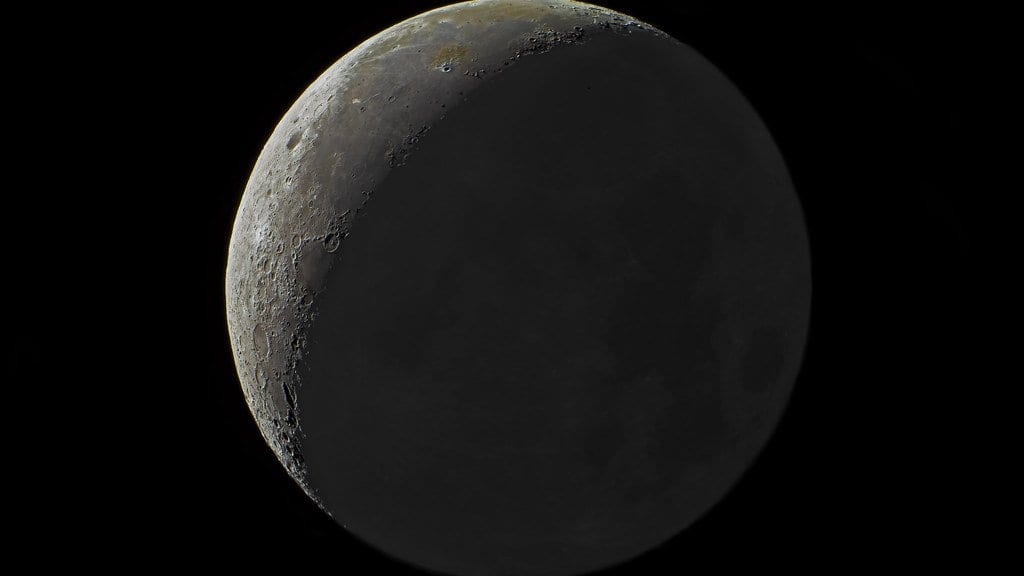
The right part of the Moon is the part the Sun is not lighting. A flash is faint, and it stands no chance against reflected sunlight, so the observing target is the unlit portion of the near side: the face that is turned toward Earth but currently in shadow, the dark crescent inside the bright one at a young or old Moon. That is not the far side. The far side never turns toward Earth, and cannot be watched for flashes from the ground at all.
Watching that shadowed sliver has been the standard method for three decades, and it exists because there is no other cheap way to count small rocks. Meteoroids in the centimeter-to-decimeter range are far too small to detect in space and mostly burn up before they reach the ground on Earth, which leaves the Moon as a detector: a rocky sphere with no air, exposed to the same population of debris the Earth-Moon system runs through. Every confirmed flash is one data point in the size and mass frequency distribution of that population, and the new paper puts its own 11 events into exactly that ledger.
The gap between 53 candidates and 11 confirmations is where the discipline of this work sits. A single frame showing a bright point can be a cosmic ray striking the camera sensor rather than a rock striking the Moon, so the convention is to demand a second look: either the flash appears across more than one frame, or another observer somewhere else caught the same event at the same moment. Eleven detections cleared that bar. They ran from magnitude +7.5 to +10.4, mostly in the visual and red bands, which puts the brightest of them roughly four times fainter than anything a person can see without help.
None of this is a first sighting. Lunar impact flashes have been monitored since the 1990s, and a dedicated survey has been running on a 1.2-meter telescope in Greece since 2017, deep enough to catch flashes several magnitudes fainter than earlier campaigns managed. What the authors claim, and what the abstract carefully says, is narrower: these are results from the first station of a telescope network under development for continuous monitoring. The novelty is the network, not the phenomenon.
Why build another one now? Because the Moon is about to acquire ears. Seismometers are being prepared for delivery to the lunar surface, and unlike the Apollo instruments they will operate as networks designed to listen for a long time. A meteoroid impact is a seismic source, and a good one: it deposits a known kind of energy at a point on the surface. The trouble is that a seismic trace alone leaves the source ambiguous. An optical flash removes much of the ambiguity, because it fixes the moment of impact to a fraction of a second and its location on the disc to within a small patch. The paper's claim for what this buys is measured, and worth keeping measured: correlating flashes with seismic signals provides useful physical constraints on the impact process.
The campaign has an unusual origin, and the author list shows it. It was initiated by the science team behind LUMIO, a small spacecraft concept for observing impact flashes from lunar orbit, as a public engagement exercise. What came back was a working observing network. Some of the confirmations in this dataset exist because a second observer elsewhere happened to be pointed at the same limb at the same second, which is the kind of coverage no single facility provides.
That leads to the argument the authors make about their own unconfirmed events. Forty-two candidates did not clear the two-look bar, and the paper does not quietly discard them. Some are probably real impacts seen once, by one telescope, with nobody else watching. Once seismometers are operating on the lunar surface, these observations become much more valuable. An optical flash detected by only one station, which today cannot be independently confirmed, could be compared with a seismic signal recorded at the same time. If both observations agree, confidence that the flash was a real impact increases substantially. A modest telescope and an accurate clock become useful in a way they are not today.
The Geminids were a sensible choice for the first observations because they produce a relatively high rate of impacts. Originating from asteroid 3200 Phaethon and peaking in mid-December, they provide enough events to test a new detection system efficiently.
Both halves of this project are still under construction: the network has one station of an intended several, and the seismometers it is meant to work alongside have not landed. December 2025 was the rehearsal. The 11 flashes are the first entries in a catalog that only becomes fully useful when something on the Moon is listening back.
Sources
- arXivPreprint