A Starburst's Ionizing Light Escapes Most Freely in Its First Three Million Years

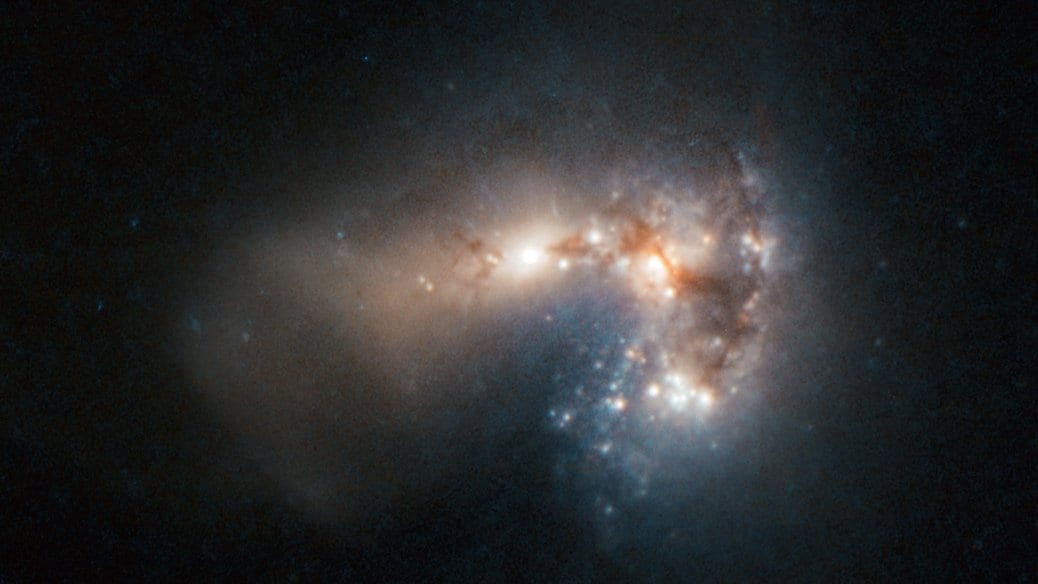
A massive star serves the universe in two ways, and they arrive in order. While it lives, it floods its surroundings with ultraviolet light energetic enough to tear the electron off a hydrogen atom. When it dies, it drives a blast wave into the gas around it. Both happen inside the same small region within a few million years of each other, which has made it hard to say which one did more to clear the hydrogen fog that filled the early universe.
A study published Oct. 15, in Nature Astronomy puts the two in sequence. Cody Carr of Zhejiang University in Hangzhou, China, and 27 colleagues used ultraviolet spectra from the Hubble Space Telescope to look at six nearby star-forming galaxies that resemble each other in most respects but were caught at different stages of a burst of star formation. In the same light they measured two things at once: how much ionizing radiation was getting out, and whether the galaxy had begun to blow a wind.
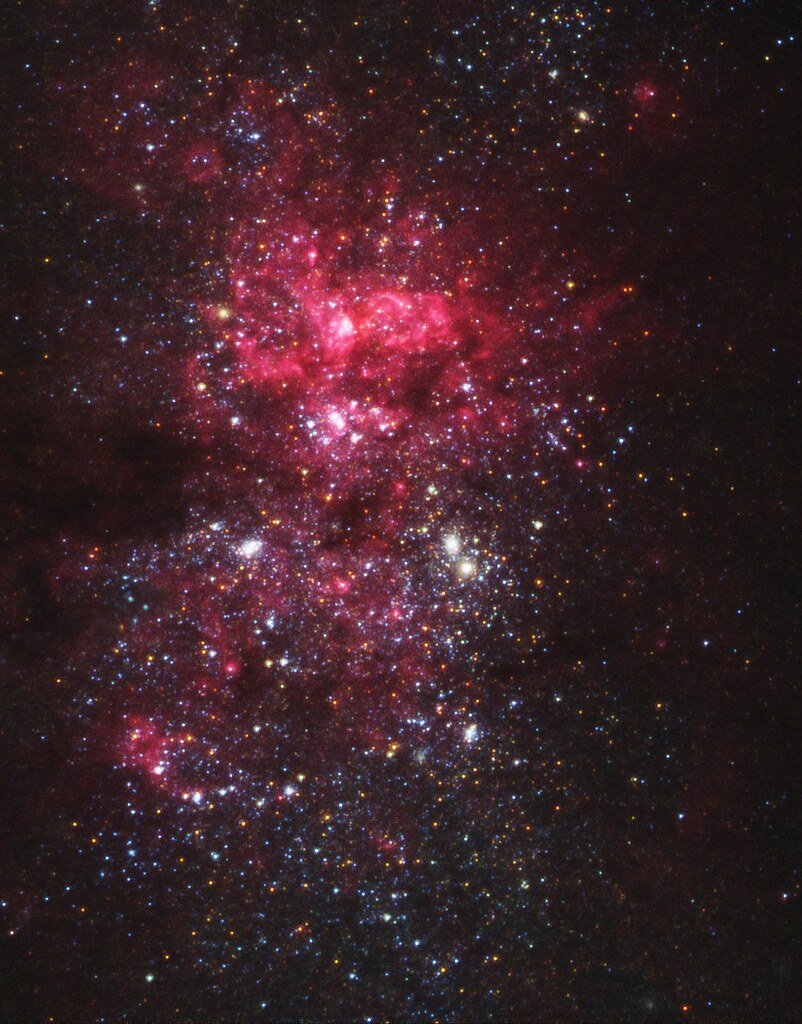
The clearest result is a timetable. The ionizing light, which astronomers call the Lyman continuum, escapes most freely from the youngest bursts. Escape peaks within the first three million years, and the paper's figure is a bound on when that peak falls rather than a point value. Those youngest galaxies are rich in radiation and in the fast winds blowing off the surfaces of individual hot stars, and they have not yet launched a fast wind on the scale of the whole galaxy.
In the galaxies farther along, past three million years, the team detects a different picture. Their galactic winds are faster, their absorption lines are stronger, and they carry more dust. Those are measurements, taken from the same spectra that gave the escape fractions, and they are the solid half of the paper.
The other half is an inference, and the paper marks it as one. The observations suggest that escape is then suppressed by the launch of a supernova-driven wind and by the gas that wind sweeps up as it goes, across roughly the first ten million years of star formation. Suggest is their word. The paper's summary figure, which lays the escape sequence out alongside the launch of the wind, is captioned as inferred from stellar and galactic absorption features. And the six galaxies are six separate objects sorted by the age of their burst rather than one galaxy watched changing, so the sequence is assembled from six snapshots rather than recorded from any single history.
Three million years is a meaningful place for a line to fall. The most massive stars live roughly that long, and the first supernovae in a young cluster are expected at about 3 to 3.3 million years. So the boundary the paper draws, between a leaky youth and a sealed middle age, lands where the explosions are independently expected to start shoving gas around. That coincidence is the strongest thing going for that reading, and it is still not the same as having watched it happen.
The sign of the effect is contested, which is part of what makes the claim interesting. A long-running line of argument in this field runs the other way: that the same winds and explosions punch holes and thin channels through a galaxy's neutral gas, and that ionizing light leaves through the holes. On that account a wind helps. Carr and his co-authors, among them Renyue Cen at Zhejiang and Stephan McCandliss at Johns Hopkins University, argue that in the supernova phase the wind works against escape, picking up gas and dust until less of the light gets out.
If the ordering holds, escape is a phase rather than a property. A galaxy is not simply a leaker or a non-leaker. It may leak ionizing radiation more readily during the first few million years of a burst, with escape declining as the burst ages. The galaxies contributing most effectively to reionization at any given moment could therefore be those whose bursts began most recently. That changes the question for anyone trying to account for reionization, the clearing of that early fog: the census that matters may be one of very young starbursts rather than of bright galaxies in general.
The material to argue with is public. The Hubble spectra sit in the Mikulski Archive for Space Telescopes, and the two codes the team used to model the lines, SALT and FiCUS, are on GitHub. Source data are posted with each figure. A group that reads the ordering differently can refit the same six spectra.
Six galaxies provide a limited basis for a claim about the whole early universe, and the youngest end of the sequence is where another handful of objects would do the most good. But the shape of the timetable is easy to state. A galaxy's most useful years for the universe come before its biggest stars start dying, and on this reading they are over before the first of them does.
Sources
- Nature AstronomyPeer-reviewed