A Condor and a Swan Weigh the Same. Only One Gets a Free Ride

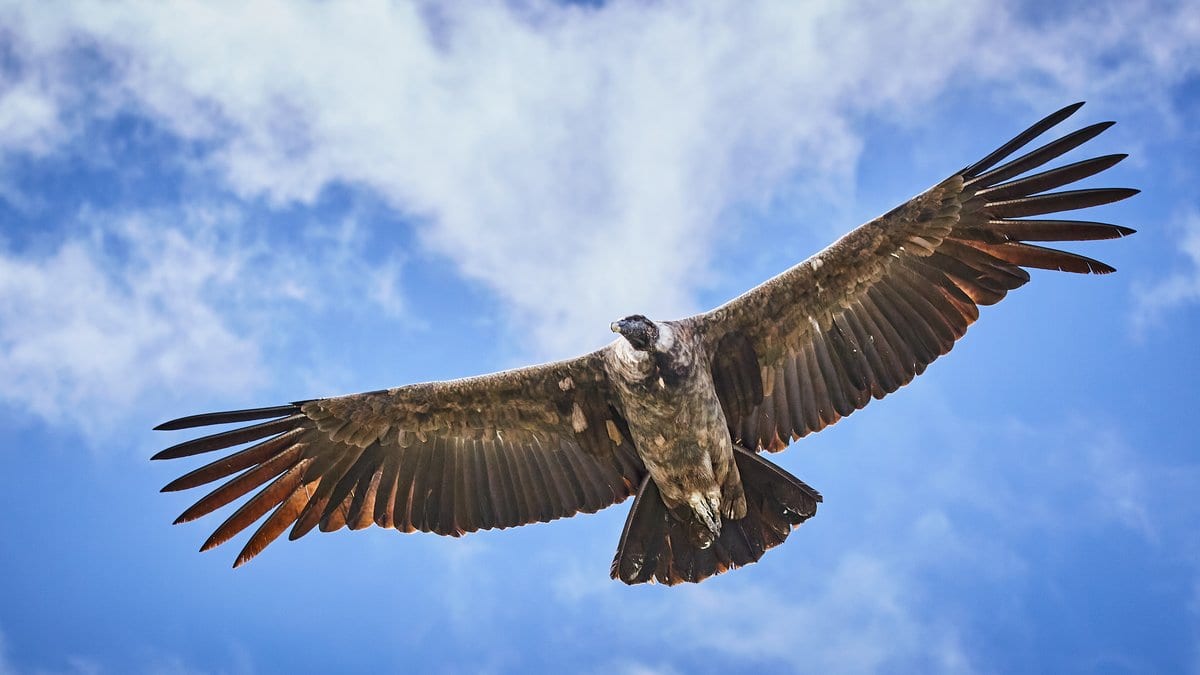
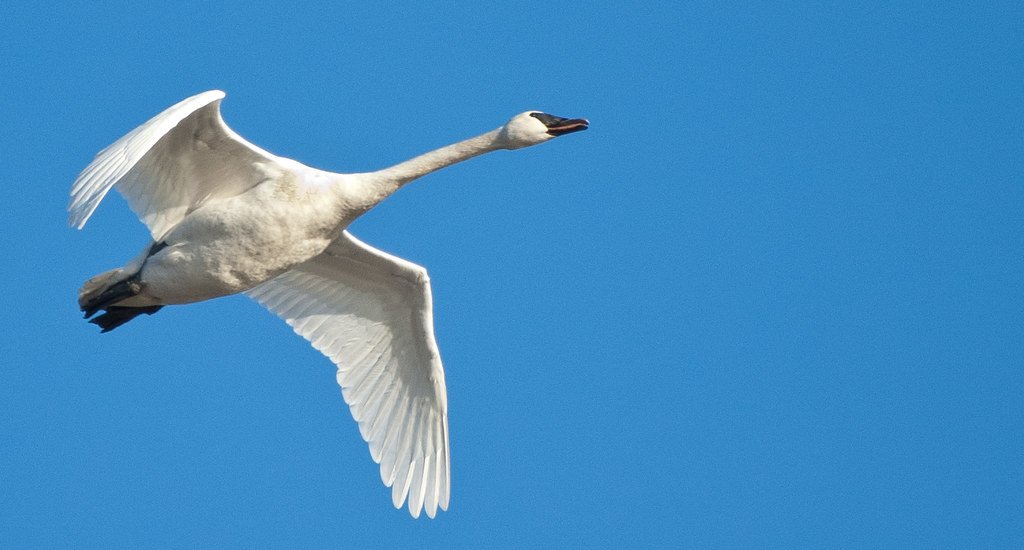
An Andean condor and a trumpeter swan are about as heavy as flying animals get, and they are almost exactly as heavy as each other: roughly 11 kilograms apiece. By the rules printed in textbooks, that should settle what it costs each of them to travel a kilometer, because those rules read the cost of flight off body mass. Anyone who has watched the two birds can see the problem. The condor hangs on a column of rising air and hardly moves its wings. The swan beats its way across the sky.
An international team set out to put numbers on that gap in the wild. Using tracking data from wild birds and bats, they estimated the energy cost of travel for each one, and published the result Oct. 15, 2026, in Science. The work was led from the Max Planck Institute of Animal Behavior in Germany together with Swansea University in Wales. Its first author is Martina Scacco, who holds posts at that institute and at the Swiss Federal Institute for Forest, Snow and Landscape Research in Switzerland. The condor covers each kilometer on about a fifth of the energy the swan needs, Swansea University says in its announcement of the study.
The ranking those textbooks carry comes from the laboratory. Birds and bats were flown in wind tunnels, and the resulting equations ranked swimming as the cheapest way for an animal to cover ground, with flying next and running dearest. The authors' objection is not to the measurements but to the room they were made in. A wind tunnel holds the air steady. Outside, air rises over a warm field or a ridge, and a soaring bird that finds it is being lifted by something it did not pay for.
The study covers 50 species, and they were followed two ways. For 38 of them, 850 individuals carried GPS tags and accelerometers over 17 years, instruments that between them record where an animal went and when its wings were beating. The smallest fliers cannot carry a tag at all, so the rest, songbirds of 12.5 to 21.2 grams, were tracked by radar instead. Both the tracking data and the code used to analyze them are deposited publicly under an open license.
What the tags cannot do is read an animal's metabolism. So the energy figures in the paper are calculated rather than measured: the accelerometers give the proportion of each flight spent flapping, a published model converts flapping into a metabolic rate, and ERA5, a reconstruction of past weather, supplies the wind and the rising air the animal met along its track. The authors name direct measurement, through something like heart-rate monitoring, as the next step, according to the Max Planck Society's announcement.
In the authors' own words, the estimates "revise the classic ranking of locomotion costs, suggesting that flying can be cheaper than swimming though almost as costly as running, depending on interactions between physical environment, morphology, and behavior." It is a revision rather than a reversal. The cheapest flight beats swimming; the most expensive flight does not; and which one an animal gets depends on the air it meets, the wings it has and how it uses them.
Emily Shepard, a professor of biosciences at Swansea and one of the study's senior authors, described the resource in the university's announcement: "When flying animals have access to natural atmospheric flows, they have free fuel from the sky. Soaring birds use this to move at costs that are cheaper than swimming." A condor working rising air barely beats its wings at all; a swan flaps for about 99% of its flight time, by the two institutions' account.
The saving comes with conditions, and that is the study's second point. The authors report that among soaring birds, the heavier the species, the less it flapped and the less each kilometer cost. Heavier soarers were also the most dependent on finding the right air, and the most restricted in when and where they could fly at all. Species that flap can set off in worse conditions and pay for the privilege. For them the strongest influence on cost was wind, a tailwind helping and a headwind hurting.
The scale of what soaring buys shows up in the vultures. Seven vulture species in the dataset covered more than 4.3 million kilometers between them, almost all of it without flapping, the two institutions report.
If the cost of a journey is set partly by the air, then it is not a fixed property of a species, and a changing atmosphere can move it. "If atmospheric conditions change, so too will the cost of flight, and therefore how animals decide to migrate and establish communities," said Kamran Safi of the Max Planck Institute of Animal Behavior, the study's other senior author.
Scacco put the point more simply. "To us, the sky might just look like background for flying animals, but it is an essential resource that can dramatically change the cost of a journey," she said.
Sources
- SciencePeer-reviewed
- www.swansea.ac.uk
- www.mpg.de
- Zenodo