27 Years of Radio Snapshots, Rebuilt Into a Movie of a Black Hole's Jet

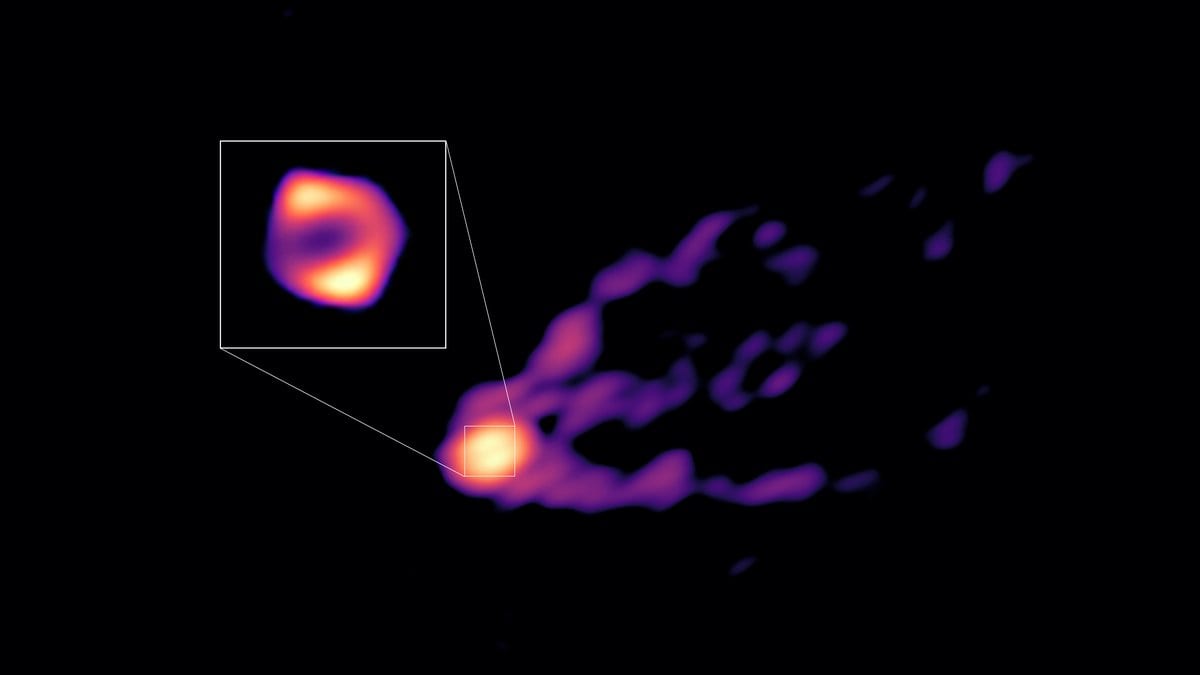
Nobody has ever watched a black hole's jet move. The plasma thrown out of the quasar 3C 345, in the constellation Hercules, has been under observation for half a century, but always as stills, an observing run one month, another the following spring, the jet quietly rearranged in between. The Very Long Baseline Array alone collected 116 such pictures of it across 27 years. What astronomers have always wanted is the film those frames were cut from.
A team led by the Institute of Astrophysics of Andalusia (IAA-CSIC) in Granada has now made one. Marianna Foschi, Brandon Zhao and Antonio Fuentes are credited as equal first authors; the senior author is José L. Gómez of IAA-CSIC, who supervised the doctoral thesis the algorithm grew out of. Their paper appeared open access in Nature on 26 August. The algorithm, called kine, refuses to treat 116 observations as 116 separate imaging problems.
Instead of solving for the pixels of each frame, kine trains a small neural network to take a position on the sky and a moment in time and return the brightness and the polarization there. The video is that network. Because the network is continuous in time, it can be asked about a date on which nobody was observing at all, and it answers from what it learned on either side of the gap.
Rebuilding every frame out of all the data, rather than out of one night's worth, buys both sharpness and depth. The video resolves detail about four times finer than the array's nominal limit, and holds a dynamic range roughly 140 times better than traditional imaging: enough to keep a faint outer plume and a brilliant core legible in the same picture. Training on the whole 3C 345 dataset took a little over an hour on four GPUs, and the code and the reconstructed video are public on GitHub. The observations themselves come from MOJAVE, a monitoring program that has been public all along.
Every point in the jet now has a speed
The standard way to measure motion in a jet is to fit blobs to the bright features and track them from one epoch to the next. That tells you how fast the knots travel and nothing at all about the plasma between them. With a continuous video in hand, the team could instead run optical flow, the same class of technique that estimates motion in ordinary video, across the whole reconstruction. It returns a velocity arrow at every point and every moment.
At its fastest, the plasma appears to move at about 12 times the speed of light. Apparent superluminal motion is a trick of geometry, well measured in other blazar jets whose beams point nearly at us; corrected for this jet's viewing angle, it works out to a real speed of 0.997 c. The speed at a given spot also wobbles from frame to frame, which the authors read as turbulence in the flow.
The knots move no faster than the plasma around them
For decades, the moving bright features in jets like this one have been read as traveling shock waves, compressing the magnetized plasma as they pass. A shock is a pattern rather than a parcel of material, so its speed and the speed of the flow need not agree, and in a strongly shocked jet they should visibly differ. Here they do not. The bright components move at 10 to 13 times light speed, the plasma around them at 9 to 12.
A second test points the same way. Compressing a magnetic field lines it up, so a traveling shock ought to leave a local peak in the fraction of polarized light. In the kine video, the polarization peaks do not sit where the bright features are. The authors read the features instead as "localized over-densities in the plasma or regions with increased emissivity," brightened where the magnetic field is locally amplified. The paper then sets its own limit on that reading: comparable pattern and flow speeds can also arise with shocks present, if the protons in the jet are not highly relativistic. The measurement disfavors strong shocks in this jet rather than removing them.
Paper's conclusions say: "Our results challenge only the current shock models for the 3C 345 blazar." Independent work published in Astronomy & Astrophysics in 2024 still models the same quasar's compact jet with stationary and moving shocks in it. The argument is live, and the abstract makes the careful version of the claim: the method could be turned on entire monitoring programs, "possibly leading to a reinterpretation of established models."
One structure did survive the whole record. The orientation of the polarized light, along the jet's spine, across it near the edges, recurs through nearly three decades of frames. That is consistent with a long-lasting toroidal magnetic field threading the jet, potentially part of a larger helical field. "From the video reconstruction we obtain, in great detail, a highly variable jet in which we can follow the movement of the plasma point by point," Foschi said in the institute's announcement of the work.
The archive is the real target
3C 345 is a demonstration. MOJAVE has tracked hundreds of active-galaxy jets with the VLBA for decades, and each of those records is a stack of stills waiting for the same treatment. "It is likely that some of the ideas we took as established about how these jets move will have to be revised," Gómez said in the same announcement, a claim about what the archives might yield.
Kine was built for the opposite problem. The original idea came from Katherine Bouman's group at Caltech and from Aviad Levis, now at the University of Toronto, and the target was Sagittarius A*, the black hole at the center of our galaxy. Its appearance changes faster than a night of Event Horizon Telescope observing takes, so no single frame can be made at all and a video is the only way to see anything. That the same method also works on a source that takes decades to change is the paper's argument for pointing it at the archives. The code is public and so is the MOJAVE data, which puts the question of whether 3C 345 is typical in reach of anyone with a few GPUs and the patience to run it.
Sources
- NaturePeer-reviewed
- www.iaa.csic.es