Physicists Pull Usable Work out of a Liquid's Memory
Physicists have pulled usable work out of the memory of a particle's surroundings, information that earlier information engines treated as lost for good. Lokesh Muruga, Clemens Bechinger and colleagues at the University of Konstanz published the experiment Oct. 16, 2026, in Nature Physics. Sarah A. M. Loos of the Max Planck Institute for Dynamics and Self-Organization worked out the theory.
An information engine turns measurements of a small system into work, the principle behind Maxwell's demon. Nearly every experimental version has assumed surroundings that forget. Real ones often do not: polymer solutions and disordered materials keep traces of what has moved through them, and the Nature Physics paper treats those traces as something an engine can draw on. The energy is not coming from nothing. It sits in parts of the fluid nobody is watching, and a well-timed measurement is what makes it reachable.
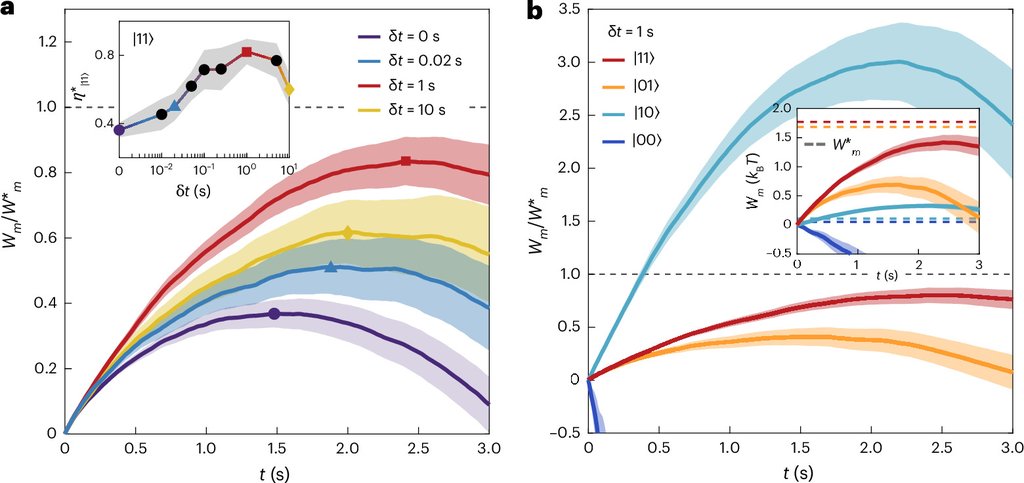
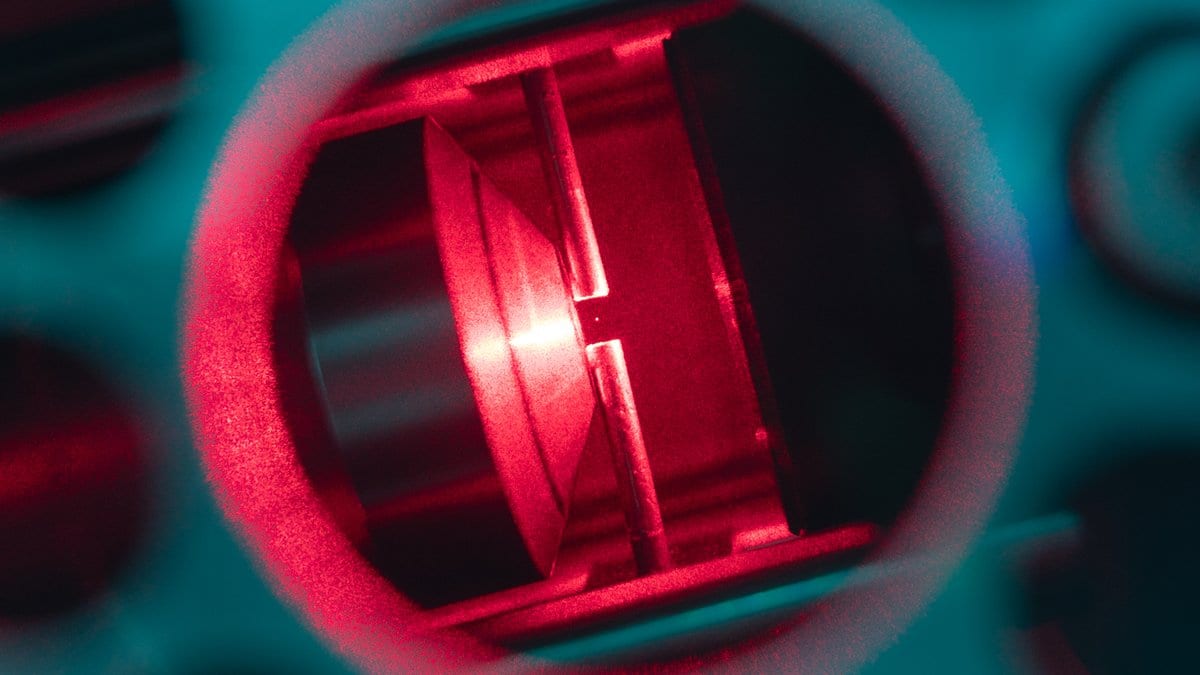
The team held a silica bead 2.7 micrometers across in a laser trap, inside a thick soapy fluid whose molecular network rearranges itself in about 6 seconds. Twice in a row they noted whether the bead sat left or right of a fixed line, then slid the trap sideways to draw work out. With about 1 second between the readings, the work recovered after one pair of readings reached up to three times what the same measurement in a memoryless fluid could allow. Spacing the readings 200 seconds apart wiped the effect out: the network had relaxed and no longer held a record of the first reading.
That ceiling applies to surroundings without memory, not to the second law of thermodynamics. The authors set their result against a broader version of that law, derived by Sagawa and Ueda, in which measured information raises how much work can come out.
One pair of readings gave up no work at all. The authors say more measurements, or freer ways of moving the trap, should raise what can be recovered. The paper and the data behind its figures are open access under a CC BY license.
Sources
- Nature PhysicsPeer-reviewed