A Planet Around Another Star Appears to Have Its Own Aurora

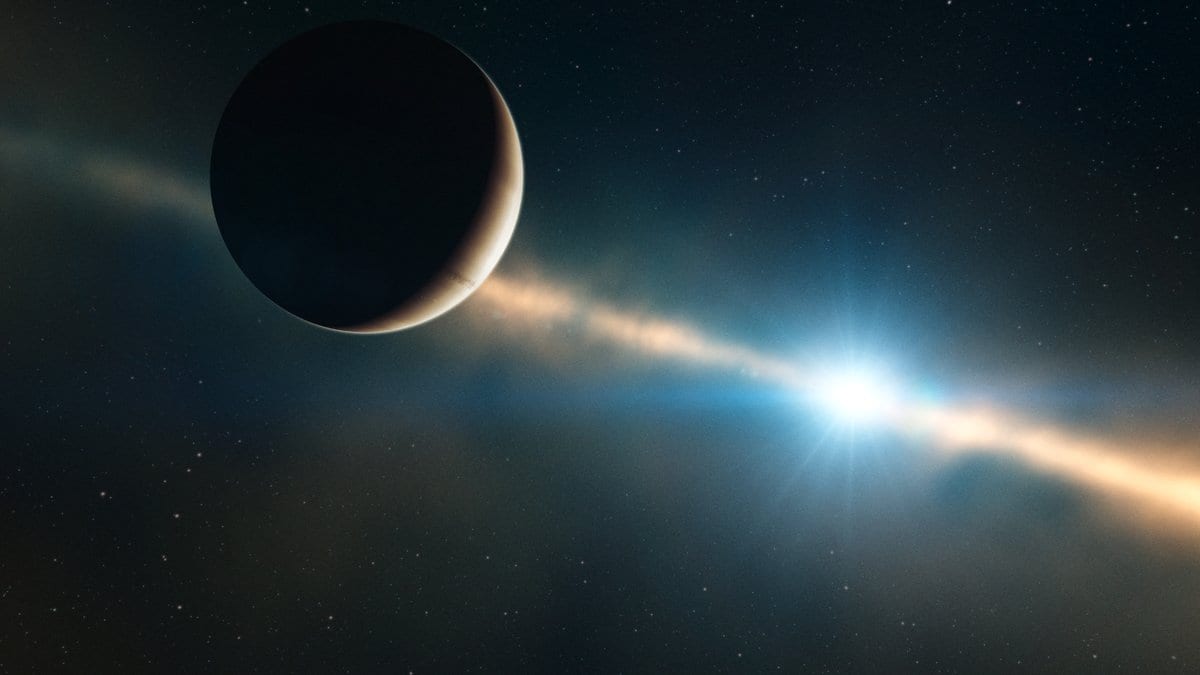
Every planet in the solar system with a magnetic field also has an aurora, and every one of those aurorae is a radio transmitter. Jupiter's was found by accident, by astronomers who were looking at something else. Turn the same idea on the planets orbiting other stars and it falls apart: radio bursts have been picked up from a few systems known to hold planets, but no telescope could say whether the signal came from the planet or from the star sitting beside it.
A preprint posted to arXiv on Sept. 15 says that has now happened. K. N. Ortiz Ceballos and E. Berger at the Center for Astrophysics, Harvard & Smithsonian, with Y. Cendes at the University of Oregon, observed the β Pictoris system with MeerKAT, a radio array in South Africa's Northern Cape, across four observing sessions in 2025 and 2026. A source turned up at the system's position every time.
Its character is what made it worth chasing. The emission arrived in short, recurring bursts, up to 70% circularly polarized, meaning the radio waves corkscrew in one direction. The bursts were flat and broad, present across the whole observed range up to 3.5 gigahertz, with a fainter steady signal in the gaps between them.
Polarization that strong is a fingerprint. It rules out the diffuse radio glow that ordinary magnetic activity on a star produces, and points instead to the electron cyclotron maser, in which electrons spiraling along magnetic field lines radiate in step with one another. That is the process behind Jupiter's bursts and the radio flashes seen from brown dwarfs, the objects too small to sustain hydrogen fusion as stars do.
Four things sit in that direction
Beta Pictoris is a young star about 64 light-years away, ringed by a debris disk and orbited by at least three giant planets. MeerKAT cannot tell them apart. Planet b, the most massive of the three, never strays far enough from its star on the sky for the array to resolve the two, so nobody took a picture of an aurora and nobody has one.
What the team did instead was fit the position of the radio source and ask which object it lands on. They tied their image to the reference frame established by the Gaia spacecraft, using nine quasars in the same field of view plus one calibrator whose position is known to better than a milliarcsecond from very long baseline radio measurements.
The corrected position falls on planet b. It sits 4.4 standard deviations from the star, and that is the conservative figure: the team widened its error budget first, using checks on its own data that included injecting fake sources into the image to see how well their positions came back. Dropping reference sources one and two at a time yields 55 alternative solutions, and the source stays consistent with planet b in all 55.
A kilogauss is a floor, not a reading
For this kind of emission, the highest frequency it reaches is set by the magnetic field strength where the radiation is made. The brightest burst was still there at 3.5 gigahertz, the ceiling of MeerKAT's band, which puts the field at the emission site at a minimum of about 1.25 kilogauss. The authors call that the first direct measurement of an exoplanet's magnetic field strength.
It is a floor rather than a reading. A stronger field would push the emission above that ceiling, where MeerKAT cannot follow, so the number says how weak the field cannot be and nothing about how strong it actually is. It also assumes the radiation leaves at the fundamental cyclotron frequency. If it leaves at the second harmonic instead, the same bursts would require only about 0.63 kilogauss, half as much, a point the paper's own methods make in passing.
A kilogauss is about what theory predicts. Running an energy-flux dynamo scaling on the planet's measured brightness, mass and radius predicts a mean surface field near 1.2 kilogauss for a young body of roughly 12 Jupiter masses. The authors offer the agreement as support rather than proof.
The load-bearing word in their claim is direct. Indirect estimates of exoplanet magnetism already exist in the peer-reviewed literature and do not contradict this one: an earlier Nature Astronomy paper put several hot Jupiters at tens of gauss from signs of star-planet interaction, and another in the same journal, published in June 2026, estimated fields of at most a few gauss for a set of ultra-hot Jupiters from their atmospheric winds. Different planets, different methods. That second paper describes direct observations of exoplanet fields as still lacking, which is the gap the MeerKAT team says it has filled.
What a referee will ask
None of this has been through peer review. The arXiv entry says only that the paper has been submitted, with no journal named, no press release beside it, and no second group yet pointing a telescope at the source.
The localization rests on a single image, the wide-field map from the last of the four sessions. There is no test across epochs of whether the source position changes as expected for the planet, which would help rule out a background radio source that happens to lie in the same place. The paper does not take that possibility up directly, and it is the kind of thing a referee asks about.
One earlier result belongs to the story rather than against it. In 2024 a team searched for exactly this signal from β Pictoris b with the upgraded Giant Metrewave Radio Telescope, at a few hundred megahertz, and found nothing. A kilogauss field puts the emission in the gigahertz range, well above the band they were listening to.
An aurora tied to a spinning magnetic field should come and go with the planet's day. The gap between two of the bursts in the lower band was close to β Pictoris b's day, which runs eight to nine hours, and the paper says this may be a signature of that modulation without claiming that it is. More monitoring would settle it. Several more directly imaged giant planets in nearby systems sit far enough from their stars for the same position-fitting method to work.