Skip to content
See the World Through ScienceA project of ALLATRA
Source: Peer-reviewedNature1 source

Better Starlight Removal Lets Webb See Fainter Planets Without New Hardware
Space

Republish this story

Our work is licensed under Creative Commons BY-NC 4.0. You may republish this piece for free — with credit to ALLATRA Media and a link to the original, unedited beyond length trims, and not for commercial use.

Read the full license

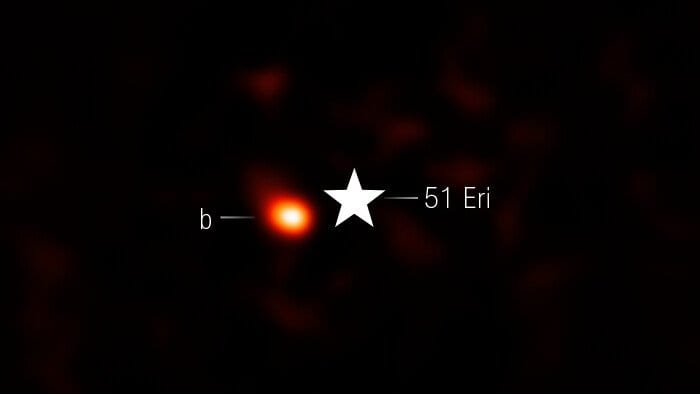
A Webb coronagraph frame of the star 51 Eridani, masked at the center, with its planet labeled b as a bright orange point just to the left of the star marker.
The planet sits a fraction of an arcsecond from its star, whose light the coronagraph blocks. Webb released this view in March 2025, and the new analysis went back to coronagraph data of this system to pull the planet out at a longer wavelength."51 Eri b (NIRcam image)" by NASA, ESA, CSA, STScI, W. Balmer (JHU), L. Pueyo (STScI), M. Perrin (STScI), via ESA/Webb, CC BY 4.0

A team led from Northwestern University reports a new way of subtracting starlight from James Webb Space Telescope images that reaches 2 to 15 times the sensitivity of standard processing, with no change to the telescope. Run on archived Webb data, it detected the giant planet 51 Eridani b at a wavelength of 4.3 microns, where the original analysis of the same observations found nothing. The work was published Nov. 4, 2026, in Nature.

The team writes in the paper that modeling starlight more accurately than the telescope's own steadiness allows would put more planets within reach of direct imaging, and would be a step toward imaging Earth-like planets with future observatories. Rodrigo Ferrer-Chavez of Northwestern led the work, with Jason J. Wang of Northwestern and Katherine L. Bouman of the California Institute of Technology as joint senior authors.

Imaging a planet means modeling the glare of its star and subtracting it. Standard methods build that model out of reference pictures of other stars, or of the same star at other times; pointing errors and thermal drift leave residual starlight that buries faint planets. The new method, which the authors call FLIP, instead fits a physical model of the instrument, solving for the telescope's optical distortions and the detector's response until the simulated glare matches what Webb recorded.
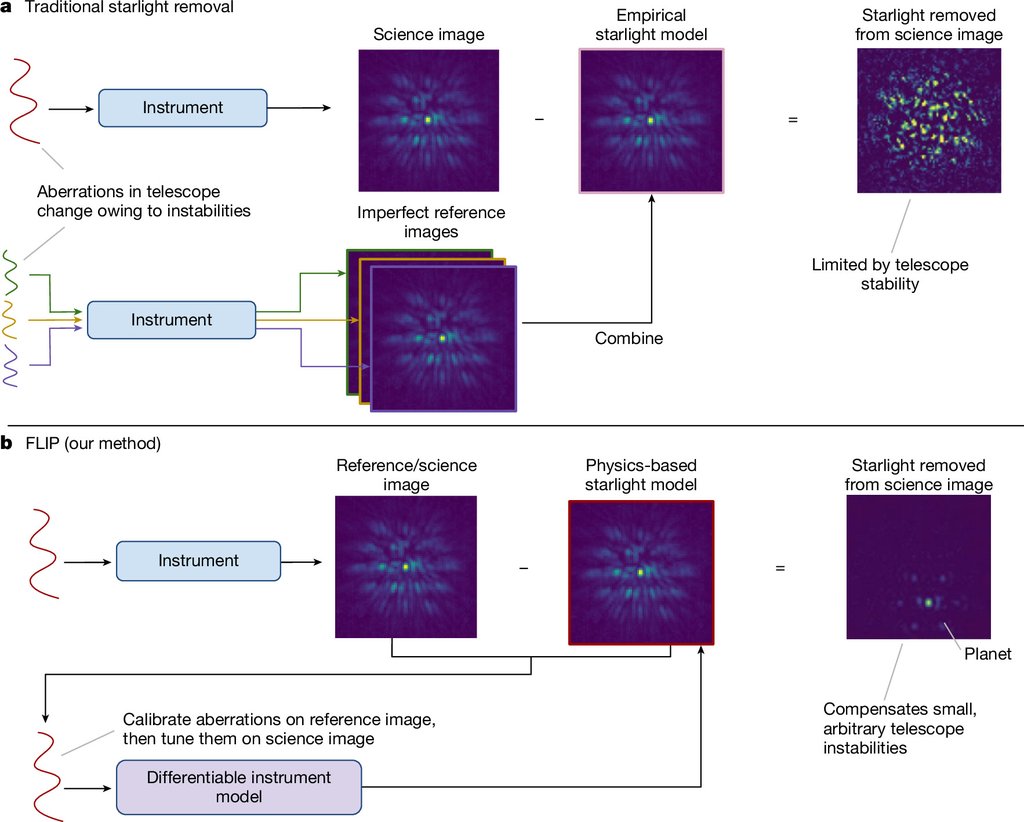
Schematic of two starlight subtraction routes, one building a model from reference images of other stars and one tuning a model of the telescope optics in a loop.
Standard subtraction builds its starlight model out of reference images of other stars. The new route instead adjusts a model of the telescope's own optics until it explains the science image. Fig. 1 from Rodrigo Ferrer-Chavez, Jason J. Wang, Katherine L. Bouman, William T. Freeman, Laurent Pueyo, Brandon Y. Feng, Marshall D. Perrin (2026), "Imaging exoplanets below the telescope stability limit", Nature — CC BY 4.0, resized

The paper puts the fit at about 35 minutes on a single graphics processor, and reports tests on published observations of three stars behind Webb's coronagraph, the mask that blocks a star's light. On one, close in to the star, FLIP reached roughly 15 times the sensitivity of the standard method: the top of its range.
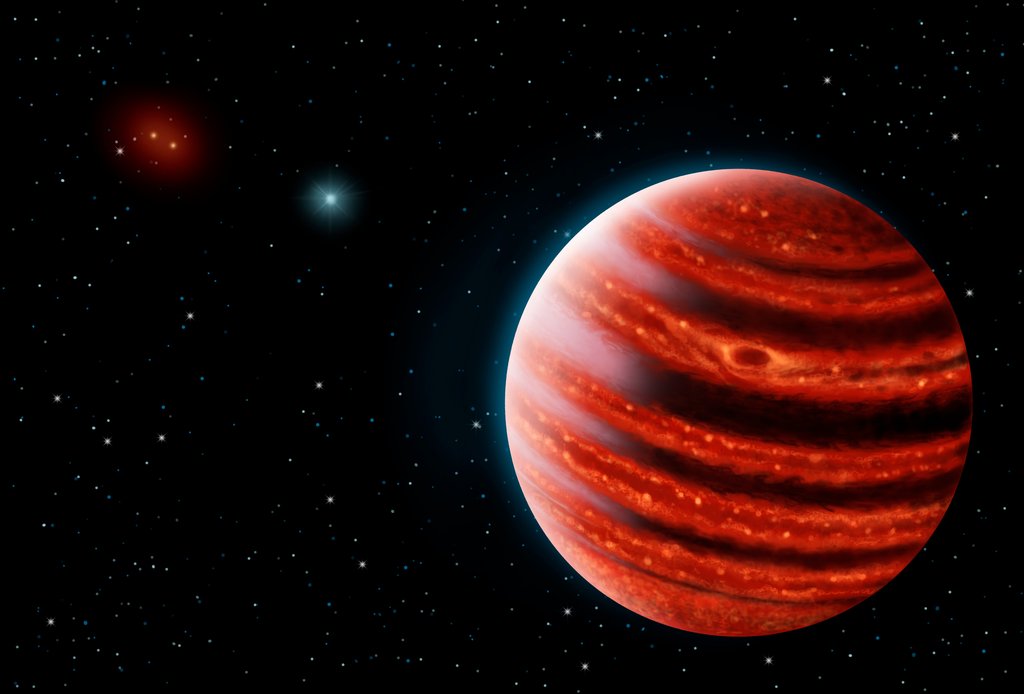
Artist's concept of a red banded gas giant planet lit from the left, with distant stars behind it.
An artist's concept of 51 Eridani b, the young giant planet the reprocessed data recovered. No telescope resolves a disk like this one; direct imaging shows the planet only as a point of light. "Gemini-Discovered World is Most Like Jupiter (gemini1505a)" by Danielle Futselaar & Franck Marchis, SETI Institute., via Wikimedia Commons, CC BY 4.0

The 4.3-micron band holds a carbon dioxide absorption feature and cannot be seen from the ground, because Earth's atmosphere blocks it. The authors say future work will measure the planet's brightness there. They describe the method as the first, to their knowledge, to improve sensitivity substantially on real coronagraph data, and say it could be extended to the Nancy Grace Roman Space Telescope and the planned Habitable Worlds Observatory. The FLIP code is posted publicly.

Sources

Spot an error?

Spot an error?

Report an error

Spotted a mistake on this page? Tell us what's wrong and our editors will take a look.

What kind of problem?

Only if you'd like us to be able to follow up. We won't use it for anything else.

We correct mistakes openly. Select any text to flag it. Fixes are logged under our Corrections Policy.

Report an error

Reporting on

Better Starlight Removal Lets Webb See Fainter Planets Without New Hardware

What kind of problem?

Only if you'd like us to be able to follow up. We won't use it for anything else.

We read every report. Corrections are logged publicly.