A Third Planet Was Hiding in the Sky's Most Famous Planetary System

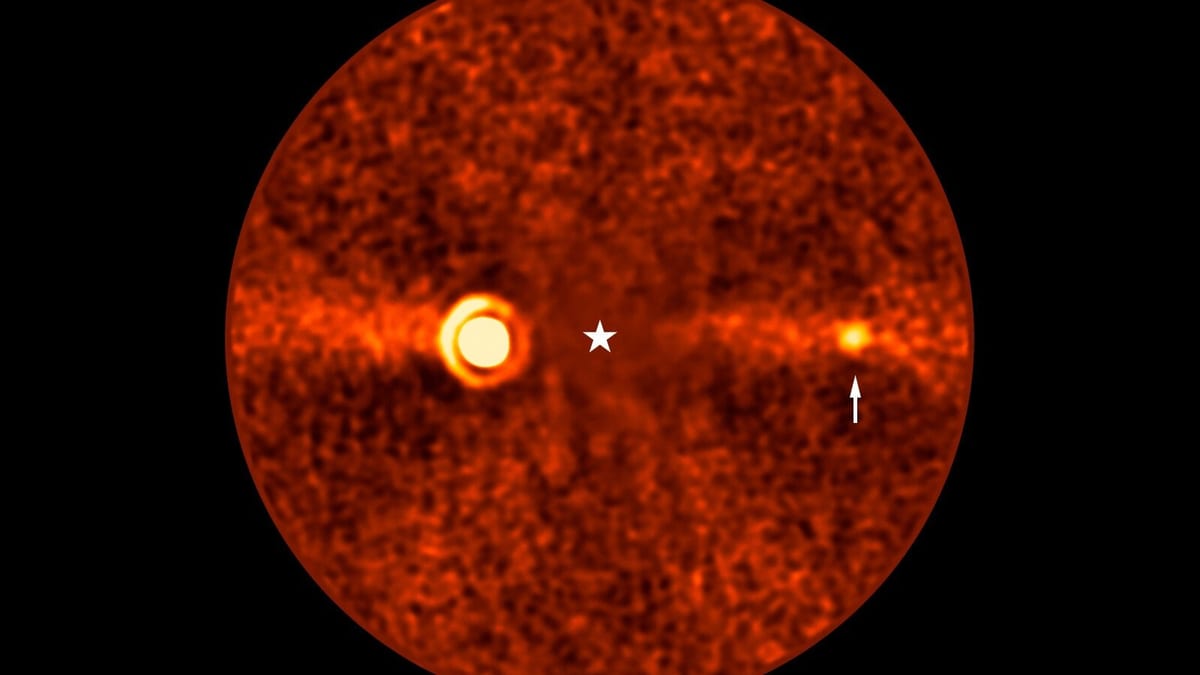
Beta Pictoris has been the poster child of exoplanet astronomy since before most exoplanets could be seen at all. In 1984 it gave astronomers their first image of a dusty disk around another star, the kind of disk that planets are supposed to form from. Two decades later, one of those planets, Beta Pictoris b, became among the very first ever captured directly, a faint dot resolved next to the glare of its star rather than inferred from a wobble or a dip in brightness. A second planet, Beta Pic c, followed. The system, 63 light-years away and young enough that its planets still glow with the heat of their formation, has been photographed and re-photographed for decades.
So it is a small astonishment that a third planet was sitting in those pictures the whole time. Two independent teams have now pulled Beta Pictoris d out of the data, and they did it almost by accident, coming at the same star from different directions with different telescopes. One group, led by Aidan Gibbs at UCLA, used the James Webb Space Telescope. The other, led by Ben Sutlieff and Markus Bonse at ESO, used the ERIS instrument on the Very Large Telescope in Chile. Both published in The Astrophysical Journal Letters, and their independent agreement is a large part of why the result carries weight: a faint smudge that two teams find on two instruments is far harder to dismiss than one team's marginal detection.
What made the planet so hard to catch is simply how little light it gives off. Beta Pictoris d is roughly 100 times fainter than Beta Pic b, which itself is a challenging target. By the measure astronomers use for intrinsic brightness, that makes d the faintest exoplanet ever directly imaged from the ground. Pulling a signal that dim out from beside a star that outshines it enormously is the central difficulty of direct imaging, and it is why the planet went unnoticed for so long. Once the teams knew what to look for, they found it lurking in archival observations reaching back more than a decade, including earlier data from the VLT's SPHERE instrument. As co-author Jayne Birkby put it, the planet "has been playing a game of hide-and-seek with us for over a decade."
The physical portrait that emerges is of a giant. Beta Pictoris d weighs in at roughly 2.4 times the mass of Jupiter and orbits far out from its star, on a path that takes about 91 years to complete, near 26 astronomical units. That places it well beyond its two known siblings and rounds out a genuinely rare kind of family portrait. Until now, only one other planetary system, HR 8799, had three planets that astronomers could photograph directly rather than detect indirectly. Beta Pictoris is the second.
Why that matters comes down to what direct imaging can do that other methods cannot. Most known exoplanets are inferred, never seen; we know they are there because of how they tug on their star or dim its light. A planet you can actually resolve is a planet whose light you can eventually take apart to study its atmosphere, its temperature, its clouds. A system with three such planets, all born from the same disk around the same star at the same time, is a natural laboratory for asking why worlds that started together turned out differently. "Systems with multiple directly imaged exoplanets," Sutlieff noted, "can teach us a lot about what different exoplanets are like in the same formation environment."
This is not a preliminary claim. The work is peer-reviewed, published, and, unusually, confirmed by two independent teams working with two of the most capable telescopes in operation before either announced it. What remains ahead is the characterization: turning a hard-won faint dot into a detailed physical description of the planet and its place among its siblings. For a star that has been photographed for forty years, the surprise is not that Beta Pictoris still had something to reveal, but that it was there in plain sight all along.
Sources
- Nature AstronomyPeer-reviewed
- www.stsci.edu