Skip to content
See the World Through ScienceA project of ALLATRA
Source: Peer-reviewedNature Astronomy1 source

Giant Impacts May Help Young Planets Keep Their First Atmospheres
Space

Republish this story

Our work is licensed under Creative Commons BY-NC 4.0. You may republish this piece for free — with credit to ALLATRA Media and a link to the original, unedited beyond length trims, and not for commercial use.

Read the full license

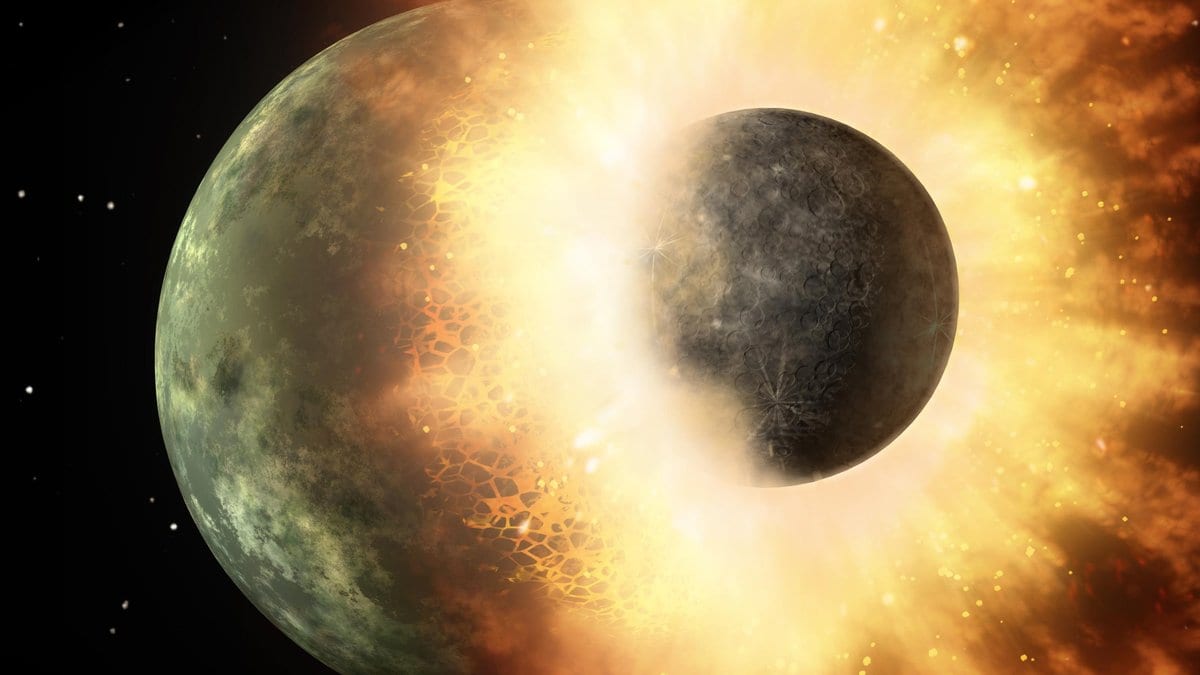
A rendering of two rocky planetary bodies colliding, molten debris spraying out between them against black space.
Two young worlds meet in a rendering of the wreck inferred around the star HD 172555. The model published Oct. 26, 2026 asks what such a blow does to the first atmosphere of a rocky planet (illustrative)."Artist's concept of collision at HD 172555" by NASA/JPL-Caltech, via Wikimedia Commons, Public domain

A model published Oct. 26, 2026, in Nature Astronomy finds that a giant collision late in a rocky planet's formation leaves the planet more likely to keep its original hydrogen-rich atmosphere, not to lose it.

Darius Modirrousta-Galian of Shanghai Jiao Tong University and Jun Korenaga of Yale University write that the direction of that effect had been unresolved, because a giant impact does two opposing things at once: it heats the planet's interior, which drives gas off, and it adds mass, which holds the atmosphere down more tightly. Their calculation comes out on the side of the second effect.

In the model, the entire accreted mass of the impactor counts toward the gravitational hold on the atmosphere, while only part of the impact energy ends up as mantle heat. Melting rock consumes energy as latent heat, and the impactor's metal core gives up little of its energy to the mantle, instead staying, in the authors' words, "superheated at depth." Their summary of the result: "Giant impacts therefore increase gravitational binding energy more than mantle thermal energy, shifting planets towards atmospheric retention."

The authors write that larger planets with atmospheres emerge mostly through this kind of collisional growth, while smaller planets that avoid such an impact tend to lose their early atmospheres to steady radiation from their star. For the two size groups small exoplanets fall into, the paper ends on a prediction: "At the population level, these results suggest that sub-Neptunes have, on average, more massive rocky interiors than super-Earths."
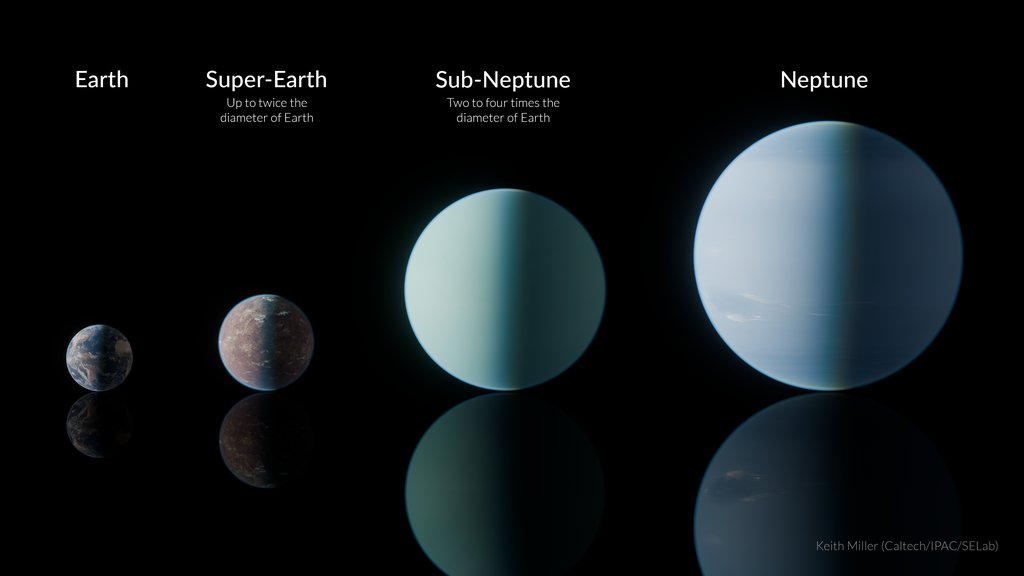
Four planets drawn to scale in a row against black, from Earth at left through a super-Earth and a sub-Neptune to Neptune at right, each one labeled with its size range.
The labels on the frame set the two classes side by side: a super-Earth up to twice the width of Earth, a sub-Neptune two to four times it. The model says the sub-Neptunes carry heavier rock underneath. "Earth to Neptune exoplanets size comparison" by Keith Miller (Caltech/IPAC/SELab), via Wikimedia Commons, Public domain

The code that produces the results and the synthetic data in the paper are available via Zenodo, according to the paper's data and code availability statements.

Sources

Spot an error?

Spot an error?

Report an error

Spotted a mistake on this page? Tell us what's wrong and our editors will take a look.

What kind of problem?

Only if you'd like us to be able to follow up. We won't use it for anything else.

We correct mistakes openly. Select any text to flag it. Fixes are logged under our Corrections Policy.

Report an error

Reporting on

Giant Impacts May Help Young Planets Keep Their First Atmospheres

What kind of problem?

Only if you'd like us to be able to follow up. We won't use it for anything else.

We read every report. Corrections are logged publicly.