Comet Ice From Another Star Does Not Look Like Ours

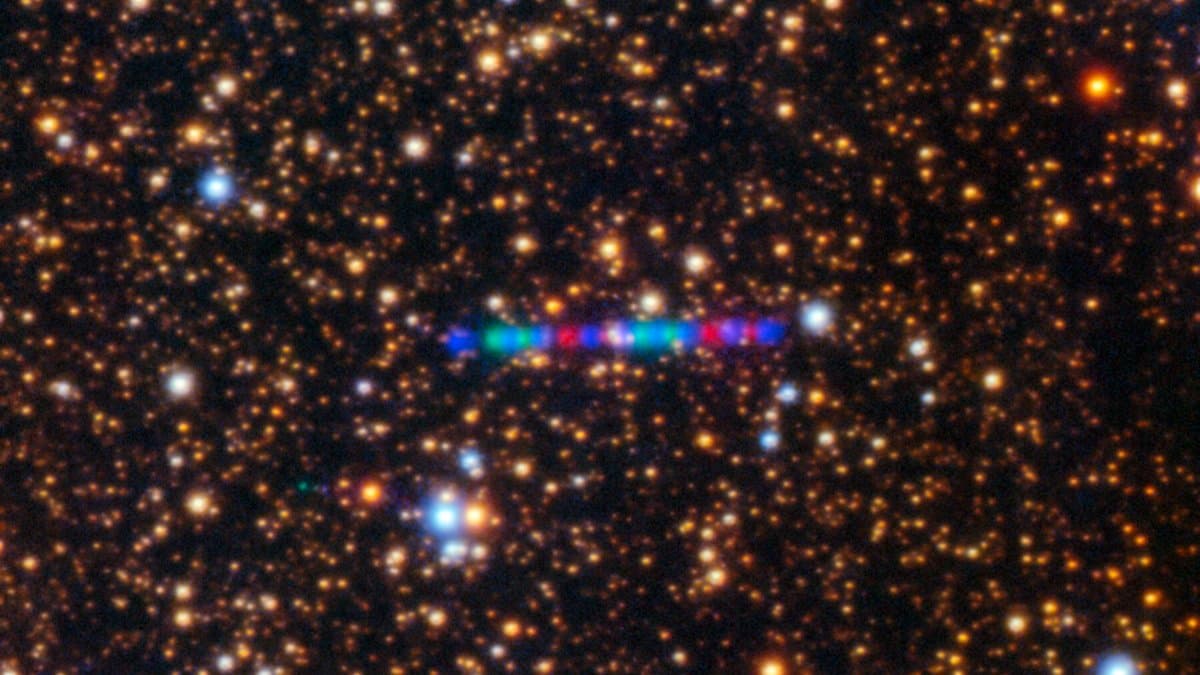
Water ice leaves the same characteristic fingerprints wherever it is. Point an infrared telescope at it and it takes bites out of the sunlight it reflects: two shallow ones near 1.5 and 2.0 micrometers, which are millionths of a meter, and a deep one near 3. Previously observed Solar System comets with water ice in their comae have shown all three.
The interstellar comet 3I/ATLAS shows the deep bite and only weak traces of the other two.
Working out what kind of ice does that is the subject of a paper accepted by The Astrophysical Journal Letters, posted on arXiv on Sept. 16 ahead of publication, by Silvia Protopapa of the Southwest Research Institute in Boulder, Colorado, and colleagues. Their answer comes from fitting models to the light rather than from seeing a grain: the ice is not clean. It appears to reside in aggregates smaller than a micron to a few microns across, with rock mixed through them.
What hides two bands out of three is how far light travels. The two shallow bands are weak to begin with, and they deepen when light travels far enough through ice to be absorbed at those wavelengths. Small grains shorten the run. Rock mixed through the grains shortens it further. The deep band, which comes from the stretching of the bond between oxygen and hydrogen, survives that treatment; the two weak ones do not.
This is the best-fitting model, not a photograph of a grain, and the team tested how firmly it holds. Fits that started from a wide spread of initial guesses converged on similar fine-grained, rock-laden ice. Versions built from pure ice, or from ice mixed with carbon or with a single mineral, either produced the stronger bands the spectra lack or failed on the deep band they have. Protopapa and colleagues still call their mixture an effective description of the coma's grains, not the only arrangement that could work.
Webb caught the comet three times. On Aug. 6, 2025, it was inbound, between the orbits of Mars and Jupiter, at 3.3 astronomical units from the Sun. On Dec. 22, 2025, it was heading back out, at 2.4 astronomical units, after its closest approach to the Sun on Oct. 29. By April 1, 2026, it had reached beyond Jupiter's distance, at 5.7 astronomical units from the Sun. The middle look was left out of the modeling because water vapor, organic emission and a line of nickel contaminated the stretch of spectrum the ice analysis needs.
The first and last looks are not the same. The April spectrum fits best with a second family of grains added, larger but still microscopic and richer in ice, and it carries a faint bump near 3.1 micrometers. That bump is consistent with crystalline ice, whose molecules sit in a regular lattice; disordered ice makes a smoother, weaker version of it.
This is where the paper stops, deliberately. Either the ice was crystalline at both looks and what changed between them is grain size and the amount of rock mixed in, or the ice began more disordered and became more crystalline over the eight months. The spectra permit both, and the authors choose neither. The same goes for why the grains changed at all: April found the comet in a far colder place, which changes what survives in the coma, but a pass by the Sun also alters the activity of the nucleus and can expose deeper material.
Part of the reason the question stays open is unglamorous. The answer depends on which laboratory measurements of ice go into the model. Two commonly used sets of optical constants disagree on how water ice absorbs and refracts infrared light, by enough to affect the shape of the very feature the crystalline interpretation leans on. The paper closes by calling for new laboratory measurements of ice across a range of temperatures and physical states.
What makes this matter beyond one comet is where 3I/ATLAS falls among everything else made of ice. The coma of comet 103P/Hartley 2 was modeled as containing essentially pure water-ice grains. In comet C/2013 US10, the ice-bearing grains carried a little rock, up to 1% of their volume. 3I/ATLAS sits far along that same line. Read together, the three stop looking like separate types and start looking like points on a range, at grain sizes that hardly differ.
The comparison then reaches somewhere the authors were not obliged to go. Strip the underlying slope out of 3I/ATLAS's spectrum and its deep band closely resembles those of mid-sized bodies beyond Neptune. That includes a class whose 3-micrometer band has been interpreted as arising from organic materials and methanol rather than primarily from water ice, partly because the two shallow features were absent. Water ice with enough refractory material mixed into it can produce a similar pattern. The paper raises that as a possibility worth testing, not as a correction.
Resemblance in a spectrum is not shared chemistry, and surfaces beyond Neptune carry both what they were born with and billions of years of radiation and impacts. Other work on this comet already points to a home disk chemically unlike the one that made our planets. What 3I/ATLAS leaves behind, on its way out of the solar system for good, is a set of spectra in a public archive and a case that the ice planets are built from is not one substance but a spread, with the comets born here sitting somewhere along it rather than defining it.
Sources
- arXivPreprint