A Laser Trap on China's Space Station Cooled Atoms to Nine Trillionths of a Degree
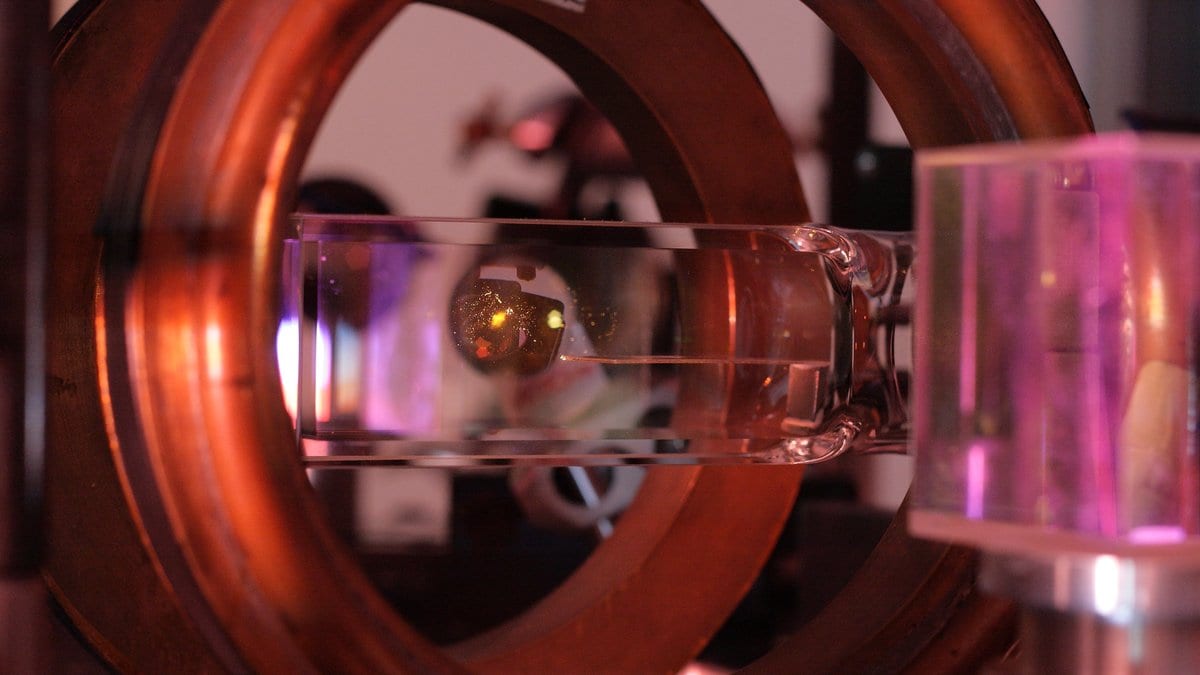
Wei Xiong of Peking University and colleagues report that they cooled a cloud of about 20,000 atoms in a trap made of laser light aboard the China Space Station to an equivalent temperature of 9.7 picokelvin, about ten trillionths of a degree above absolute zero. The cloud stayed measurable through 7.0 seconds of free expansion. Science published the work online Nov. 5, 2026.
The authors say ultracold atom platforms supply low temperatures together with long free evolution times, and that the pair is crucial for tests of fundamental physics and for atom interferometry, which measures gravity and motion using matter waves. Colder atoms spread more slowly, which gives an instrument longer to watch them.
The paper puts the lowest equivalent temperature previously reported for such a system at 38 picokelvin, with a free expansion time of 2 seconds, reached in magnetic traps built on atom chips in microgravity. Traps made of laser light, which the paper calls optical dipole traps, had not been used before to prepare quantum degenerate gases under microgravity conditions. Quantum degenerate gases are matter cold enough to behave as one quantum object. The authors add that such traps give better optical access and can condense both magnetic and non-magnetic atoms.
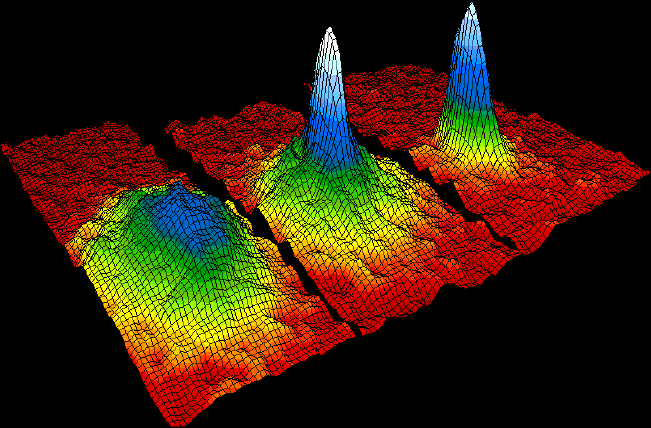
That temperature, the authors write, could stimulate a new generation of laser-trap experiments in quantum simulation and precision measurement in space. The uncertainty they give on the 9.7 picokelvin figure is not symmetric: 3.2 picokelvin above and 2.7 picokelvin below. The paper lists its data set as publicly available on Zenodo.
The senior author is Xuzong Chen, also at Peking University. Co-authors are at the Shanghai Institute of Optics and Fine Mechanics and the Technology and Engineering Center for Space Utilization, both of the Chinese Academy of Sciences, and at Fudan University. The work was funded by the National Natural Science Foundation of China, the National Key Research and Development Program of China and the Space Application System of China Manned Space Program.
Sources
- SciencePeer-reviewed