Two Black Holes Feeding Above Their Limit Are Already the Right Size

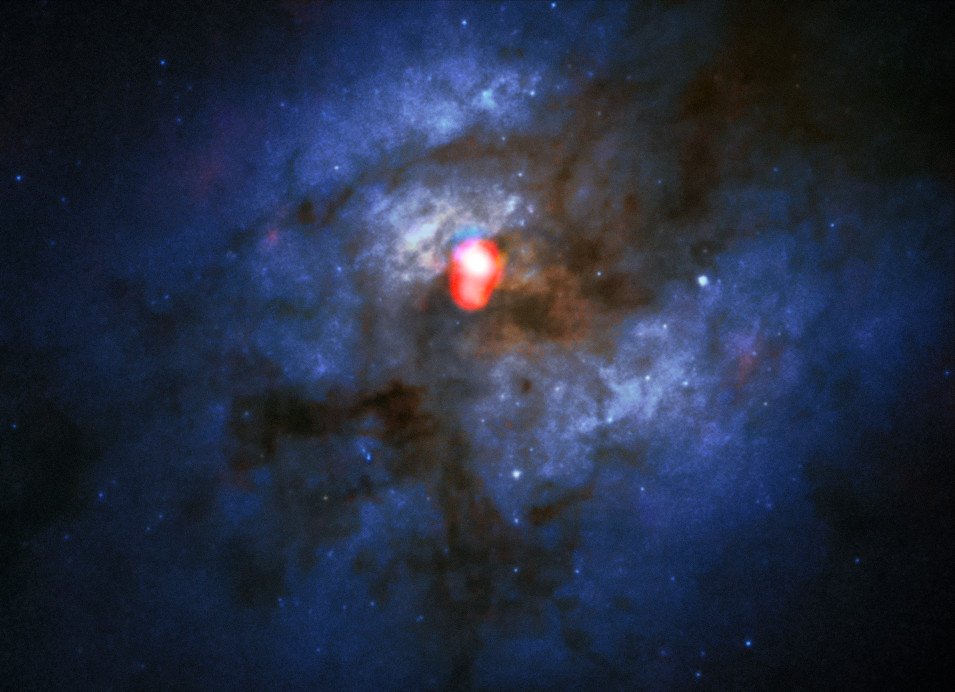
At a redshift of about 4.5, the sky gives an observer very little room to work in. The pair of supermassive black holes that Hyewon Suh and colleagues describe in Nature Astronomy, published Oct. 30, sits a projected 1.5 kiloparsecs apart in a galaxy seen as it was about 1.3 billion years after the Big Bang. On the sky, that gap covers about a quarter of an arcsecond, roughly two or three spatial resolution elements in the instrument used to distinguish the pair.
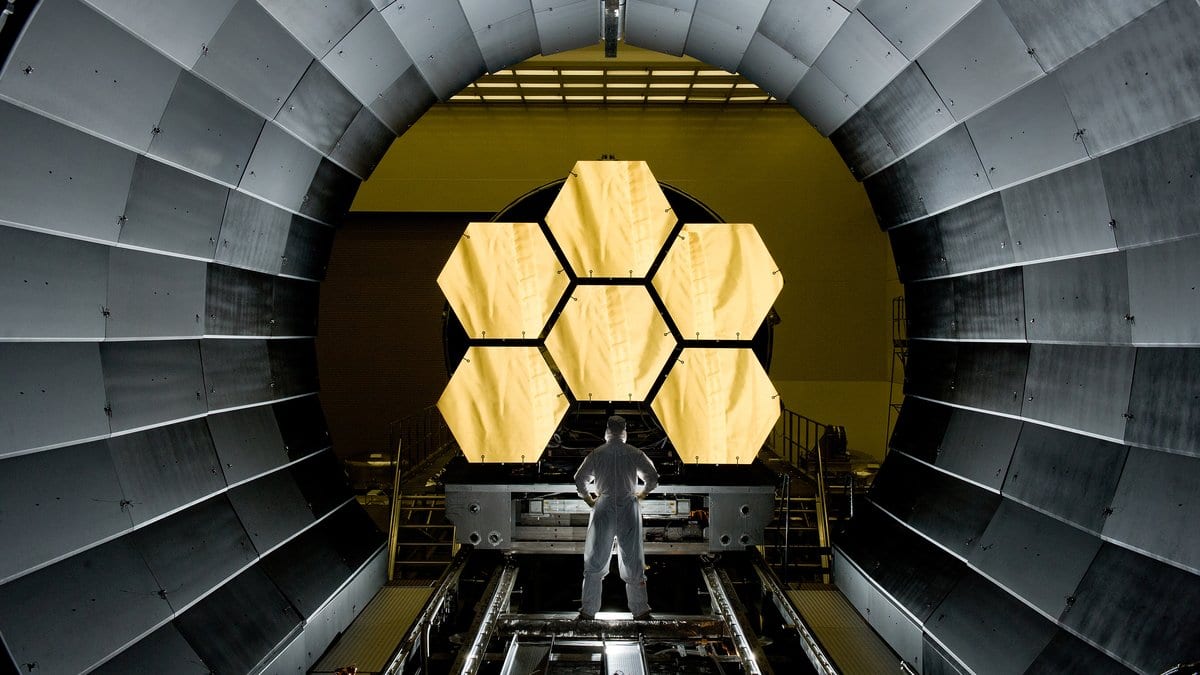
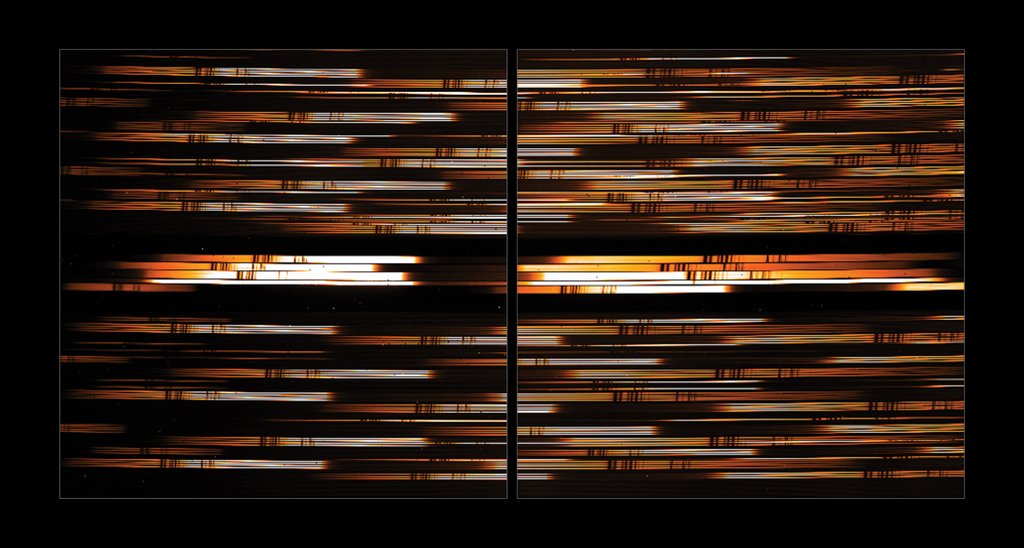
The instrument is NIRSpec on the James Webb Space Telescope, used in a mode that records a spectrum at every point across a small patch of sky. In the object cataloged as LID-1166, it picks out two clumps of narrow emission lines that are distinct both in position and in velocity, with a line-of-sight velocity offset of about −164 kilometers per second. Both clumps also carry broad Hα emission, the mark of gas moving at high speeds close to the black holes, and one of those broad components sits off the main nucleus, on the companion. That off-nucleus component is what the paper treats as evidence for two actively feeding black holes rather than one.
A second line of evidence comes from a different telescope. ALMA, the millimeter array in northern Chile, observed the same system in the 158-micron line of singly ionized carbon, which traces cold gas. The paper describes those observations as independent of the Webb spectroscopy, and they turn up cold-gas components that are separated in the same way and associated with the same two nuclei, which the authors read as a gas-rich merger in its late stages.
The companion does not simply stand out in the raw data. At that separation, the two nuclei sit inside the telescope's own blur, so the team built a model of that blur with WebbPSF and subtracted it; the companion shows up in what is left behind. This point-spread-function subtraction is a standard way to isolate faint sources beside brighter ones, and the detection rests on it.
The result the authors build their argument on is harder to picture. Both black holes are drawing in gas at super-Eddington rates, above the threshold at which radiation pressure from infalling matter can counteract gravity and impede further accretion. Such rapid accretion can allow black holes to gain mass quickly, but it does not by itself show whether they are outpacing their host galaxies. Here, the paper reports, the combined mass of the two black holes lies close to the relation between black hole mass and host-galaxy dynamical mass seen in nearby massive elliptical galaxies. The host's dynamical mass is estimated from gas kinematics rather than from starlight.
The authors put the ordering no more strongly than this: rapid, obscured growth "may help establish this relation early in cosmic history." Obscured is their word, and in this system the evidence comes partly from its X-ray spectrum: LID-1166 was cataloged as an X-ray source in the Chandra COSMOS Legacy Survey, and the paper fits its Chandra spectrum with a model of a thick torus of gas and dust surrounding the black hole.
Context makes that worth a pause. Some recent JWST studies at these redshifts have pointed the other way, toward black holes that look too big for the galaxies holding them, and the papers this team cites include several on that puzzle. Suh's own earlier result ran closer to the new one: a 2020 paper from that group reported no significant change out to redshift 2.5 in how black hole mass tracks a galaxy's stellar mass. One system does not settle a disagreement that size, and the new paper does not claim to.
Why the late stage matters is stated in the paper's first line: pairs at kiloparsec separations are a critical phase for black hole growth, for the joint history of black holes and galaxies, and for the low-frequency gravitational waves that such pairs could eventually produce. They are also hard to pin down. The paper says confirmed pairs closer than 3 kiloparsecs "remain rare, particularly in the merger-rich early Universe," and argues that this one "points to a missing population of heavily obscured, merger-driven dual AGNs at high redshift": pairs growing fast while buried deeply enough to be missed.
Both datasets are public: the Webb observations under General Observer program 1760 and the ALMA data under program 2024.1.01025.S. The corresponding archives are identified in the paper's data availability statement. The study concerns one system, observed by one team with three facilities. On the authors' reading, the growth came fast and the galaxy was already keeping pace.
Sources
- Nature AstronomyPeer-reviewed
- ALLATRA MEDIA