A Melon That Went With Dinner, Not Dessert, in Song Dynasty China

Melon seeds are a problem on an archaeologist's table. They turn up at Chinese sites, small and flat and stubbornly anonymous: melons, cucumbers and their wild relatives all belong to the genus Cucumis, and their seeds look so much alike that no one can reliably tell them apart by eye. So the one thing such a seed cannot tell you is which fruit it came from.
Two of them just have. Nathanael Walker-Hale of Durham University, Susanne S. Renner of Washington University in St. Louis, and colleagues report nuclear genomes from two Song dynasty melon seeds, 960 to 1279 CE, recovered from the site of Shuomen Gugang in China. Their paper appeared in the Proceedings of the National Academy of Sciences on Sept. 4. The seeds were sequenced at different levels of detail: each position in the genome was read about five and a half times over in the better one, and about twice in the other.
Both seeds land inside cultivated Cucumis melo from China. The nuclear genome says so, and so does the much smaller genome carried inside the plant's chloroplasts. More precisely, they sit within the "agrestis" gene pool, the East Asian branch of cultivated melon. What those two seeds came from was a crop, not a wild relative growing nearby.
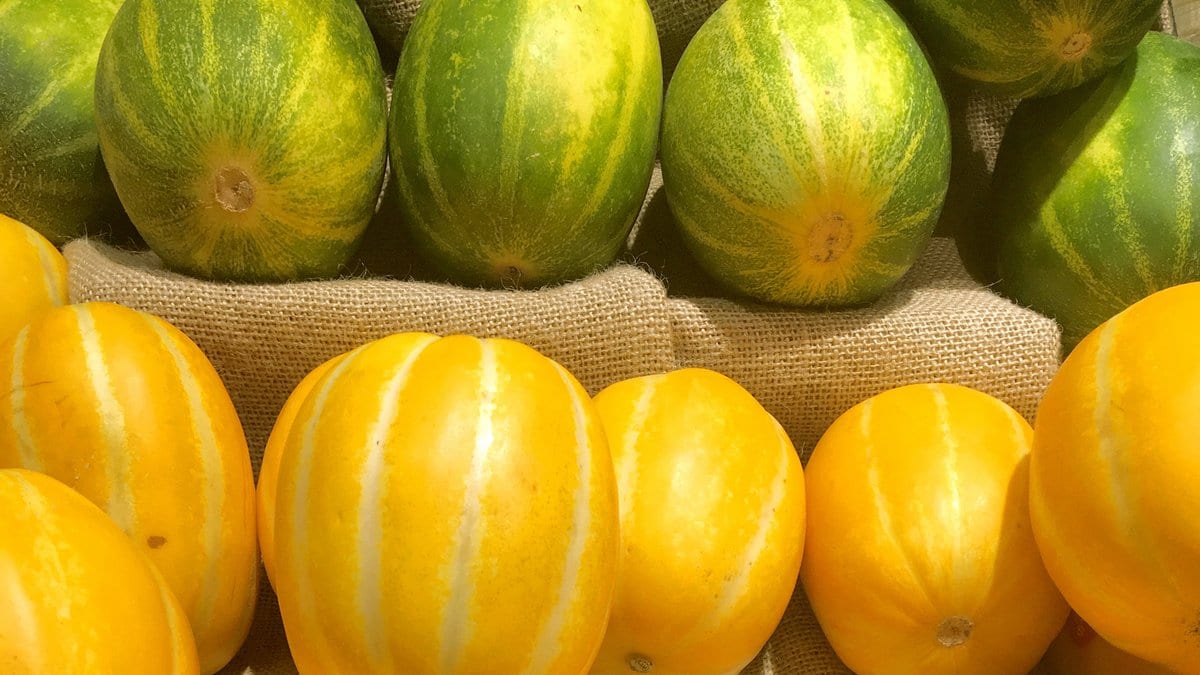
With a genome in hand, the team could go to the particular genes that set a melon's color, acidity and shape and ask which versions these two plants carried. Neither seed had the versions that turn flesh orange. One carried a version linked to yellow or orange peel; the other, versions associated with green flesh and reduced acidity. Together, the authors write, that indicates melons eaten as "fresh or culinary fruits" rather than as sweet dessert melons.
One seed carried something else. Wild melons keep their male and female flowers separate on the same plant. One of the two had the newer version of a gene that gives a plant flowers carrying both sexes at once, called andromonoecy in the botanical shorthand. In modern melons that version travels with rounder fruit, so its presence in a thousand-year-old seed suggests growers were already selecting for shape, and not only for what was inside.
That matters because the early history of the crop is unsettled. Melon is thought to have been domesticated independently once in Northeast Africa and twice in India, and archaeological seeds from China have hinted at an additional event there. Those seeds are the ones nobody can identify by eye, which is why the question has been hard to settle from the seeds themselves. Ancient genomes have been read from Chinese archaeological sites before, mostly from the people who lived at them.
What the two melon genomes add is an anchor point: a dated place where Chinese archaeological seeds can be tied to the genetic variation of melons alive today. The authors describe that as a temporal framework for melon cultivation in China. They do not claim to have found where the crop was first brought under cultivation in Asia, and two seeds from one site could not carry the answer anyway.
The authors can't resist adding one charming detail. Song potters worked in celadon, the jade-green glazed ware, and often shaped it like a melon. The green flesh the seeds point to, the authors write, "resonates with Song-period aesthetic sensibilities, exemplified by jade-green celadon ceramics frequently crafted in melon-shaped forms."
The data are freely available to other researchers. Two seeds are a start. What would move the question further is more of them, from more sites and earlier centuries, read the same way.
Sources
- Proceedings of the National Academy of SciencesPeer-reviewed