Biology Had Never Tied a Protein Knot This Complex

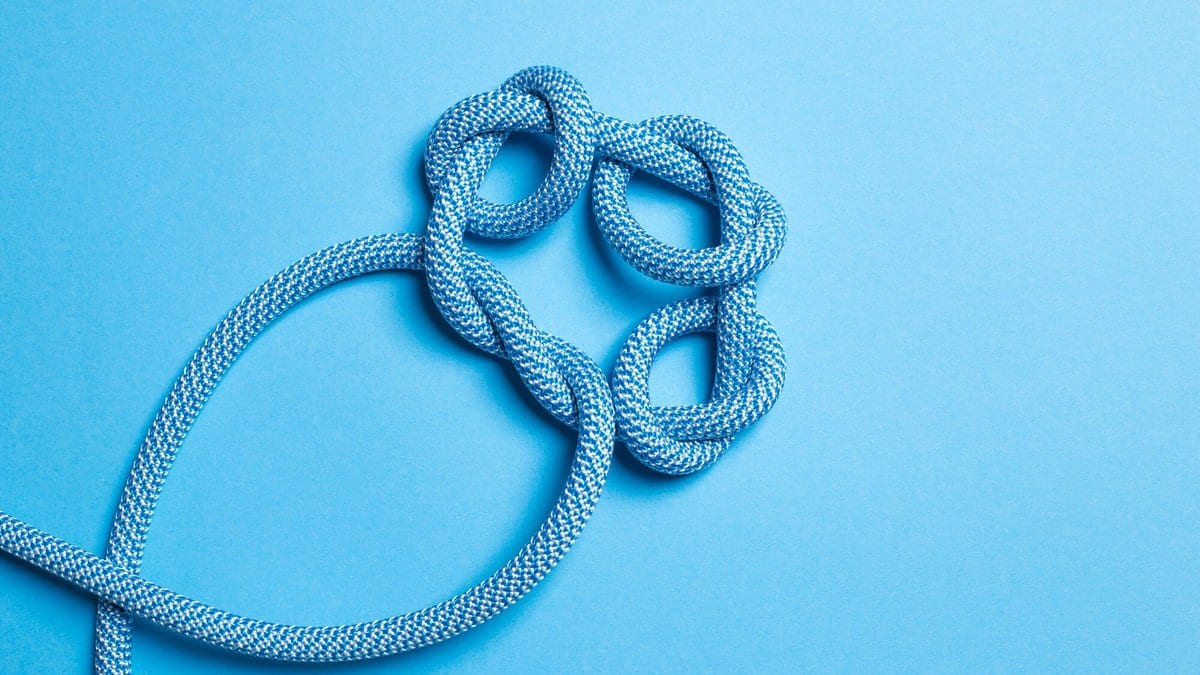
Mathematicians sort knots by how many times the string crosses itself. Three crossings give you the overhand knot anybody can tie in a shoelace. Past that, the catalog runs on for pages, and almost none of it has ever turned up in living matter. A protein chain is a string, and a few proteins are genuinely knotted, but biology had never produced one past seven crossings.
It has now produced eight. In a paper published Oct. 19, 2026, in the Proceedings of the National Academy of Sciences, Mariusz Mozajew, Joanna I. Sulkowska and colleagues at the Centre of New Technologies of the University of Warsaw, with Sophie E. Jackson at the University of Cambridge, report three crystal structures of a bacterial protein tied in a knot with eight crossings, the type mathematicians label 8₃. They call it the most complex knotted protein found to date, and the fold it makes was unfamiliar enough that they gave it a name: the EIGHT fold, short for Extraordinarily Intricate Globular Helical Tangled fold.
The record they take over is recent, and it was set in a laboratory, not in a computer. For years the deepest knot anyone had solved in a real protein was a 6₁, six crossings, in a bacterial enzyme called DehI. A seven-crossing knot was first predicted in another bacterial protein by AlphaFold, the structure-prediction program, in 2022. Min-Feng Hsu, Shang-Te Danny Hsu and colleagues then determined it for real, by X-ray crystallography and nuclear magnetic resonance, in the Journal of Biological Chemistry in January 2024. Their own paper called it the most complex knotted protein known at the time. Both of those papers sit in the reference list of the new one. Seven crossings had been reached. Eight had not.
What lifts the knot above a curiosity is where it is found. The authors report the 8₃ knot in only one group of bacteria, which the paper does not name, and inside that group it is strictly conserved: proteins whose sequences overlap by as little as 10% still carry the same knot. Which raises the question they take up next, of where a shape that intricate could have come from.
The structure is unusually symmetrical, with two halves that mirror each other in shape. One possibility the authors raise, and they put it no more strongly than that, is that the EIGHT fold began as a single unknotted half that duplicated and formed one complex protein.
Three of these proteins were then taken apart in the laboratory. Mozajew and colleagues estimated how much heat and how much chemical stress each one could take, and report that at equilibrium the proteins unfold in a single step, folded or unfolded with nothing stable in between. Three proteins are a small set, and the stability figures are estimates rather than fixed values. Refolding is the part that surprises: the chain comes back not to its original structure but to a compact state that is not the native one.
Watching the unfolding as it happens gives a messier picture. With stopped-flow fluorescence and circular dichroism, two ways of following a protein's shape as it changes, the team resolved six separate phases in the unfolding, spanning milliseconds to days. Parts of the chain come loose almost at once. Other rearrangements are still working themselves out a day later.
Which leaves the question any knotted protein raises. A protein has no hands. It has to arrive at the knot by itself, in a crowded cell, by threading its own chain through its own loops. In a structure-based simulation, not an experiment, the authors showed that an 8₃-knotted chain can reach its knot by passing through a simpler one along the way, a 6₁. It can also untie itself, through a further intermediate such as a 4₁. Nobody has watched one do it.
The authors' own conclusion is careful: proteins like these do not seem to fit the folding theories available today, they write, and a new approach will be needed. The three structures are deposited in the worldwide Protein Data Bank, as 9rh0, 9tmh and 32uy. All three are on hold until release, so for now the eight-crossing knot rests on the authors' own account of it. Once they are released, anyone can count the crossings for themselves.