Earth's Core May Run 1,000 °C Cooler Than the Textbooks Say: A Conference Claim That Could Fix an Old Paradox

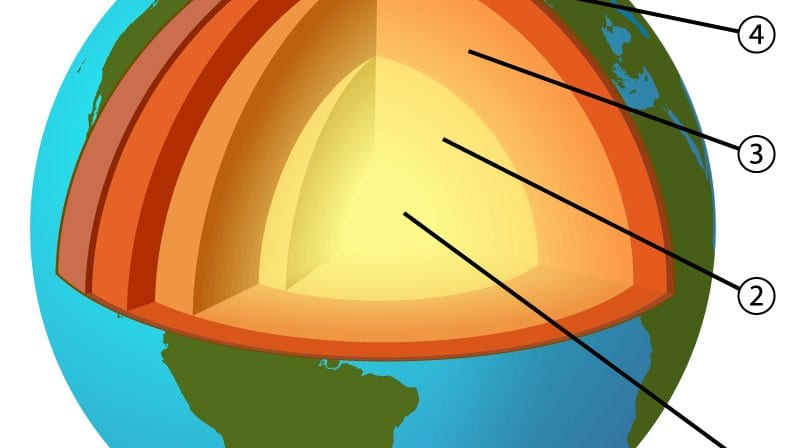
Nobody has ever put a thermometer 5,000 kilometers down. The temperature at Earth's center is inferred, not measured, and one of the load-bearing numbers behind that inference is the melting point of iron at the pressure of the inner core boundary: the depth where the liquid outer core meets the solid inner one. Pin down when pure iron turns from liquid to solid under that pressure, and you can anchor the whole temperature profile of the deep Earth. Get it wrong, and everything built on top of it shifts.
That number, according to work presented on 17 July at the Goldschmidt Conference, may have been running too hot. Using a new technique to gauge iron's melting point under extreme pressure, the researchers put the melt somewhere between 4,420 and 5,220 kelvins at the inner core boundary, more than 1,000 °C below previous estimates. Correcting for the lighter elements known to be mixed into the real core pulls the working temperature down further, to a central figure near 4,284 kelvins.
Before going further, the honest framing. This result comes from a conference presentation, not a peer-reviewed journal article: there is no published paper to read and check, and the measurement has not yet run the gauntlet of independent review that turns a striking claim into an accepted one. The work was presented by M. Walter of the Carnegie Institution, and for now it stands as one unconfirmed result. That is not a knock on the science; it is where the science currently sits. Treat everything below as a promising lead awaiting the paper.
With that stated, the reason the claim is interesting is a decades-old headache called the "new core paradox." Earth's magnetic field is generated by a geodynamo: churning, electrically conductive liquid iron in the outer core, stirred largely by heat escaping toward the mantle. The trouble is that theoretical estimates of how well iron conducts heat down there came out high, around 150 watts per meter per kelvin. If the core sheds heat that efficiently by simple conduction, there is little energy left over to drive the convection the dynamo needs. Worse, the field is known from ancient rocks to have been running for billions of years, long before the inner core started freezing solid, an event thought to have happened only a bit over half a billion years ago. So what powered the dynamo for all those earlier eons?
A cooler core helps the numbers work. If the center is 1,000 °C less scorching than assumed, the researchers argue, the slow cooling of the core alone could have supplied enough energy to run the magnetic dynamo through most of Earth's history, carrying it right up to the moment the inner core began to crystallize and lend a hand. The paradox eases not because anyone found a new energy source, but because the old accounting was starting from a temperature that was too high.
The paradox-solving part is a modeling interpretation layered on top of the melting-point measurement, a story about thermal evolution that depends on assumptions, not a direct observation of the ancient dynamo. Even if the cooler melting point survives peer review, whether it fully resolves the paradox is a separate question that other groups will want to test with their own models.
Still, the appeal of the picture is that a single revised number would tidy up several loose ends at once: the core's temperature, the energy budget of the dynamo, and the long puzzle of a magnetic field that seems to predate its own most obvious power source. Whether the tidy picture survives contact with the published paper and independent replication is exactly what the coming months should reveal. Until then, it is a conference claim worth watching, not a rewrite of the textbook.