Anthropic Says Claude Found Leaner Designs for Quantum Computing's Building Blocks
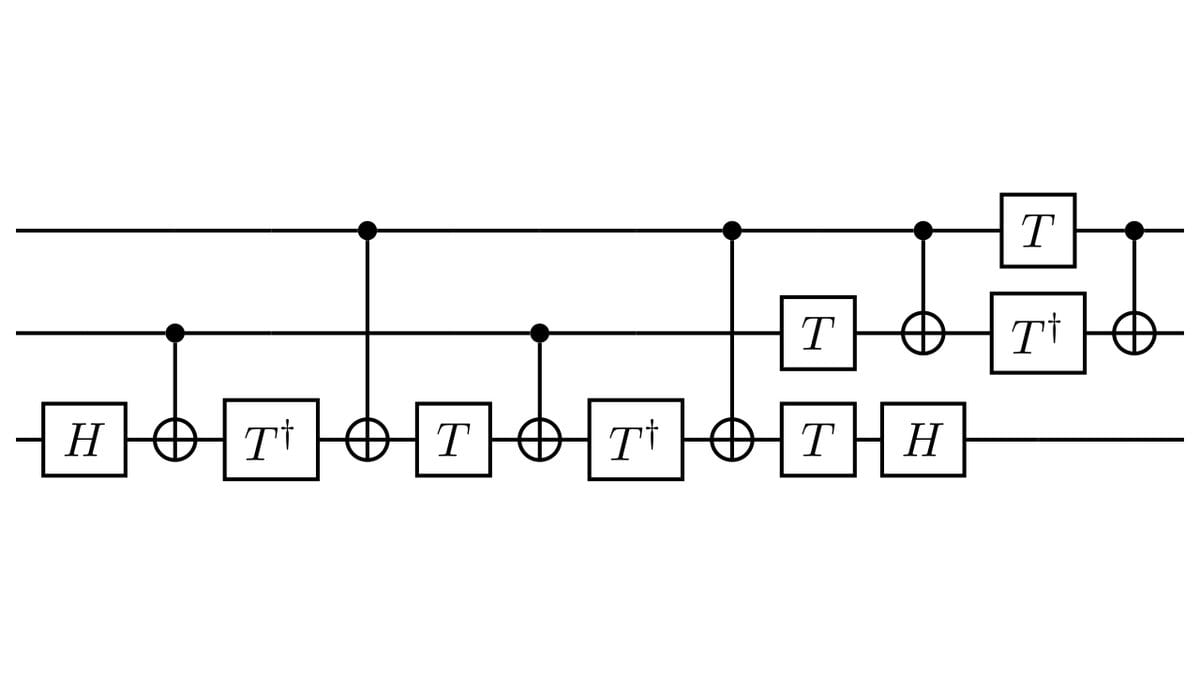
Anthropic reported Oct. 16, 2026, that its Claude model produced, for eight basic building blocks of quantum algorithms, circuits that use fewer qubits and fewer gates than the best published designs. The model worked inside a loop with a program that checked and scored each attempt. The work is a preprint, not yet peer reviewed, with co-authors at Harvard University, and the resource comparisons are the team's own, measured against published designs rather than against quantum hardware.
Anthropic frames the problem as scarcity: the machines built so far hold too few qubits to run most useful quantum algorithms, so researchers have been rewriting the algorithms to need less hardware instead of waiting for bigger machines.
Anthropic's write-up describes the method as a closed loop. Claude wrote each candidate circuit as ordinary Python code and passed it to an evaluator program separate from the model, which checked whether the circuit was correct and scored it on the number of qubits multiplied by the number of gates, a stand-in for how long it would run. The score went back to the model, which tried again. Anthropic says that nobody intervened between rounds and that human input was limited to the opening brief and occasional prompts to search more broadly. The model was Claude Mythos 5.
The preprint reports that in seven of the eight tasks the new circuits cut both gate counts and qubit counts against the state of the art. The eighth is a trade-off rather than a clean win. For point addition, a rule for combining two points on a mathematical curve and the costliest step in some quantum algorithms, one new design uses 12% more qubits but 17 times fewer gates than the smallest previous design. Anthropic says that design came out of a single 53-hour run.
Anthropic also reports that the gate count for an error-correcting decoder inside one leading quantum optimization method fell by a factor of 12 against Google's previous construction. These are counts of operations, not measured runtimes.
Andi Gu of Anthropic's STEM Fellows Program led the work, mentored by Alek Kemeny, a quantum physicist at the company. The Harvard physicists Susanne Yelin and Mikhail Lukin are the other co-authors, and Lukin also works at QuEra Computing. One decoding rule the model derived was also written out as a formal proof in Lean, a language whose proofs a computer can check.
Sources
- www.anthropic.com
- arXivPreprint