Two Labs Disagree About Where Water's Simplest Ice Ends

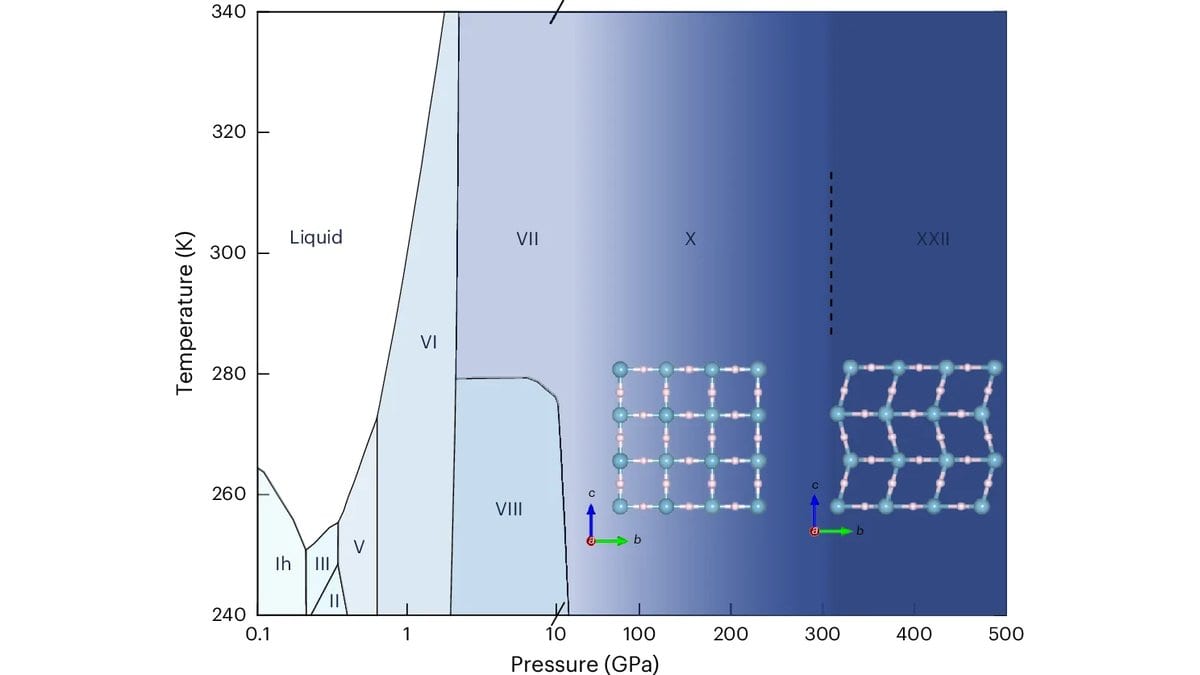
Water is the compound physicists are most confident they understand, and the one that keeps finding ways to misbehave. Compress ordinary ice far enough and the molecules stop being molecules: each hydrogen atom gives up its allegiance to one oxygen and settles midway between two, leaving a plain cube of oxygen atoms with hydrogen locked symmetrically in between. That is ice X, and for decades it looked like the end of the road, the simplest and densest arrangement water could be forced into.
Ashkan Salamat and colleagues at UNLV, the University of California, Berkeley, and Argonne National Laboratory report experimental evidence that the cube comes apart. Their paper was published Oct. 15, 2026, in Communications Chemistry. Squeezed past 222(12) gigapascals, roughly 2.2 million times the air pressure at sea level, the ice in their diamond anvil cell loses its cubic symmetry. The team pressed samples between two diamond tips and read the atomic arrangement with synchrotron X-ray diffraction at Argonne's Advanced Photon Source, watching the sharp pattern of a cube split into something lower.
"Water beyond Earth-like conditions has more complex behavior than we ever previously imagined," said Salamat, who directs UNLV's Nevada Extreme Conditions Lab, in the university's announcement of the work. "It's amazing how water can behave under pressure."
What the Las Vegas measurement is not is the first sighting of ice past ice X. Five weeks earlier, an independent group had reported the same symmetry-breaking and put it somewhere else. Israel Osmond and colleagues at the University of Edinburgh's Centre for Science at Extreme Conditions published their result in Nature Materials on Sept. 7, 2026. Their runs at the PETRA III synchrotron in Hamburg and the European Synchrotron in Grenoble read the lattice as distorting gradually above about 160 gigapascals, then breaking cleanly at 308(5) gigapascals into a phase with a stretched, box-shaped cell that they call ice XXII.
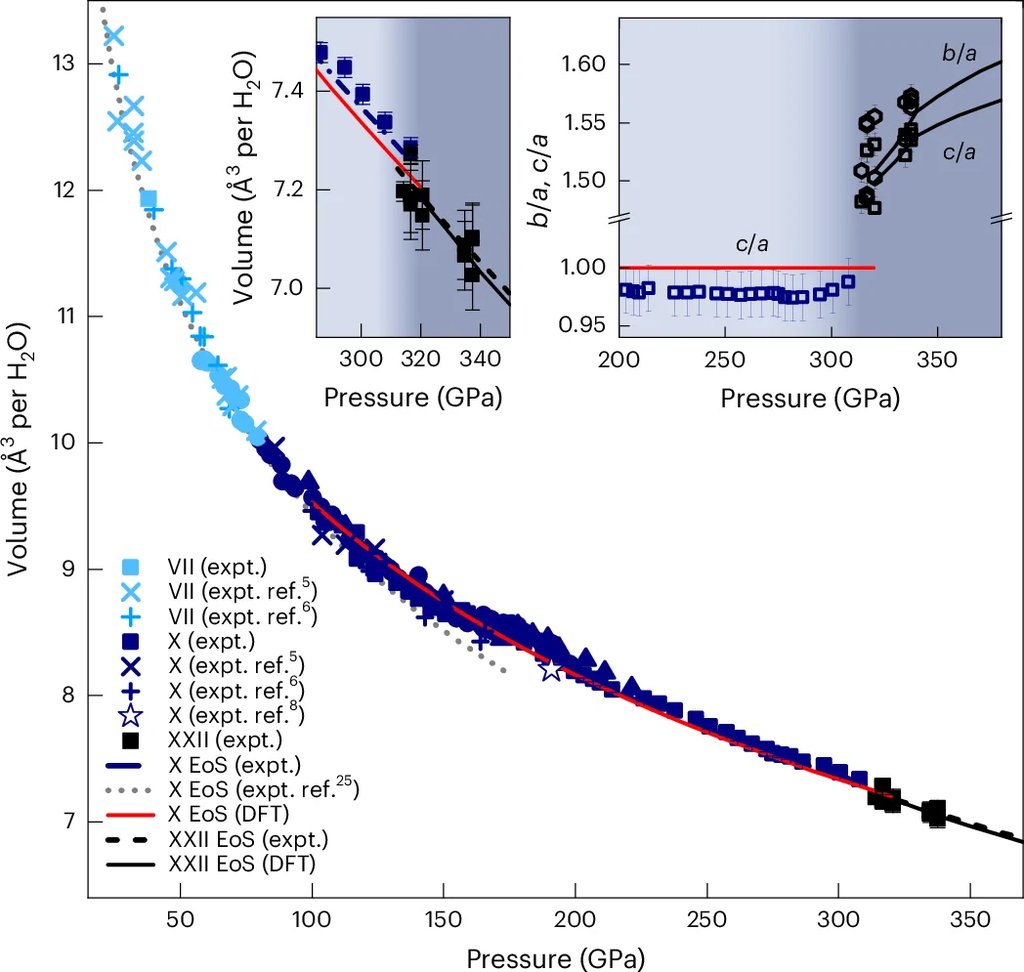
That leaves two sets of diamond cells and two numbers 86 gigapascals apart for the same boundary, with both papers describing themselves as redrawing the upper limit of ice X. Neither offers a way to square them. One reading, which is nobody's published conclusion, is that the two groups may be watching the same physics and disagreeing about where to draw a line through it: 222(12) gigapascals falls inside the stretch the Edinburgh team reads as ice X continuously distorting rather than ending. On the thing that matters most the two experiments agree, which is that the cube does come apart under enough pressure. What they disagree about is when to start calling it something else.
The Las Vegas result also stops short of a structure. The diffraction pattern, the authors write, reveals a distortion "consistent with either Pbcm or P4₂/nnm symmetry, the former being strongly favorable by ab initio calculations": two candidate arrangements of the same atoms, with the team's own first-principles modeling preferring one. That preference is softer than it reads, and the Edinburgh paper shows why. Run the same kind of calculation with different standard approximations for how electrons behave and the predicted transition pressure shifts by about as much as the gap between the two measurements.
Why press water this hard at all? Because that is the range inside the ice giants, where water is not a trace ingredient but much of the planet. That is the authors' motivation rather than their result. The pressures inside Uranus and Neptune can be reached in a diamond cell; the thousands of kelvin cannot, and temperature is what breaks the analogy. In the pressure band where the new phase appears, shock experiments find that water above about 2,000 kelvin takes a different, more closely packed form, ice XVIII, one of the superionic states that sit between solid and liquid.
Salamat is open about the laboratory being a stand-in for a place nobody can go. "We can't enter the crust or atmospheres of these planets because of distance, but we have data from things like the Voyager program," he said in the release. "We have an idea of their compositions, and interior pressure and temperatures. And in labs like mine, we can mimic the chemistry and experiment with what could be occurring inside these planets."
The Salamat paper's own closing claim is cautious in wording and large in reach: the transition "marks the onset of a new regime of structural complexity in high-pressure H₂O, redefining the upper stability limit of ice-X." The Edinburgh paper claims the same redefinition at a higher pressure, and calls its new phase the densest form of water yet observed. The work has cleared peer review, and is being served in its accepted version, which the publisher says may still be edited before the final version of record.
"When we eventually get to these worlds, what are we going to see?" Salamat said. "We're really the initial pioneers in trying to answer these questions in the laboratory." Two laboratories have now put a number on where ice X ends, and the two numbers are not the same.
Sources
- Communications ChemistryPeer-reviewed
- www.nature.com
- www.unlv.edu