Magnetism Looks Like the Glue That Pairs Electrons in One Superconductor Family
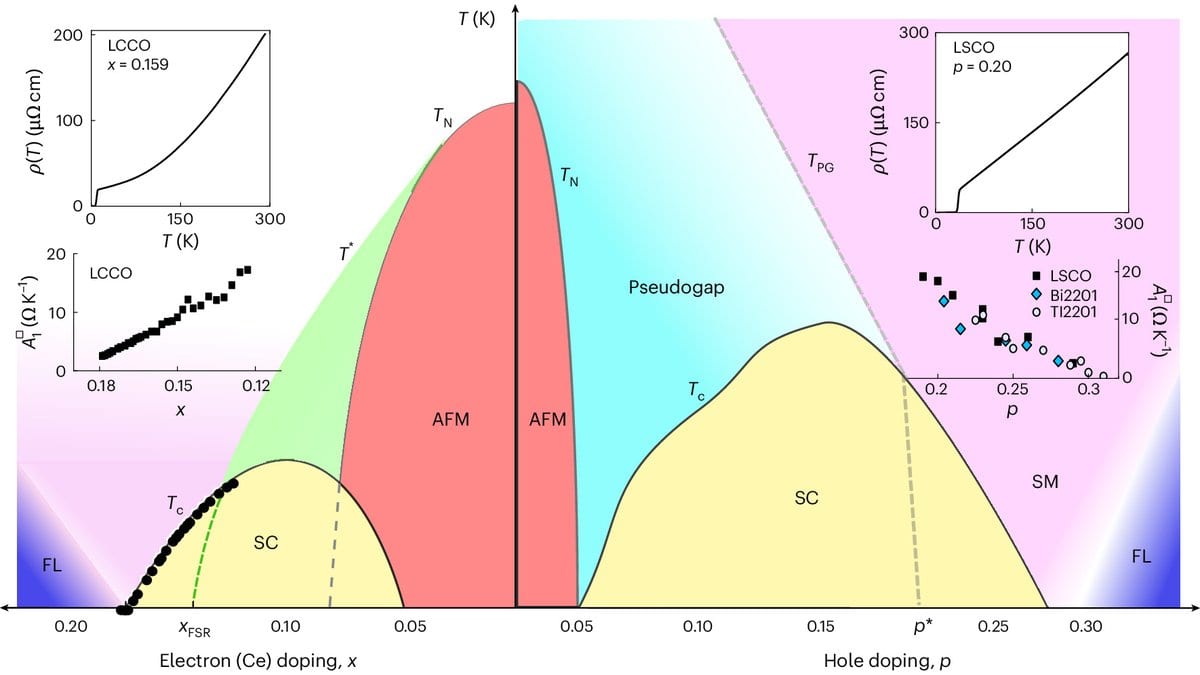
Nature Physics published a measurement on Oct. 19, 2026, linking how hard electrons are scattered inside one family of copper oxide superconductors to the temperature at which they begin carrying current with no resistance. C. M. Duffy of Radboud University in Nijmegen, N. E. Hussey of Radboud and the University of Bristol, and their colleagues report that the link points to magnetic fluctuations as what binds electrons into the pairs superconductivity runs on.
Superconductivity needs electrons to pair up, and in ordinary superconductors the glue is a vibration of the atomic lattice. The Nature Physics paper notes that the transition temperature there is tied to the strength of that coupling, which also shows up as scattering while the material is still an ordinary metal. The authors write that no equivalent relationship between the critical temperature and the coupling had been identified in the copper oxides, which superconduct at far higher temperatures.
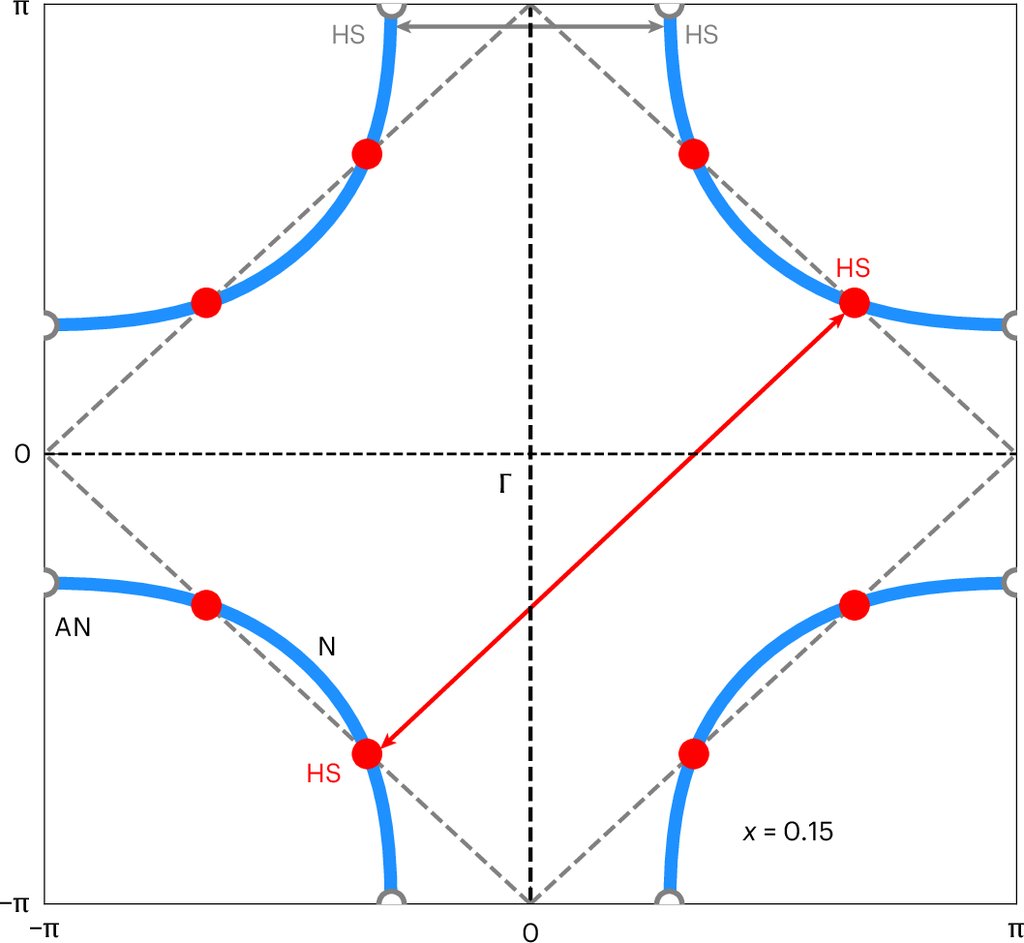
The team worked with thin films of a cerium-doped lanthanum copper oxide, grown so that the cerium content varies continuously across one substrate. That gave 19 closely spaced compositions, from just above the one with the highest transition temperature out to the edge of the range where the material superconducts. The authors measured electrical resistance across the series, and how that resistance changes in a magnetic field, in a 35-tesla magnet at the High Field Magnet Laboratory in Nijmegen. They report that the part of the scattering which grows with temperature depends strongly on which way an electron travels, and that it falls off markedly as more cerium is added, in step with the critical temperature.
That conclusion is held to the electron-doped copper oxides, where the doping adds electrons rather than removing them, and the paper's own title claims evidence rather than proof. Hole-doped copper oxides, the family reaching the highest transition temperatures, behave differently under the same field measurements. The authors say their higher critical temperature cannot be attributed solely to stronger coupling to the magnetic fluctuations, and that resolving high-temperature superconductivity there may require more than a simple extension of the Bardeen-Cooper-Schrieffer theory.
The paper is open access, and the authors say the measurements and the analysis code are posted in a Radboud University repository. Co-authors are at the Institute of Physics of the Chinese Academy of Sciences, Songshan Lake Materials Laboratory and the University of Maryland.
Sources
- Nature PhysicsPeer-reviewed