A Third of the Weather on the Coldest Known Brown Dwarf Is Unexplained

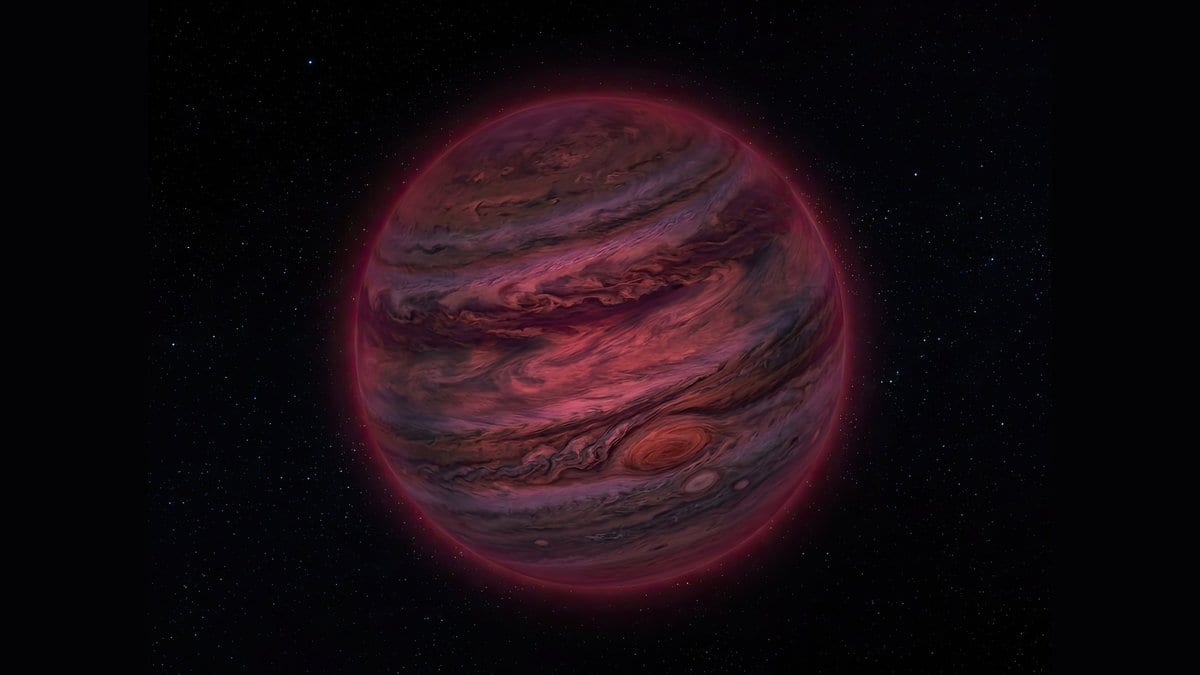
Watching the weather on a brown dwarf means staring at a single point of light and waiting for it to change. In December 2023 the James Webb Space Telescope stared at one of the Sun's closest neighbors for eleven hours: WISE 0855, the coldest known brown dwarf, a Jupiter-sized failed star about 7.4 light-years away whose atmosphere sits near 265 K, colder than Earth's average surface temperature. The light changed. Carbon monoxide absorption rose and fell by as much as 10% peak to peak at some wavelengths, and phosphine varied with it.
Brittany E. Miles of Steward Observatory at the University of Arizona and colleagues posted their analysis on Sept. 17; it has been accepted for publication but has not yet appeared in a journal issue. Those eleven hours produced the first time-series spectra of this object taken with Webb's Near Infrared Spectrograph in bright-object mode, at one grating setting. The main interpretation is that patchy water clouds vary higher in the atmosphere while the gas variations originate much deeper down. Both parts of that interpretation are carefully qualified, and the rest of the paper examines what the models do not explain.
The wording matters. The authors write that they present evidence of patchy water clouds, not that they have directly observed them. The clouds are inferred by comparing the spectra with atmospheric and structural models for an object no telescope can resolve into a disk. Whether WISE 0855 has water clouds has been debated since Jacqueline K. Faherty and colleagues reported indications of them in 2014. A 2016 study of its spectral energy distribution further characterized the object, which remains the coldest brown dwarf. The model grids astronomers use on these atmospheres still have difficulty reproducing observations of the coldest objects.
To identify patterns in the changing spectra, the team used principal component analysis, a method for extracting recurring patterns from a time series. One component dominates and resembles a change in apparent temperature or cloud cover. A second, much weaker component affects the wavelengths where carbon monoxide and phosphine absorb, indicating that the two gases vary together. The two components account for 65.3% of the variability, leaving 34.7% unexplained. The authors describe the remaining variability as evidence of complex behavior in the time series, while noting that weaker components are consistent with measurement scatter.
One atmosphere, three stirring rates
The sharper gap is in the chemistry. Carbon monoxide, carbon dioxide and phosphine all show up in greater amounts than balanced chemistry allows at the levels Webb sees. That is the familiar signature of convection hauling warm gas up from deeper layers faster than the chemistry can re-adjust, and it is true of nearly every brown dwarf this cold. Each of the three molecules therefore carries a depth with it: its quench point, the level where its chemistry stops keeping up. Miles and colleagues put all three between 23.5 and 70.7 bars, less than one scale height apart, which makes them effectively the same layer of air.
In a one-dimensional atmosphere with a constant vertical mixing rate, three molecules quenching within the same pressure scale height should imply similar mixing rates. They do not. Carbon monoxide implies an eddy diffusion coefficient of about a million square centimeters per second. Carbon dioxide, whose quench point depends on the local carbon monoxide abundance, implies a coefficient of at least a hundred million. Phosphine implies a coefficient of about ten, indicating very weak mixing. The authors conclude that the three molecules do not yield consistent mixing rates and that the inferred mixing strength does not increase with quench pressure.
The authors suggest two possible explanations, neither of which they test here. The phosphine estimate may be unreliable because the main reaction or chemical sink that removes phosphorus-bearing molecules in such an atmosphere is uncertain, leaving the chemical timescale used to estimate its quench point poorly constrained. The carbon dioxide estimate may change if the atmosphere's metallicity differs from the assumed solar abundance, because metallicity affects the relative abundances of carbon dioxide and carbon monoxide.
Only two clouds could do it
The cloud question requires a similar distinction. For patchy clouds to modulate both carbon monoxide and phosphine, a cloud layer would have to extend to the depths where both gases are affected. The condensates considered at those depths, zinc sulfide, potassium chloride and sodium sulfide, could reach the carbon monoxide quench level but not the phosphine quench level. Only two candidates in the models could span both: water and ammonium dihydrogen phosphate, a phosphorus-bearing salt. Yet the authors suggest that the gas variations may not be caused by clouds at all. Because phosphine and carbon monoxide vary together, they attribute the changes to temperature variations deep in the convecting atmosphere, at or below the carbon monoxide quench level. In this interpretation, temperature changes rather than variations in vertical transport drive the observed gas signals.
The two model families the team tested also differ in their treatment of clouds. In one, the cloud thickness remains constant over the eleven hours, and allowing it to vary does not improve the fit. In the other, changes in cloud thickness and apparent temperature are needed to reproduce both the broad spectral variations and the muted water bands. The models also place the water clouds at different depths, and none of the tested grids fully reproduces the observed spectrum. The authors use the comparison to assess how well current models explain the data and conclude that the models need to be adapted to this object.
The measurement that would turn this into a map
The rotation period of WISE 0855 remains uncertain. Periods of a few hours are consistent with the eleven-hour Webb observing window, but longer periods cannot be ruled out. Across this observation and two earlier Spitzer observing runs, the object has not shown a consistent rotation period. Its inclination to our line of sight is also unknown. The paper's picture of its atmospheric circulation, with zonal jets at low and middle latitudes rather than long-lived vortices, is therefore a schematic based on theory and observations of Jupiter, not a map of WISE 0855 itself.
A longer observing baseline could help constrain the rotation period. A composition that differs from solar abundances might reconcile the mixing-rate estimates inferred from carbon monoxide and carbon dioxide. The phosphorus chemistry also needs further study before the phosphine-based mixing estimate can be interpreted confidently. For now, the results support evidence of patchy water clouds, possible temperature variations at depth and a substantial fraction of the observed variability that the two dominant patterns do not explain.