The Only Hot Jupiter Known to Be Locked in Step With a Neighbor

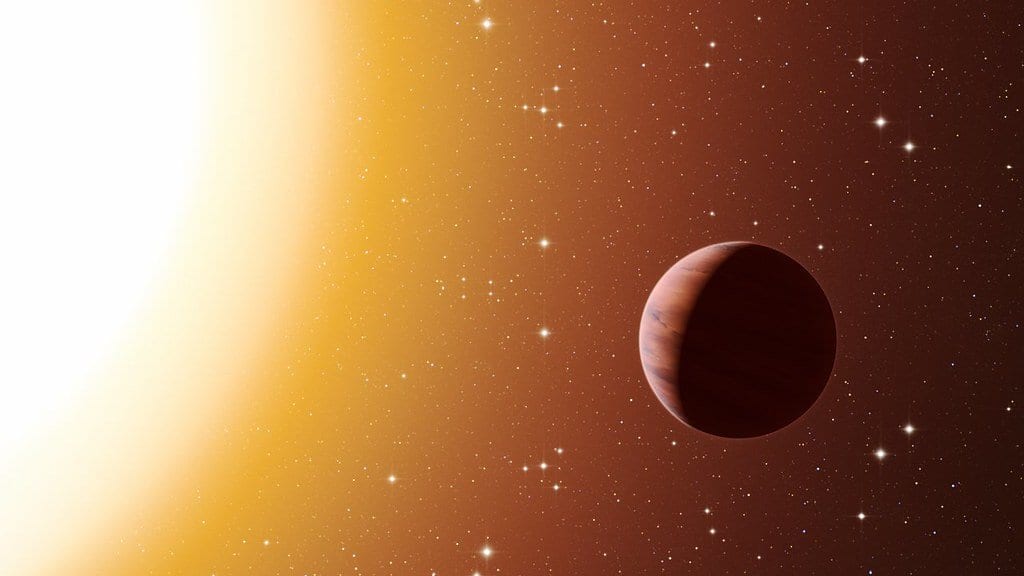
A hot Jupiter is not supposed to have neighbors. These are giant planets that circle their stars in a few days, and most known hot Jupiters have no nearby planetary companions, which astronomers see as a clue to how they reached their close-in orbits. One proposed route, high-eccentricity migration, can disrupt or eject smaller planets along the way. So when one of them starts crossing the face of its star off schedule, the timing itself becomes evidence. Something nearby is pulling on it.
That is roughly what happened at TOI-3686, a star a little more massive than the Sun. Its giant planet, on a 5.078-day orbit, shows transit-timing variations of 40 minutes from peak to peak. A subsequent search of NASA's TESS data revealed the transits of a second, much smaller planet. A team led by Samuel W. Yee of the University of California, Los Angeles, reported both planets in a preprint posted Oct. 20, submitted to The Astronomical Journal and not yet peer reviewed.
For scale, the authors note that transit-timing variations measured in hot Jupiters with known close companions have ranged from seconds to about 10 minutes. The 40-minute variation in TOI-3686 c is, in their words, "amongst the largest ever observed for a hot Jupiter". The inner planet, TOI-3686 b, shows even larger variations. It is a sub-Neptune on a 2.54-day orbit, with a mass about 10 times Earth's, and its transit times vary by as much as 10 hours peak to peak, about 16% of its orbital period. The authors report that this is the third-largest transit-timing variation relative to orbital period measured for any planet, after TOI-1408 c and TOI-4504 d.

Close to a rhythm is not the same as caught in it
The distinction is the whole finding. Planet pairs whose orbital periods happen to lie near a simple ratio are common; pairs actually held in resonance by their mutual gravity are not. At TOI-3686, the orbital periods are close to a 2:1 ratio, but that alone does not establish a resonance. The key evidence is that the resonant angle oscillates around a preferred value rather than circulating through all angles. This libration is a defining feature of the resonant configuration and helps explain the observed transit-timing variations.
To test whether that is a real lock rather than a coincidence, Yee and colleagues reduced the system to a standard one-dimensional model of resonance dynamics. The model yields a dimensionless parameter that depends on the orbital periods, planetary masses and eccentricities. Below a threshold of about 0.945, the model has no separatrix dividing resonant from nonresonant motion. TOI-3686 has a value of 3.64, which the paper describes as "deep in resonance". The orbital solution comes from a joint fit to TESS and ground-based light curves, along with radial-velocity measurements from NEID and MAROON-X.
That threshold also explains how the authors qualify their novelty claim. In July 2023, Korth and colleagues reported in Astronomy & Astrophysics that TOI-1130 was "the first known system with a hot Jupiter and an inner lower mass planet locked in a mean-motion resonance". In September 2024, Borsato and colleagues re-examined the system using observations from the CHEOPS space telescope and found that the planets "lie just outside the resonant region", possibly because of past tidal evolution. Yee and colleagues adopt that classification: TOI-1130 and TOI-1408 both fall below the 0.945 threshold and are, in their words, "formally outside the resonant regime". They therefore stop short of claiming that TOI-3686 is the first such system ever found. Instead, they describe it as the only hot Jupiter system currently known to be in a truly resonant state. That claim depends in part on the adopted dynamical classification of previously studied systems.
Built quietly, and already coming loose
How does a giant planet end up locked to a much smaller one this close to a star? The authors favor a dynamically quieter route. Two planets migrating through their protoplanetary disk can move into a resonant configuration as their orbital periods converge. They call this "one plausible formation history" rather than a settled explanation. The alternative, high-eccentricity migration, involves a giant planet being driven onto an elongated orbit before tides circularize it. Such a disruptive path would likely have destroyed or ejected an inner planet.
A resonance this deep is not expected to last indefinitely. Tidal dissipation within the inner planet should gradually damp its eccentricity and push the pair out of resonance. A system still in resonance may therefore be young. The evidence for youth here is limited, as the authors acknowledge.
The star rotates faster than a typical field star. Because stellar rotation generally slows with age, this yields a gyrochronological age of about 730 million years, with an uncertainty extending beyond a billion years. This method can be unreliable for stars hosting hot Jupiters, which can spin up their host stars through tidal interactions. The authors argue that this effect is likely limited here because the giant planet has about half Jupiter's mass and a relatively long orbital period of 5.078 days. Lithium in the stellar atmosphere, which is gradually depleted as stars age, gives an estimated age of about 1.3 billion years, although the authors describe this estimate as weakly constraining. Stellar evolution models provide "only a wide constraint". The authors' conclusion is cautious: several indicators suggest that the system may be younger than about a billion years. That is an inference, not a direct measurement.
The formation scenario comes with a constraint that the authors acknowledge. For the inner planet to retain its moderate eccentricity and remain in resonance over the inferred age of the system, it must dissipate tidal energy less efficiently than sub-Neptunes are often assumed to do; they point to another system where a similarly high value has been proposed. If it holds, TOI-3686 is what they call "an early snapshot of an evolutionary sequence": planet pairs captured into resonance during disk migration and gradually pushed out of resonance by tides, leaving the near-resonant and nonresonant pairs observed around older stars.
Twelve companions, eight of them weighed
The inner planet's mass was not measured directly with a spectrograph. Its gravitational pull on the outer planet produces transit-timing variations that help constrain its mass through dynamical modeling. The outer planet's transits vary by 40 minutes from peak to peak, providing a strong signal for the analysis. That dependence on detectable gravitational effects also limits the broader picture. Of the 12 known transiting companions to hot Jupiters, the paper reports measured masses for eight. Both transit-timing variations and radial-velocity measurements are more sensitive to more massive planets, while transit detection itself favors larger planets. The apparent tendency for these companions to be larger and more massive than typical sub-Neptunes could therefore partly reflect observational biases. Additional mass measurements and more sensitive transit surveys such as PLATO could help test whether the pattern is real.