Newborn Star Clusters Could Explain the Most Smeared-Out Radio Bursts
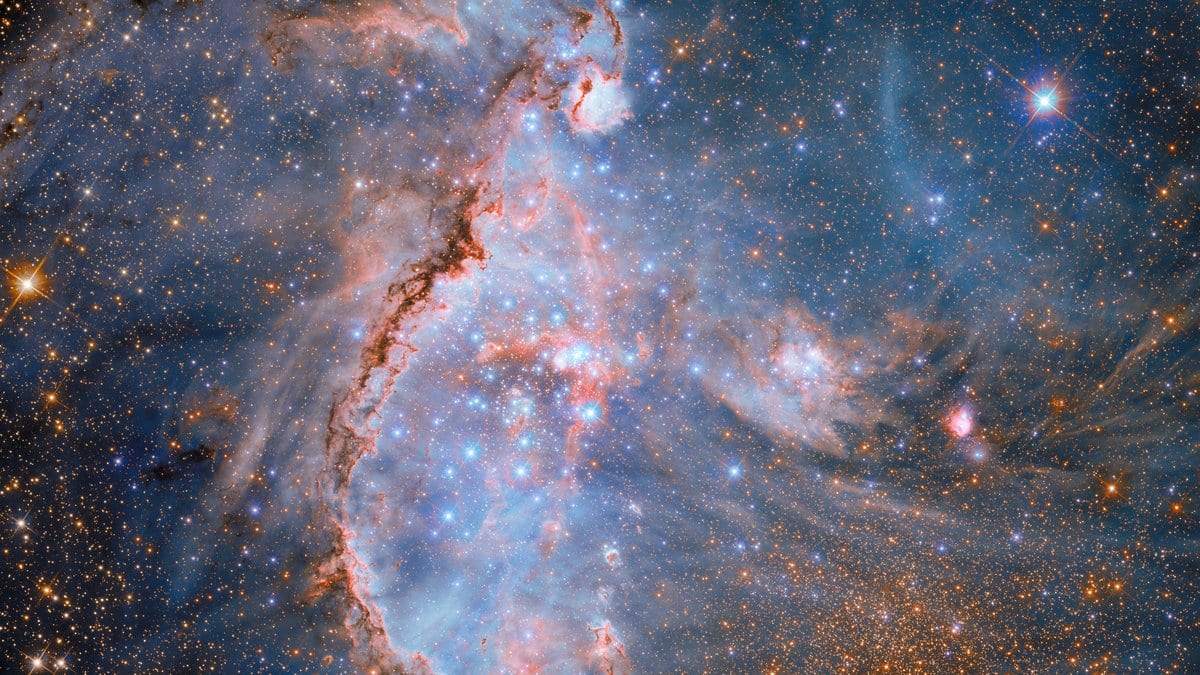
Ionized gas around a star cluster only a few million years old can account for the extreme dispersion of some repeating fast radio bursts, according to a model published Nov. 27, 2026, in The Astrophysical Journal Letters.
A burst's lower radio frequencies arrive later than its higher ones, and the size of that lag, the dispersion measure, records how much ionized gas the signal crossed on the way. A handful of repeating bursts show far more of it than their host galaxies should supply, and they keep turning up in small galaxies poor in elements heavier than helium. The authors tested whether one environment could explain both.
Eliza C. Diggins, Calvin Leung and Wenbin Lu, all at the University of California, Berkeley, built a model of neutron stars born inside star-forming clouds and ran simulations of the gas under the cluster's radiation. In their standard runs, associations holding 100,000 to a million solar masses of stars reach dispersion measures above about 1,000 pc cm⁻³ in gas as metal-poor as the Magellanic Clouds. That holds provided the burst switches on within roughly 5 million years of the cluster's birth and stays inside the ionized bubble. The phase is brief, about 2 million to 3 million years, and Milky Way-like gas never reaches those values.
Dust is the reason: grains compete with hydrogen for the ionizing ultraviolet photons, so a dustier cloud holds a smaller column of ionized gas.
The usual explanation for values that large is an expanding supernova remnant. The paper notes that this picture requires the burst to begin almost immediately after the star collapses, while the debris is still compact; gas kept ionized by a whole association can stay dense for millions of years.
Diggins and colleagues say the model can be tested in nearby galaxies by looking for near-ultraviolet light and the red glow of hydrogen at the burst's position. They also expect that bursts in massive, metal-rich, quiet galaxies, where this local contribution is suppressed, would make a cleaner sample for weighing the gas between galaxies.
Sources
- The Astrophysical Journal LettersPeer-reviewed