Webb Catches a Molecule Still Spinning From the Reaction That Made It
David A. Neufeld of Johns Hopkins University and three colleagues report that the James Webb Space Telescope has caught the molecular ion CH+ in a shock wave near a young star, spinning far faster than the surrounding gas could spin it. Their paper, published Nov. 26, 2026, in The Astrophysical Journal Letters, reads the brightness of those lines as the first measurement of how the reaction leaves the ion rotating.
CH+, a long-standing puzzle in interstellar chemistry, forms efficiently only when a carbon ion strikes a hydrogen molecule hard enough to supply about 0.4 electronvolts, so the ion marks where energy is being dumped into cold molecular gas. The levels it glows from sit more than 19,000 kelvin above its resting state, far higher than collisions in the shocked gas could lift it. The authors write that each ion arrives already spinning and then emits one photon in every line below the rung it entered on, so each line's brightness counts the ions that came in above it.
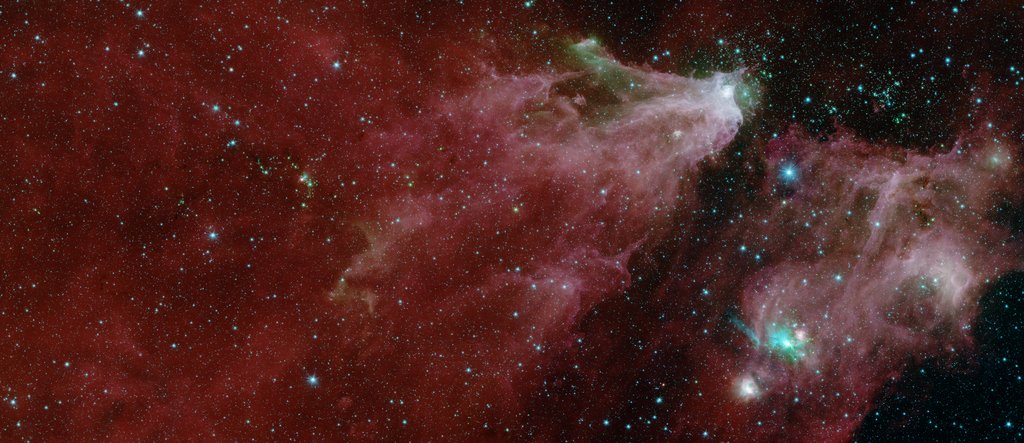
The team mapped two fields along HH 168, a shock in Cepheus A West, with Webb's mid-infrared instrument, MIRI. Eleven of the CH+ lines stand well clear of the noise in both fields and track the hot hydrogen gas in velocity and position.
The authors report a run of brightnesses close to a thermal distribution, with the formation temperature, multiplied by the share of the reaction's energy that ends up as rotation, coming out near 6,200 kelvin and implying reactants that carry energies equivalent to several thousand kelvin. The lines also sit up to 150 kilometers per second from their predicted positions, which the paper reports as the first measurement of the ion's rotational spacings at these high spins.
The same Webb observations have already produced another first. On Nov. 12, 2026, this publication covered the forbidden rotational spectrum of H3+, detected in the same fields of HH 168 and reported in a companion paper: another molecule, not this one.
The paper is open access and the Webb data are public in the MAST archive.
Sources
- The Astrophysical Journal LettersPeer-reviewed