Skip to content
See the World Through ScienceA project of ALLATRA
Source: Peer-reviewedMonthly Notices of the Royal Astronomical Society2 sources

In Simulations, an Unseen Planet Explains the Solar System's Strangest Orbits
Space

Republish this story

Our work is licensed under Creative Commons BY-NC 4.0. You may republish this piece for free — with credit to ALLATRA Media and a link to the original, unedited beyond length trims, and not for commercial use.

Read the full license

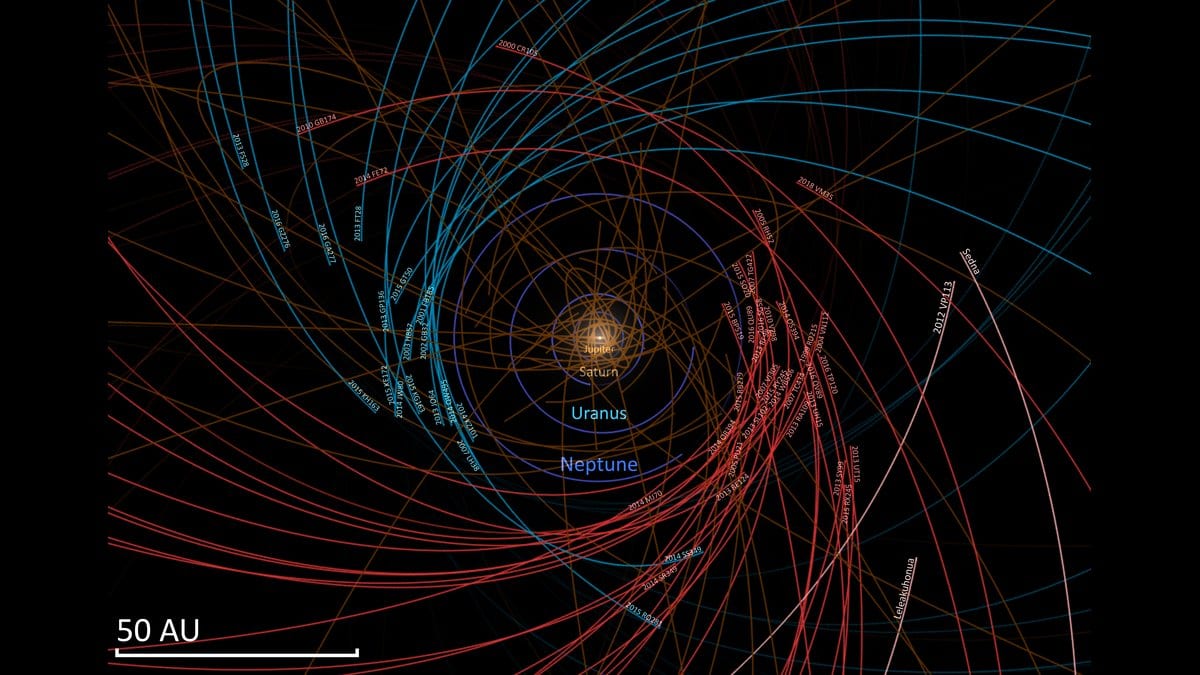
Orbital diagram of the outer solar system showing dozens of long, looping paths of distant icy bodies around the orbits of Saturn, Uranus and Neptune, with a 50 astronomical unit scale bar.
The stretched, tilted paths of icy bodies beyond Neptune, with Sedna and 2012 VP113 labeled at right. Patterns like these are what the simulations set out to reproduce."Distant object orbits and positions closeup" by Nrco0e, via wikimedia, CC-BY-SA-4.0

Simulations that follow the solar system for 4.5 billion years reproduce the tilted and stretched-out orbits of icy bodies far beyond Neptune when an unseen planet of about twice Earth's mass is placed on a distant orbit. Nothing has been detected — the result is a model.

The work, by Patryk Sofia Lykawka of Kindai University in Japan and two co-authors, was published Nov. 23, 2026, in Monthly Notices of the Royal Astronomical Society. The authors say the results are evidence for an undiscovered planet and offer predictions that the Vera C. Rubin Observatory's sky survey can test. They call the proposed body Planet X2.

The team tested two explanations for orbits beyond Neptune that the gravity of the known planets does not account for. Small planets scattered among the icy bodies early on were typically thrown out within a few to tens of millions of years and explained nothing, the authors report. A single planet of two Earth masses held an orbit 350 to 500 times the size of Earth's, never closer to the Sun than 200 times Earth's distance and tilted by 1 to 15 degrees. The planet reproduced the detached and steeply tilted orbits, including Sedna's.
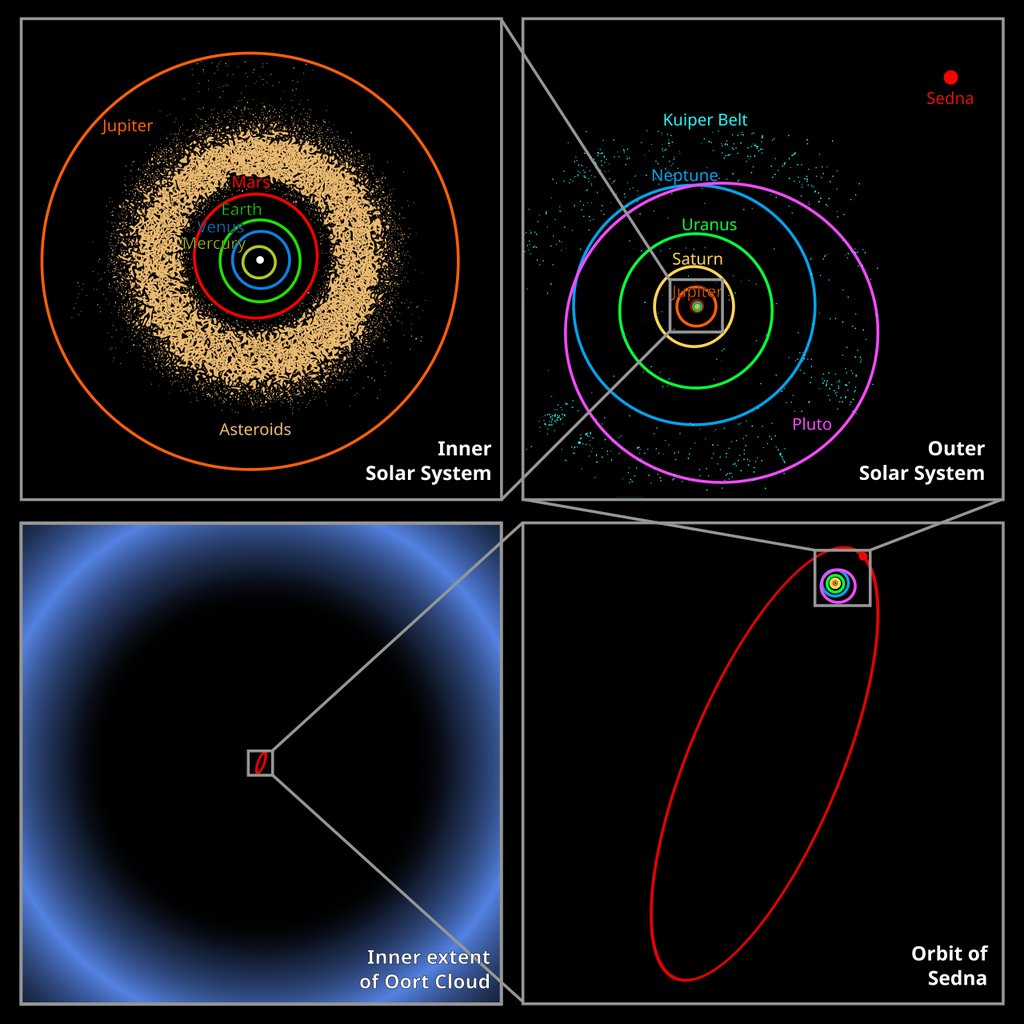
A four panel scale diagram: the inner solar system, the outer solar system out to Pluto, the inner edge of the Oort cloud, and the long narrow loop of Sedna reaching far past the Kuiper Belt.
The four panels step outward in scale, from the planets to a loop so long that the whole planetary system fits in a small box at its top. Paths like that one are what the model was built to explain. "Oort cloud Sedna orbit" by Image courtesy of NASA / JPL-Caltech / R. Hurt Original text courtesy of NASA / JPL-Caltech SVG conversion by Holek, via Wikimedia Commons, Public domain

The Royal Astronomical Society's announcement puts the mass at about 1.5 to 2 times Earth's and says the proposal differs from the Planet Nine hypothesis, which involves a substantially more massive world.

The authors report that the model matches the observed tilts and closest approaches of distant objects but not the spread of their orbit sizes. "Our model reproduces several of the unusual orbital patterns observed among distant icy objects, although there are still differences between the model and observations that we need to investigate further," Lykawka said in the society's announcement.

Co-author Jonti Horner of the University of Southern Queensland pointed to the Rubin survey in the same announcement: "The exciting thing is that we now have an opportunity to put this idea to the test."
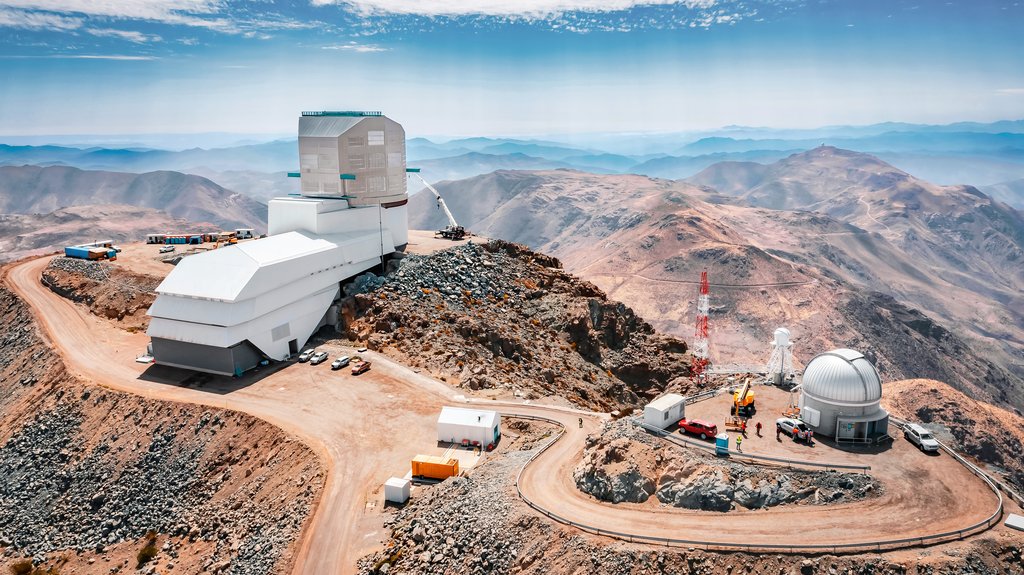

An aerial view of the Vera C. Rubin Observatory, a white dome and attached building on a bare ridge in the Chilean Andes, with mountain ranges fading into haze behind.
The observatory sits on Cerro Pachon in Chile. Its sky survey is the one the authors say could put their proposal to the test. "Drone View of Vera C Rubin Observatory (noirlab2411b)" by Rubin Observatory/NSF/AURA/A. Pizarro D, via Wikimedia Commons, CC BY 4.0

Sources

Spot an error?

Spot an error?

Report an error

Spotted a mistake on this page? Tell us what's wrong and our editors will take a look.

What kind of problem?

Only if you'd like us to be able to follow up. We won't use it for anything else.

We correct mistakes openly. Select any text to flag it. Fixes are logged under our Corrections Policy.

Report an error

Reporting on

In Simulations, an Unseen Planet Explains the Solar System's Strangest Orbits

What kind of problem?

Only if you'd like us to be able to follow up. We won't use it for anything else.

We read every report. Corrections are logged publicly.