Hera's First Close-Up Shows the Side of Didymos That DART Never Saw
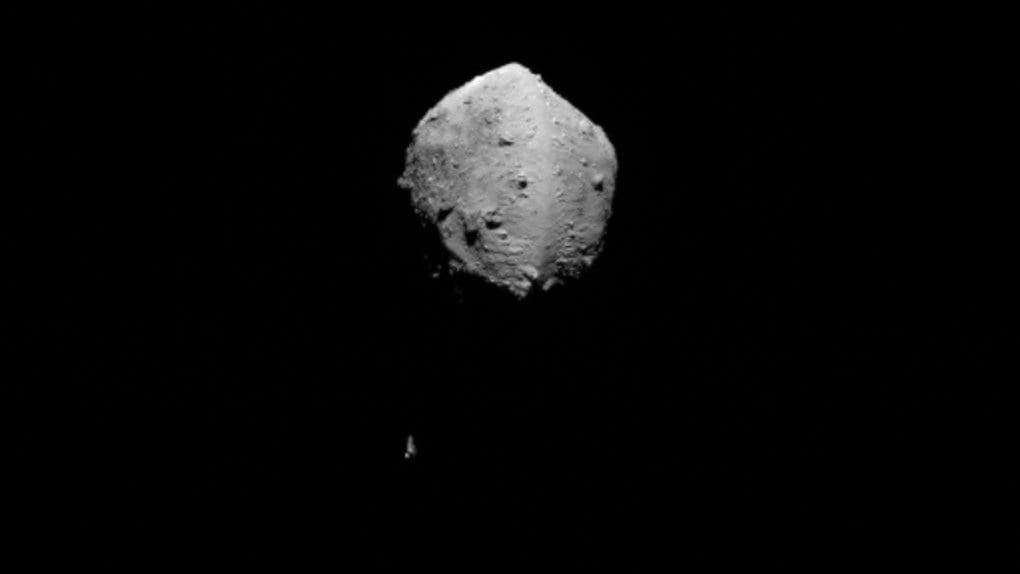
The European Space Agency says its Hera spacecraft has taken its first close-up of the Didymos asteroid pair, from 60 kilometers away, and that it shows the side of the larger asteroid that NASA's DART spacecraft never photographed.
The agency says Hera is about to begin a close-up survey of the crash site, and that what it learns should help turn the kinetic impact method of asteroid deflection, the technique DART tested, from a one-off experiment into a repeatable one.
The picture came from Hera's black-and-white Asteroid Framing Camera, according to the agency's release of Nov. 5, 2026. Didymos, 780 meters across, is shown clearly. Most of the smaller Dimorphos, which orbits it, sits in shadow.
Hera principal investigator Patrick Michel, of CNRS and the Observatoire de la Côte d'Azur, said: "This is the other side of Didymos from the one that DART's camera showed us shortly before impact, so this feels like looking at a whole new world." He said that side keeps the same central ridge along its equator seen before the impact, but otherwise looks very different, with "multiple boulders and craters and what look like patterns of grooves or ridges."
Hera mission scientist Michael Kueppers offered a possible explanation the mission has yet to test: the team expects a lot of the material thrown off Dimorphos by the impact to have crossed the roughly 1 kilometer of space to Didymos, and "it may be that some of these characteristics originate from this transport of material."
ESA says Dimorphos is the first object in the Solar System to have had its orbit measurably changed by human action. The DART impact of Sept. 26, 2022, shortened that orbit around Didymos by 33 minutes, give or take a minute. ESA says that was a much larger change than predicted.
Hera reached the pair after a two-year flight, and its earlier approach images had separated Didymos and Dimorphos only as two points of light. ESA says detailed images of both asteroids will be unveiled Nov. 25, 2026.