What One Molecule in 3I/ATLAS Says About the Cold It Came From

A methane molecule keeps a record of the place it was built, and the record is written in hydrogen. Most of the hydrogen atoms in it are ordinary, a single proton each. A few are deuterium, the heavy form, with a neutron riding along. The proportion of one to the other is set by the cold and the radiation where the ice first froze, and after that it can persist. It survives being warmed. It survives billions of years in the dark, and it survives a trip between stars.
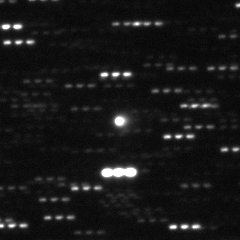
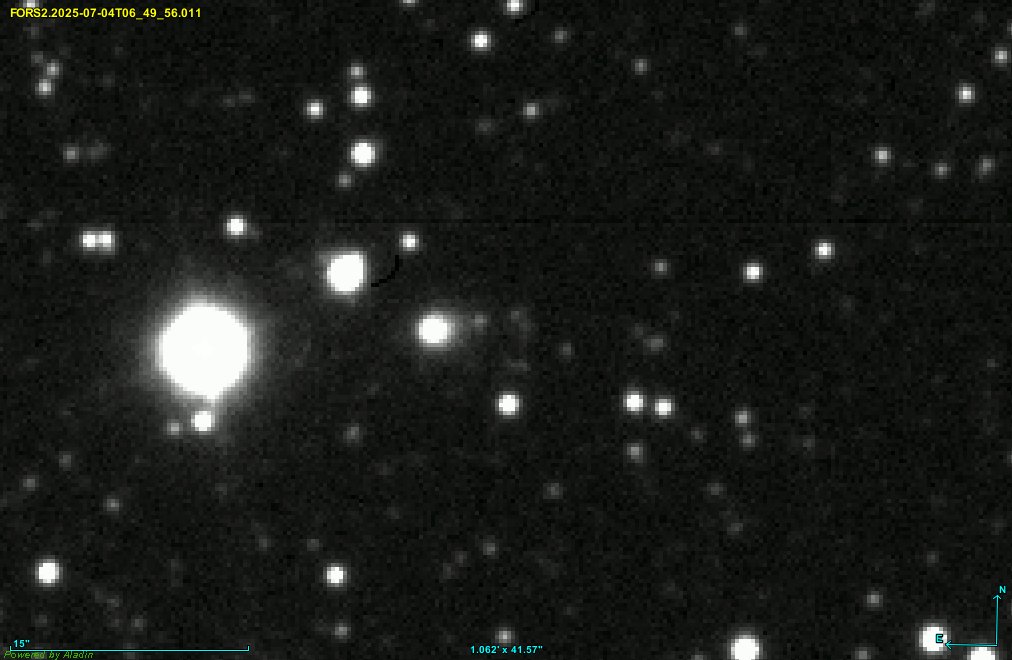
On Dec. 22 and 23, 2025, the James Webb Space Telescope spent two sessions watching the gas leaving 3I/ATLAS, the third object ever caught crossing the solar system on a path that started somewhere else. A team led by Nathan X. Roth of NASA's Goddard Space Flight Center and Martin Cordiner of Goddard and the Catholic University of America has now read what that gas was carrying. Their measurement appeared in Nature Astronomy on Oct. 23. They report that 3.18% of the hydrogen in 3I/ATLAS's methane is deuterium, give or take 0.30 percentage points.
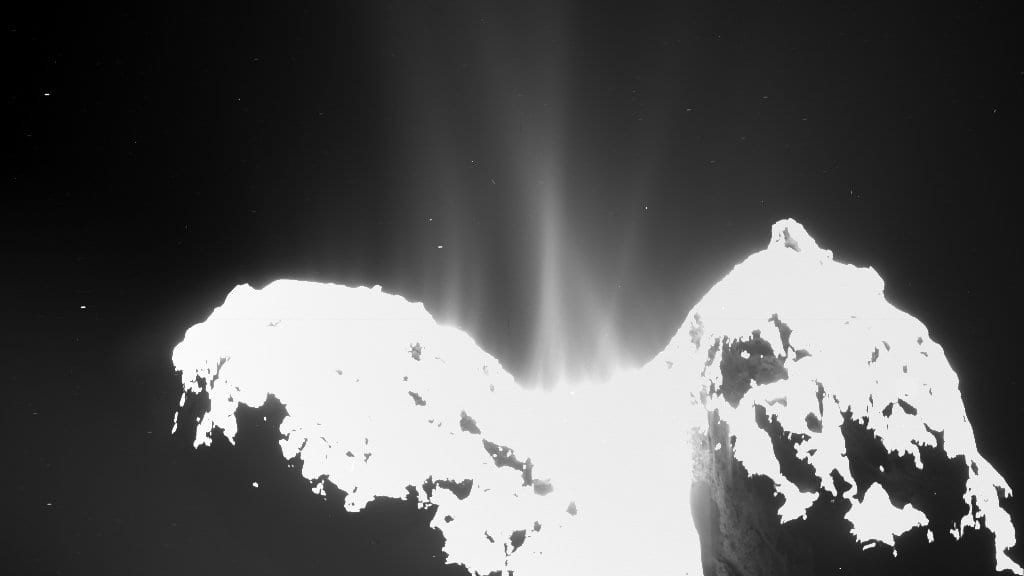
There is exactly one other comet to compare that with. Deuterated methane, the version with one hydrogen swapped for the heavy kind, has been detected in 67P/Churyumov-Gerasimenko and nowhere else. Methane itself turns up in comets routinely; the heavy variant is what is rare, and before 3I/ATLAS it had been seen once. In 67P, the share is roughly 0.24%, which leaves the interstellar object a factor of 13 plus or minus 2 above it. It also sits above every methane measurement made in the solar system, including those from Titan's thick atmosphere and the distant dwarf planets.
The comparison's two halves do not come from the same place. The 67P number is not Webb's and not this team's. It comes from Rosetta, the European spacecraft that flew alongside that comet, and from a 2022 analysis of its onboard mass spectrometer by a different group: a different instrument, a different method and a different set of people. Work the two figures against each other and the factor of 13 follows directly.
The Rosetta work also found something the new paper repeats. In 67P, the simple carbon compounds are several times more deuterium-rich than the comet's water. The same lopsided pattern turns up in 3I/ATLAS, and more strongly. Water in the same object, measured from the same two nights of Webb data by the same team, was published in Nature in June at about 0.98%, well above anything seen in ordinary comets and still only about a third of what the methane shows. A partly overlapping team had already established a lower limit for that water figure with ground-based ALMA observations in April. Roth, Cordiner and colleagues report that carbon-bearing molecules being more deuterium-rich than water is the trend across solar system bodies and in the interstellar gas nearby.
Why that should be is a question about temperature. The chemistry that concentrates deuterium into molecules only runs in the cold, below about 30 kelvin, which in practice means a cloud of gas before any star has lit inside it, or the chilly outer margin of a young planet-forming disk. That is why the ratio gets read as a thermometer for a place nobody can visit. For 3I/ATLAS, the authors put it this way: the elevated ratio "is consistent with the hypothesis that its ices formed in a cold, low-metallicity interstellar or protostellar environment under a high cosmic ray irradiation rate." Cold, short on elements heavier than helium, and heavily irradiated.
The hedge in that sentence is the paper's own and it matters. Consistent with is not the same as shows. The authors do not pick a birthplace for 3I/ATLAS and they do not rule one out; what they have is a number that such an origin would produce.
There is nothing else to compare it with. The authors write that the deuterium-to-hydrogen ratio in methane "is observationally unconstrained in extrasolar sources to date." Nobody has measured it anywhere beyond the solar system, around any star. What the 3I/ATLAS figure does resemble is the deuterium found in methanol and formaldehyde "towards pre- and protostellar environments," the cold places where stars are on the way to forming. The first such number in existence does not look like home.
What planet-formation modelers now have is a single data point: one molecule, in one comet, from a planetary system nobody has identified. It rests on one JWST dataset, two nights with one instrument, and no one has independently reproduced the measurement. The observations sit in the Mikulski Archive under proposal 5094, and the spectra and analysis scripts are posted on Zenodo, so a second group can redo the arithmetic without waiting for another interstellar visitor.
One thing to know if you saw this result when it first circulated as a preprint in March: the methane figure shifted before the journal published it, by less than the measurement's own uncertainty, and the comparison with 67P moved with it. The published pair is the one above.
3I/ATLAS is on its way out and will not come back. Whatever else is written into its ice will have to be read from the data already in the archive.