A Robot Assembled a Structure in Orbit With No Astronauts Involved
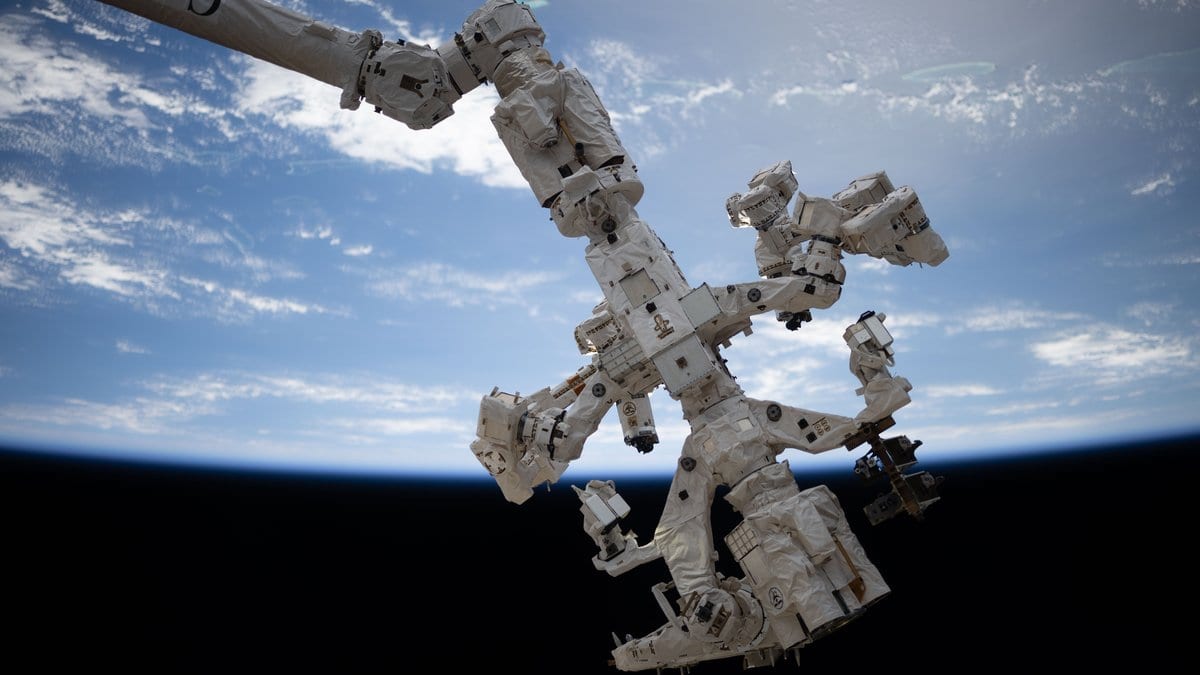
A robot aboard a California Institute of Technology payload has assembled a structure in orbit out of separate parts. DARPA announced the result Nov. 5, 2026, calling it the first-ever demonstration of automated in-space assembly; that priority claim is the agency's own, and no independent assessment of it has been published.
The work belongs to DARPA's Novel Orbital and Moon Manufacturing, Materials and Mass-efficient Design program, known as NOM4D, and its aim is size. "NOM4D's objective is to enable efficient, scalable construction of very large structures in space," said Andrew Detor, the program manager. "By 'very large,' I mean hundreds of meters or kilometers in scale. Nothing approaching that scale can be achieved today."
The builder is a gantry robot that moves along three linear axes. It connected composite truss members using custom-designed joints while deploying a thin reflective mesh, which the agency calls a proof of concept for future space-based antennas. Detor likened the method to construction toys: "individual truss members are joined at nodes, one section at a time, to create a larger structure." He added, "There are no complicated robotics or advanced algorithms; it's just solid engineering from the Caltech team to combine operations in a way that scales."
DARPA's announcement says assembly for space has until now been done either entirely on Earth, which limits a structure to what can be folded into a launch vehicle, or by putting large pieces together by hand after sending them up over a series of launches. The agency presents the Caltech system as a step toward hardware that travels as a box of building materials and is put together where it will operate.
The payload reached orbit aboard SpaceX's Transporter-16 mission at the end of March 2026, and Momentus hosted it on its Vigoride platform, supplying communications, power and imaging during the demonstration. NOM4D had not been built around a flight test; Detor redirected the program's final phase toward one after promising results in the preceding phase, and DARPA says 15 months passed between the decision to fly a demonstration and the launch of a working prototype.
One NOM4D milestone remains. A University of Illinois team will send a project to the International Space Station before the end of 2026 to test a space-compatible resin for making a high-strength composite structure in orbit, rather than assembling one from parts.