Skip to content
See the World Through ScienceA project of ALLATRA
Source: Peer-reviewedThe Astrophysical Journal Letters1 source

Astronomers Pull a Faint Carbon Monoxide Signal out of Two Public Archives
Space

Republish this story

Our work is licensed under Creative Commons BY-NC 4.0. You may republish this piece for free — with credit to ALLATRA Media and a link to the original, unedited beyond length trims, and not for commercial use.

Read the full license

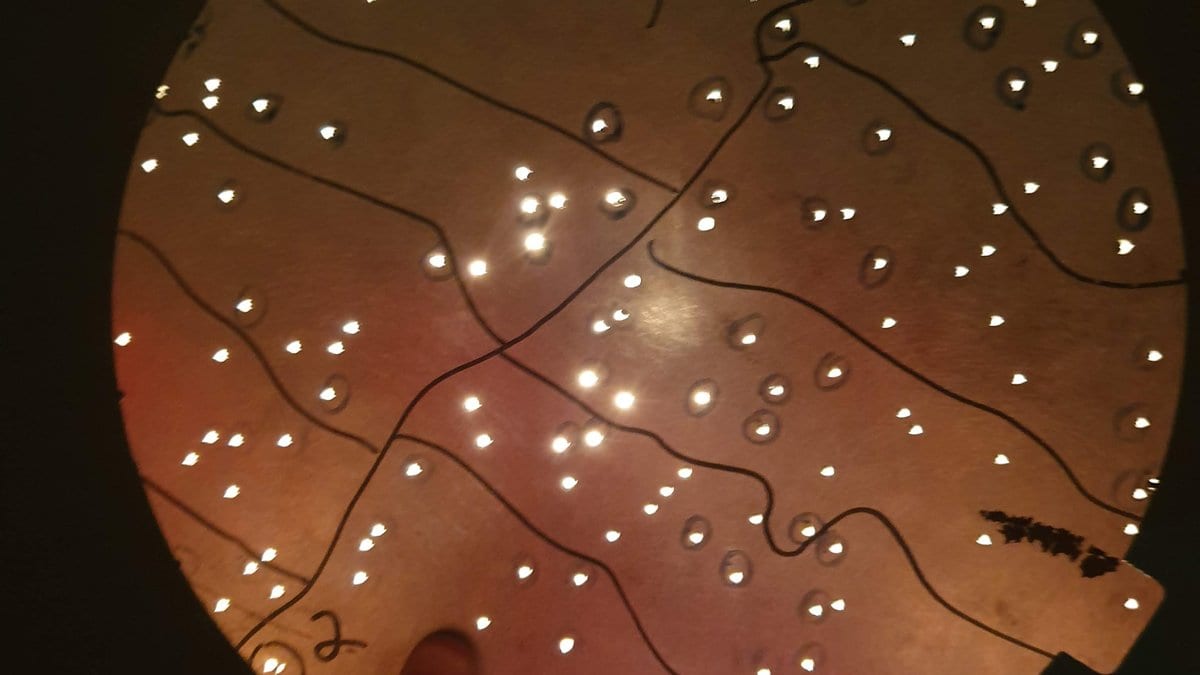
A circular metal plate drilled with dozens of small holes, held up to a light so the holes glow like stars.
Each hole takes a fiber aimed at one galaxy or quasar, and the catalog of positions and distances built that way is one of the two public archives this team stacked (illustrative)."Plug plate from the Sloan Digital Sky Survey, held up to the light" by Drkirstyross, via Wikimedia Commons, CC BY-SA 4.0, cropped

Three astronomers have pulled a faint carbon monoxide signal out of two public archives, with no instrument built for the job. In a Letter published Nov. 11, 2026, in The Astrophysical Journal Letters, Anirban Roy of New York University and the Flatiron Institute, with Nicholas Battaglia of Cornell University and Anthony R. Pullen of New York University, report emission tied to galaxies at a redshift of about 0.5, found by stacking a Planck map on the positions of galaxies recorded by the eBOSS survey.
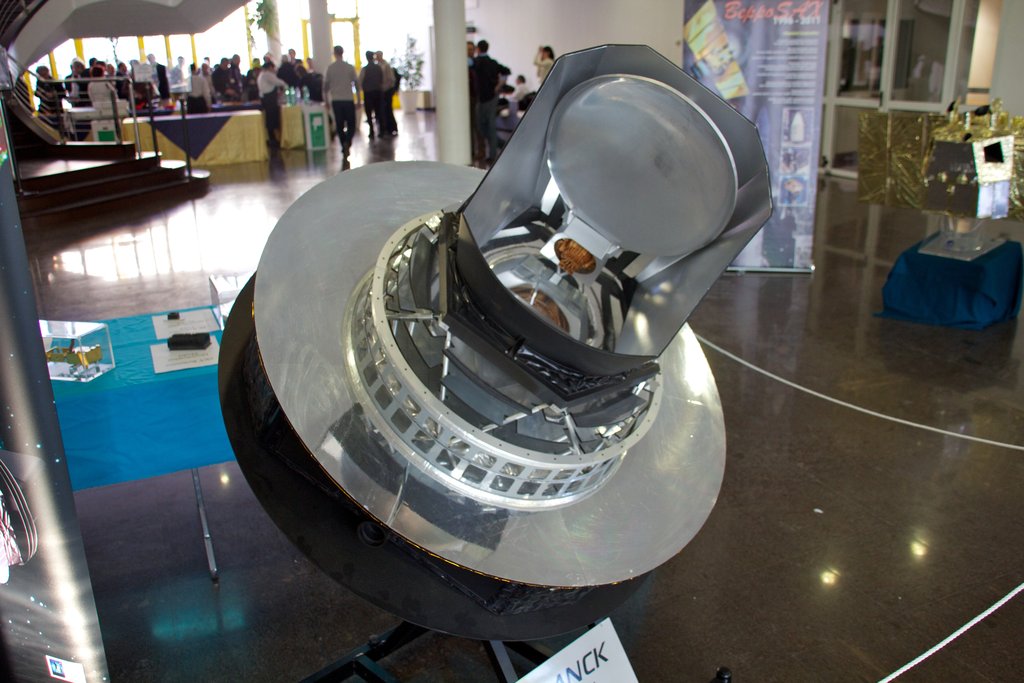
A display model of the Planck spacecraft, a dish-shaped reflector angled above a ring-shaped shield, standing in an exhibition hall.
A display model of the spacecraft, the reflector that swept the microwave sky angled above its shield (illustrative). "Planck model" by Photograph by Mike Peel (www.mikepeel.net)., via Wikimedia Commons, CC BY-SA 4.0, resized

The method under test is line intensity mapping. Rather than resolving galaxies one at a time, it adds up the light of a single spectral line from many of them at once, which the authors describe as a way to study how galaxies form and how matter is arranged on the largest scales. New instruments are being designed for that job. The paper asks how far the data already on hand can get, and both the Planck maps and the eBOSS galaxy catalog are public.
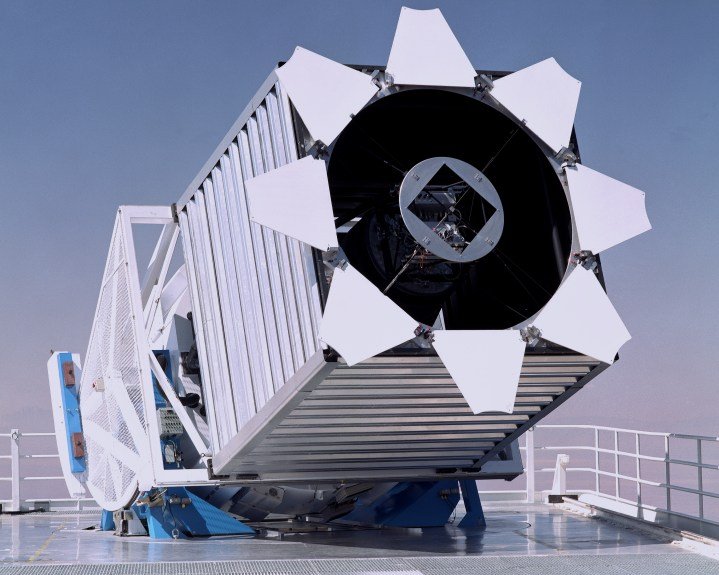
A wide-field telescope with white petal-shaped baffles around its open tube, standing on a platform against a pale sky.
The 2.5-meter telescope that recorded the spectra behind the galaxy catalog, open on its mount (illustrative). "SDSS telescope new" by Sloan Digital Sky Survey, via Wikimedia Commons, CC BY 4.0

Carbon monoxide is the usual stand-in for the cold clouds that stars form out of, because the hydrogen that makes up most of that gas is hard to see directly.

How firm the signal is depends on the analysis. The authors report that reading the stacked emission as the CO(3-2) line depends on the continuum model, the spectral response and the background treatment, and that those choices put the detection confidence somewhere between 2.2 and 3.4 sigma. Sigma is a measure of how far a signal stands above the noise, and at the low end of that range noise alone could account for what they see. That is why the confidence is given as a range rather than a single number.

Roy and colleagues write that stacking is already workable with existing observations from cosmic microwave background experiments and galaxy surveys, and that it complements the purpose-built experiments.

Sources

Spot an error?

Spot an error?

Report an error

Spotted a mistake on this page? Tell us what's wrong and our editors will take a look.

What kind of problem?

Only if you'd like us to be able to follow up. We won't use it for anything else.

We correct mistakes openly. Select any text to flag it. Fixes are logged under our Corrections Policy.

Report an error

Reporting on

Astronomers Pull a Faint Carbon Monoxide Signal out of Two Public Archives

What kind of problem?

Only if you'd like us to be able to follow up. We won't use it for anything else.

We read every report. Corrections are logged publicly.