Skip to content
See the World Through ScienceA project of ALLATRA
Source: Peer-reviewedNature1 source

The Famous Black Hole Picture Holds up When Another Team Rebuilds It
Space

Republish this story

Our work is licensed under Creative Commons BY-NC 4.0. You may republish this piece for free — with credit to ALLATRA Media and a link to the original, unedited beyond length trims, and not for commercial use.

Read the full license

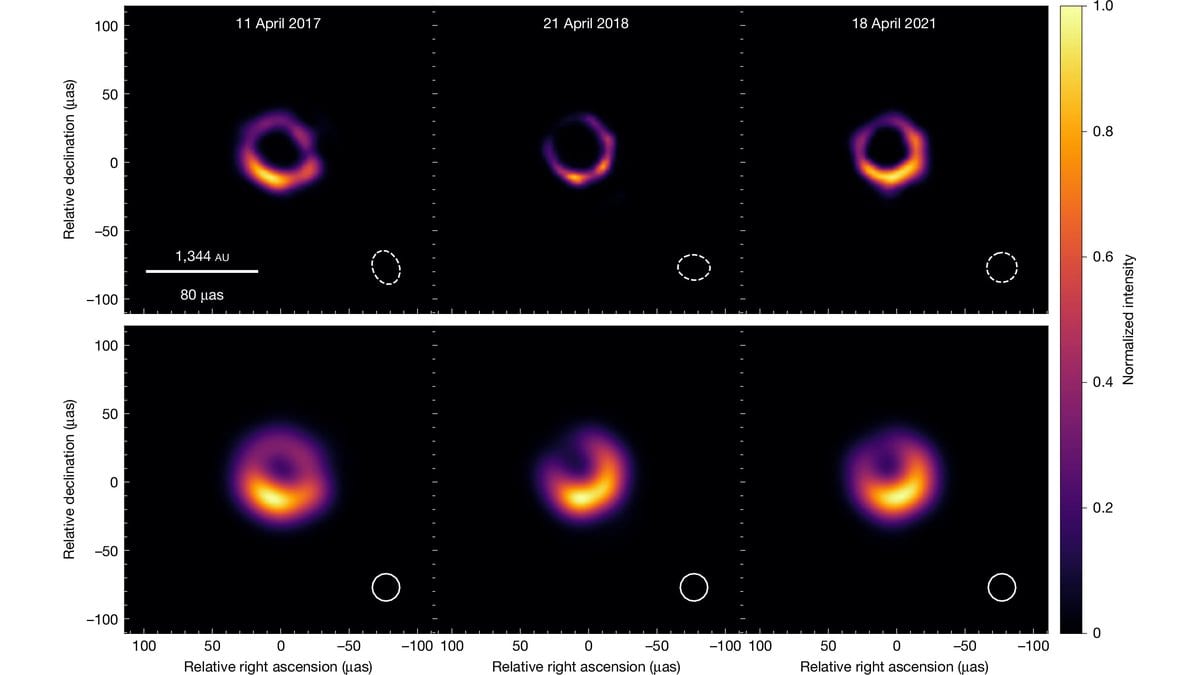
A six-panel figure of ring-shaped reconstructions of the M87 black hole shadow from three observing dates, at full resolution in the top row and blurred in the bottom row.
Rings the new method recovered from Event Horizon Telescope data taken in 2017, 2018 and 2021, at full resolution above and blurred below to match the published reconstructions.Fig. 1 from Samuel Lai, Nithyanandan Thyagarajan, O. Ivy Wong, Foivos Diakogiannis (2026), "Independent interferometric observable confirms black hole shadow in M87*", Nature — CC BY 4.0, resized and padded

Writing in Nature on Nov. 11, 2026, researchers at CSIRO, Australia's national science agency, report that they rebuilt the Event Horizon Telescope's picture of the black hole at the center of the galaxy M87 with an imaging method that assumes nothing in advance about the shape it should find, and the ring came back. They put its angular diameter at 42.2 ± 1.5 microarcseconds.

The doubt is why the work was done. The ring was first published in 2019 from sparse radio data, and outside groups have since argued that it owes more to the choices made while building the image than to the sky; at least one reported that a single elongated bright spot fits the data better once the field of view is widened. Samuel Lai and colleagues say they set out to resolve that tension, and describe what they got as an independent verification of the ring geometry.

Their algorithm, GenDIReCT, is a machine-learning image generator trained on pictures that have nothing to do with astronomy. Rather than calibrated telescope readings, it is fed closure invariants, combinations of the array's measurements that are unaffected by calibration errors. The team ran it over every public Event Horizon Telescope dataset of M87 from 2017 through 2021, at several field-of-view settings, and reports a compact ring of steady size and orientation in each case.
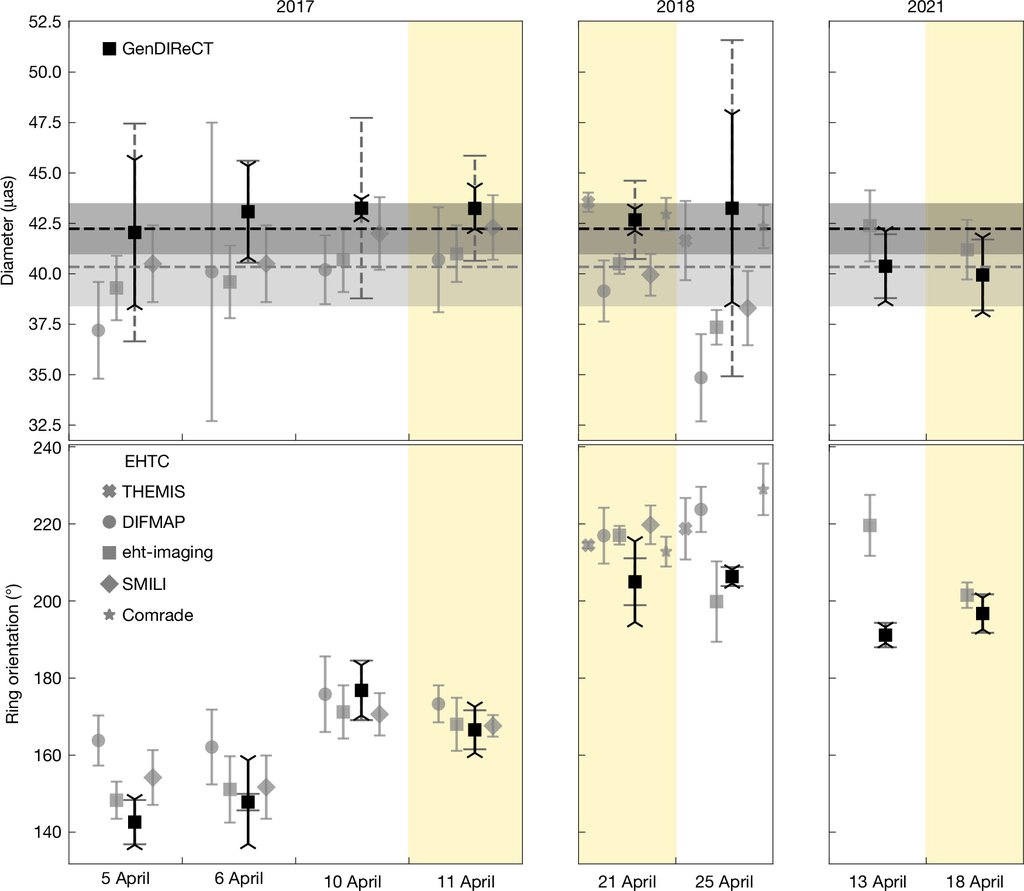
A chart comparing ring diameter in microarcseconds and ring orientation in degrees measured by the new method, in black, against five Event Horizon Telescope imaging algorithms, in gray, for observing dates in 2017, 2018 and 2021.
Ring diameter, top, and orientation, bottom, from the new reconstructions in black beside the five algorithms the Event Horizon Telescope collaboration used, by observing date. Fig. 2 from Samuel Lai, Nithyanandan Thyagarajan, O. Ivy Wong, Foivos Diakogiannis (2026), "Independent interferometric observable confirms black hole shadow in M87*", Nature — CC BY 4.0, resized

From that diameter the authors infer a black hole mass of 6.5 ± 0.5 billion solar masses, assuming nominal scaling parameters, the standard conversion from ring size to mass. The picture best matches a system viewed about 20 degrees from the approaching jet. Their analysis does not pin down how fast the black hole spins.

The telescope data they used were already public, and the authors say their code and their reconstructed images are public too.

Sources

Spot an error?

Spot an error?

Report an error

Spotted a mistake on this page? Tell us what's wrong and our editors will take a look.

What kind of problem?

Only if you'd like us to be able to follow up. We won't use it for anything else.

We correct mistakes openly. Select any text to flag it. Fixes are logged under our Corrections Policy.

Report an error

Reporting on

The Famous Black Hole Picture Holds up When Another Team Rebuilds It

What kind of problem?

Only if you'd like us to be able to follow up. We won't use it for anything else.

We read every report. Corrections are logged publicly.