Skip to content
See the World Through ScienceA project of ALLATRA
Source: PreprintarXiv1 source

Where Planets End and Small Stars Begin Depends on the Star's Mass
Space

Republish this story

Our work is licensed under Creative Commons BY-NC 4.0. You may republish this piece for free — with credit to ALLATRA Media and a link to the original, unedited beyond length trims, and not for commercial use.

Read the full license

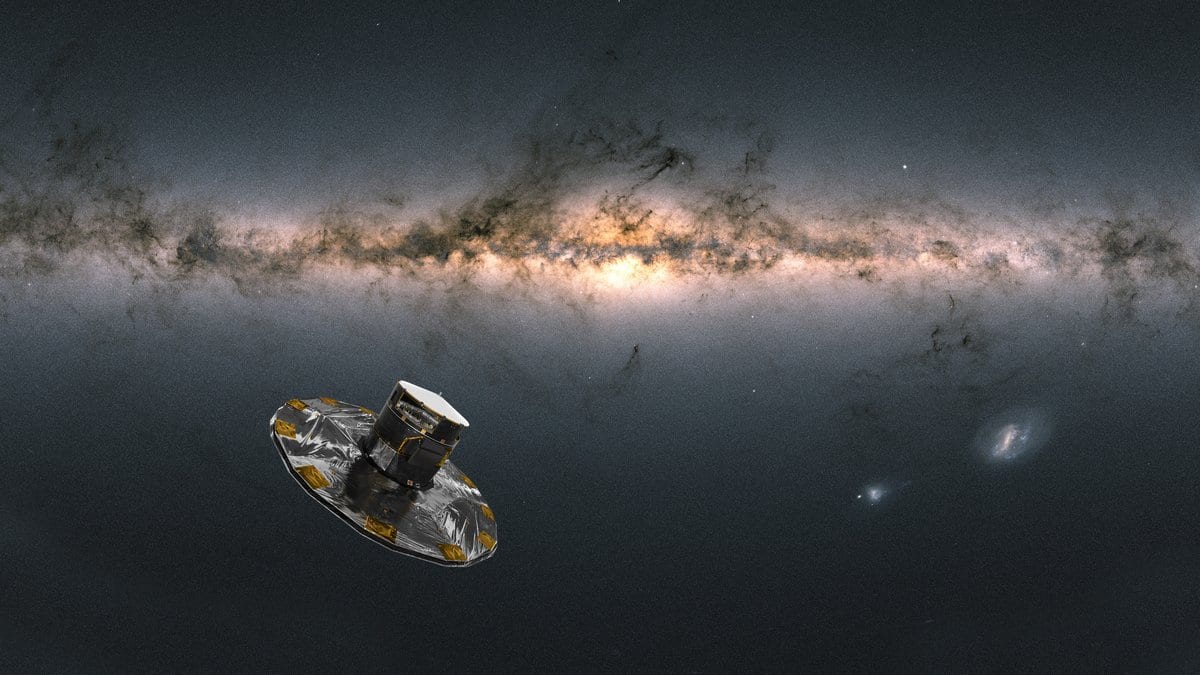
Artist's impression of the Gaia spacecraft, a boxy telescope on a wide circular sunshield, in front of a star map of the Milky Way.
The survey behind the result: positions measured by this spacecraft and by Hipparcos were modeled together for 63,254 stars (artist's impression)."Gaia observes the Milky Way ESA24305955" by European Space Agency, via Wikimedia Commons, CC BY-SA 3.0 igo

A survey of 63,254 stars finds that brown dwarfs, the objects between planets and stars, go missing as close companions at a fixed fraction of the host star's mass, close to 2%, rather than at a fixed mass. William Thompson of NRC Herzberg Astronomy and Astrophysics in Victoria, British Columbia, and colleagues report that companions are strongly depleted at that ratio from small M dwarfs up to hot B stars. The work is a preprint, posted Nov. 9, 2026, and has not been peer reviewed.
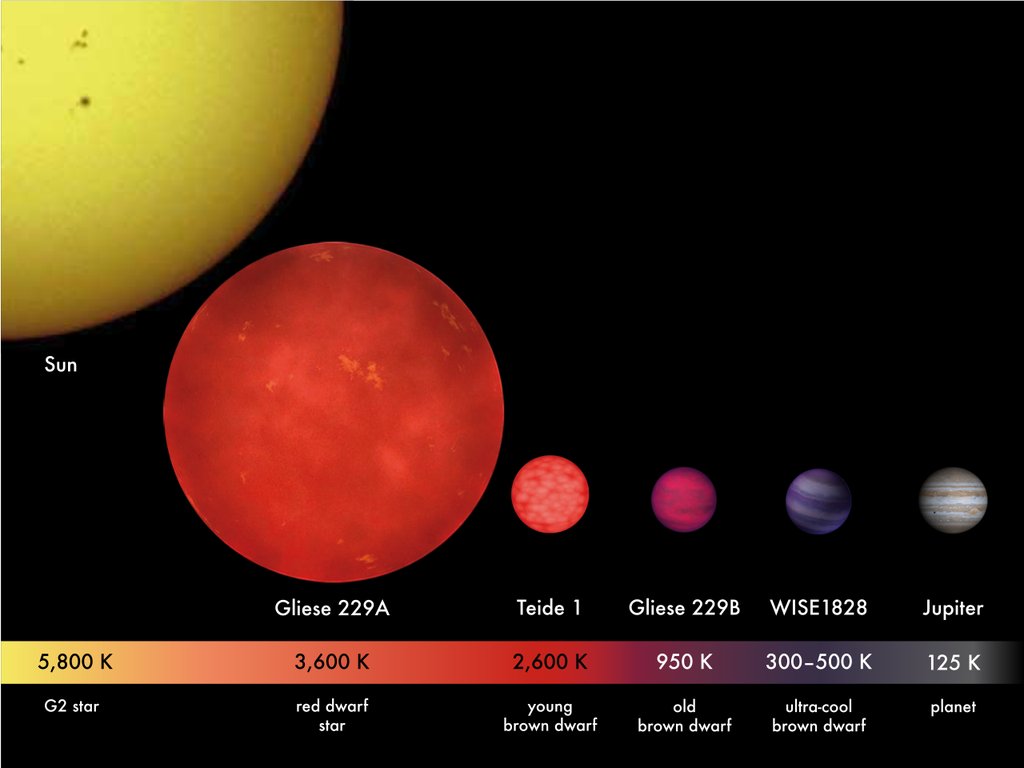
Diagram comparing the Sun, the red dwarf Gliese 229A, the brown dwarfs Teide 1, Gliese 229B and WISE1828, and Jupiter, with each object's temperature labeled below it.
The sequence the measurement cuts across, from a Sun-like star through brown dwarfs to Jupiter, with surface temperatures (illustrative). "BrownDwarfs Comparison 02" by MPIA/V. Joergens, via Wikimedia Commons, CC BY 3.0

The authors argue that this makes the ratio of the two masses, not the companion's mass, the meaningful line between planets and star-like companions, that it shifts with the star, and that the gap marks the divide between two ways a companion can form: building up inside a disk below it, and collapsing out of a fragmenting cloud above it.

In the preprint, the team fit a single model to astrometry, the measurement of a star's position, from the Hipparcos satellite and Gaia's second and third data releases, covering companions on orbits of 3 to 94 years. Fitting the gap separately in each host-mass range put its floor at 1.76% of the host's mass across K through B stars. In the fit to the whole sample, companions at the floor turn up tens of times less often than at the peaks on either side.
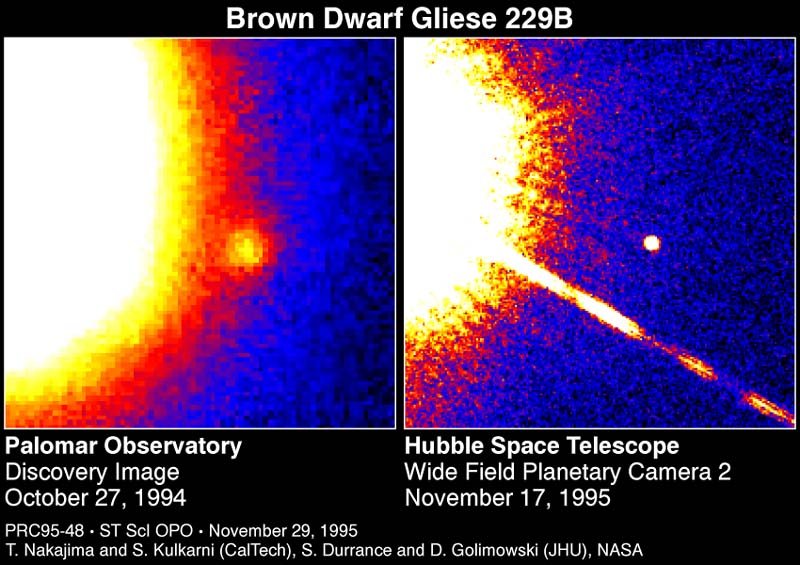
Two false-color infrared images side by side, each showing a bright star with a small companion point beside it.
A companion picked out beside its host star from Palomar Observatory Oct. 27, 1994, and by Hubble Nov. 17, 1995; one example of the kind of object the survey counts. "Brown Dwarf Gliese 229B" (no author stated), via Wikimedia Commons, Public domain

The two populations overlap in mass, so one mass cut cannot describe both: the lightest star-like companions of K stars come in near 13 times Jupiter's mass, below the heaviest planet-like companions of B stars, which reach roughly twice that. Some companions below the gap are heavier than the deuterium-burning limit, the usual dividing line between a planet and a brown dwarf, and still look like a smooth continuation of the planet population, the authors write.

Companions below the gap are more common around stars rich in heavy elements, and those above it rarer, which the authors take as support for two formation routes. The paper has been submitted to The Astrophysical Journal Letters.

Sources

Spot an error?

Spot an error?

Report an error

Spotted a mistake on this page? Tell us what's wrong and our editors will take a look.

What kind of problem?

Only if you'd like us to be able to follow up. We won't use it for anything else.

We correct mistakes openly. Select any text to flag it. Fixes are logged under our Corrections Policy.

Report an error

Reporting on

Where Planets End and Small Stars Begin Depends on the Star's Mass

What kind of problem?

Only if you'd like us to be able to follow up. We won't use it for anything else.

We read every report. Corrections are logged publicly.