Two Cold Failed Stars Appear to Be Moving With Debris From Swallowed Galaxies

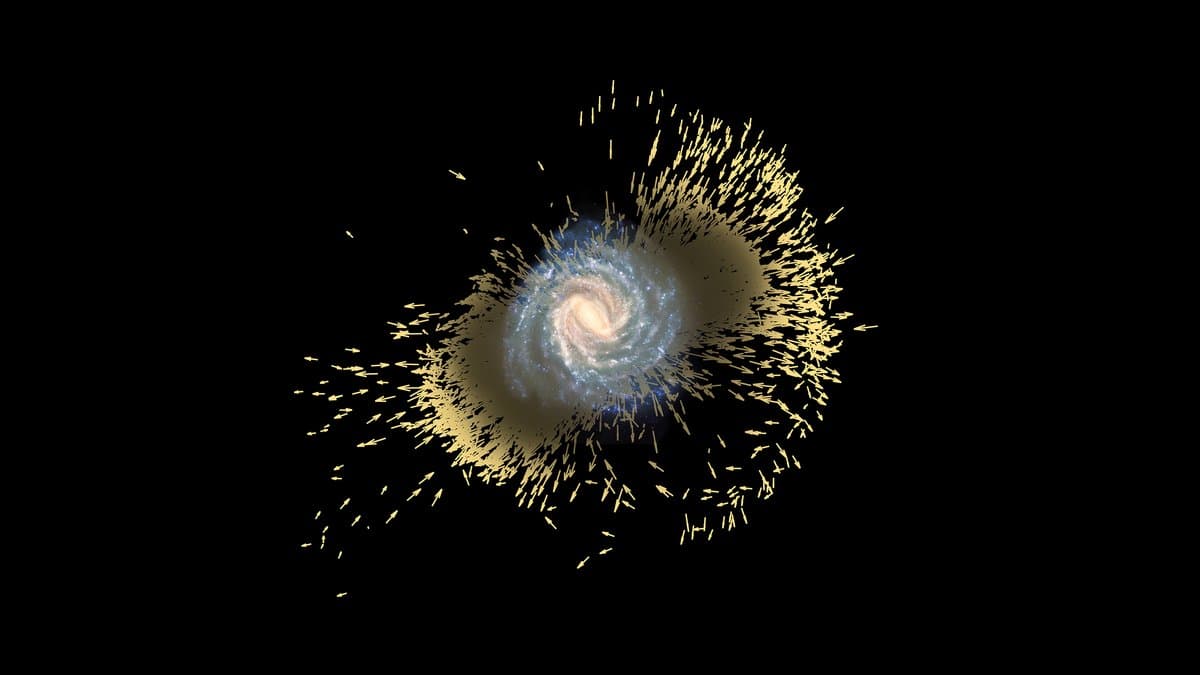
The Milky Way ate its neighbors, and the meals left traces. Stars pulled in from galaxies that fell into ours billions of years ago still thread through the outer Galaxy on orbits far more stretched than anything born here, and they carry the chemistry of wherever they formed. Telling those stars from the natives is a whole field of astronomy, and it runs on two measurements: how a star moves, and what it is made of.
One class of object has sat outside it. Brown dwarfs are the things that almost became stars and never did, too light to start burning hydrogen, and they spend the billions of years afterward simply cooling. The coldest put out most of what little light they have in the infrared, which is why precise measurements of cold brown dwarfs are rare enough to be news in themselves.
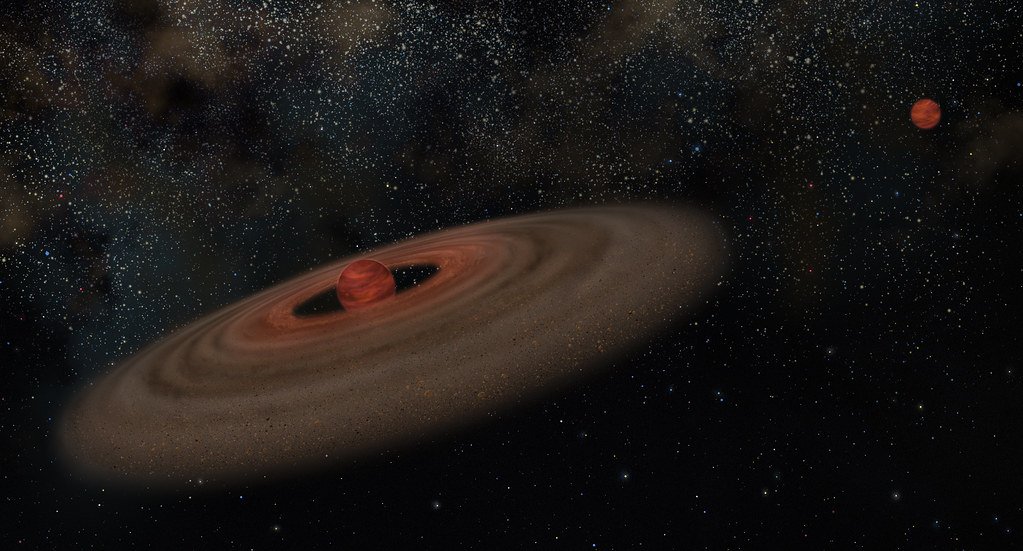
Chih-Chun Hsu and colleagues report that the James Webb Space Telescope can supply those velocities anyway. In a paper posted Sept. 23 and accepted for publication in The Astrophysical Journal, they present what they describe as the first radial-velocity survey of brown dwarfs aimed at the Galaxy's metal-poor population: 23 L, T and Y dwarfs, spanning a wide range of temperatures and compositions, each observed with Webb's NIRSpec spectrograph.
The method rests on one feature of the spectrum. Carbon monoxide absorbs in a dense thicket of lines near 4.5 micrometers, and rather than measuring any single line the team fits a model of the whole band at once, letting all those lines together pin down the Doppler shift. Checked against brown dwarfs whose velocities had already been measured on much higher-resolution instruments, the technique holds a systematic uncertainty of 5 kilometers per second. That is a floor for the method rather than an error bar on each object, and it is enough to reconstruct an orbit.
With velocities in hand, the sample sorts itself. All three of the Milky Way's main stellar populations turn up among the 23: the thin disk, where the Sun and most young stars sit; the thick disk above and below it, older and moving faster; and the halo, the sparse and ancient envelope wrapped around the whole thing. Brown dwarfs, in other words, can be assigned to Galactic populations the way stars are.
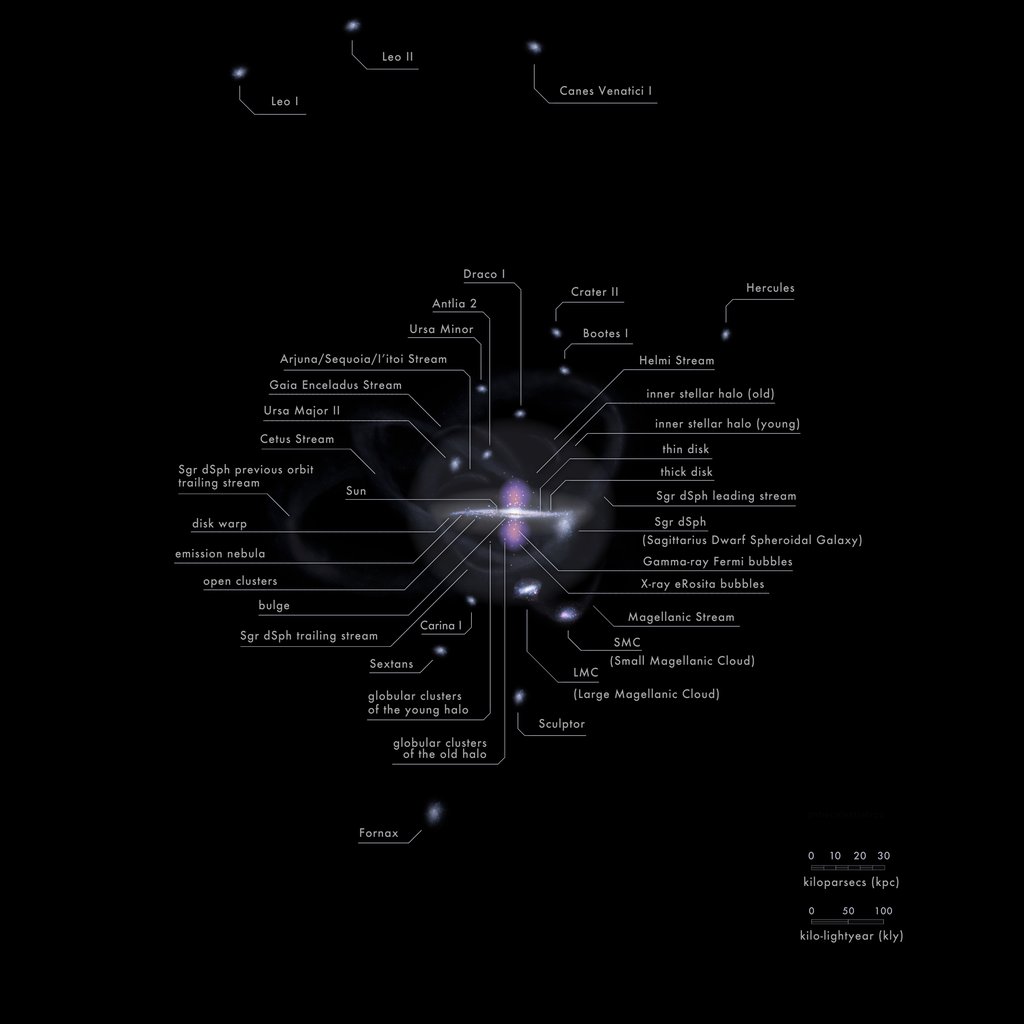
Two of the objects go further. WISEA J155349.96+693355.2, a T dwarf, is likely associated with Gaia-Enceladus, the remnant of a galaxy the Milky Way swallowed long ago. A second object, 2MASS J05325346+8246465, is likely associated with Thamnos, another shred of accreted debris. That second identification rests on the object's motion alone. No chemistry for it is reported here, which makes it the thinner of the two claims and the one most likely to move when somebody looks again.
The Gaia-Enceladus object has a paper of its own. Aaron M. Meisner and colleagues, in a companion study posted to arXiv on Sept. 24 whose review status the archive does not state, turned both of Webb's spectrographs on it and stitched together coverage from 0.6 to 12 micrometers. The two papers write the object's catalog name to slightly different precision; it is the same source, WISE J1553+6933 for short. Its spectrum shows water, methane and ammonia, strong pressure-induced absorption by hydrogen, and carbon monoxide and carbon dioxide weak or missing altogether.
Every one of those is a marker of a cold atmosphere with little in it beyond hydrogen and helium. Fits to atmosphere models give an effective temperature of about 960 kelvin and a heavy-element content roughly a fourteenth of the Sun's. A separate route through the object's total energy output puts the temperature near 974 kelvin, consistent with the first. The spectrum also shows a modest enrichment in the alpha elements, the ones supernovae make fast.
From the sharper part of the data, the object is moving toward us at 163 kilometers per second, which, with its motion across the sky and an estimated distance, gives an orbit of eccentricity at least 0.9: a long ellipse, not a circle, and consistent with something the Galaxy caught rather than made. Motion, bulk metal content and alpha enrichment all land where stars already identified with Gaia-Enceladus land, and that is why Meisner and colleagues call it the first brown dwarf with both kinematic and chemical evidence of association.
Association here means a match on three independent quantities, not a demonstration that the object formed in that galaxy, and neither paper says it did. One measurement of it has also moved a long way: earlier ground-based spectra made this object look considerably richer in heavy elements than the Webb data now do. Both papers come from the same collaboration, so the two associations rest on one group's reading of one set of observations.
Hsu and colleagues end on what the method opens rather than on what it has found. Every brown dwarf turned up in a halo stream from here on is a test of whether the models of how these objects form and cool still work at metal contents nothing like the Sun's, and at the moment there is exactly one of them with chemistry to go on.