This White Dwarf's Light Has Four Peaks. Every Other One Has Two.

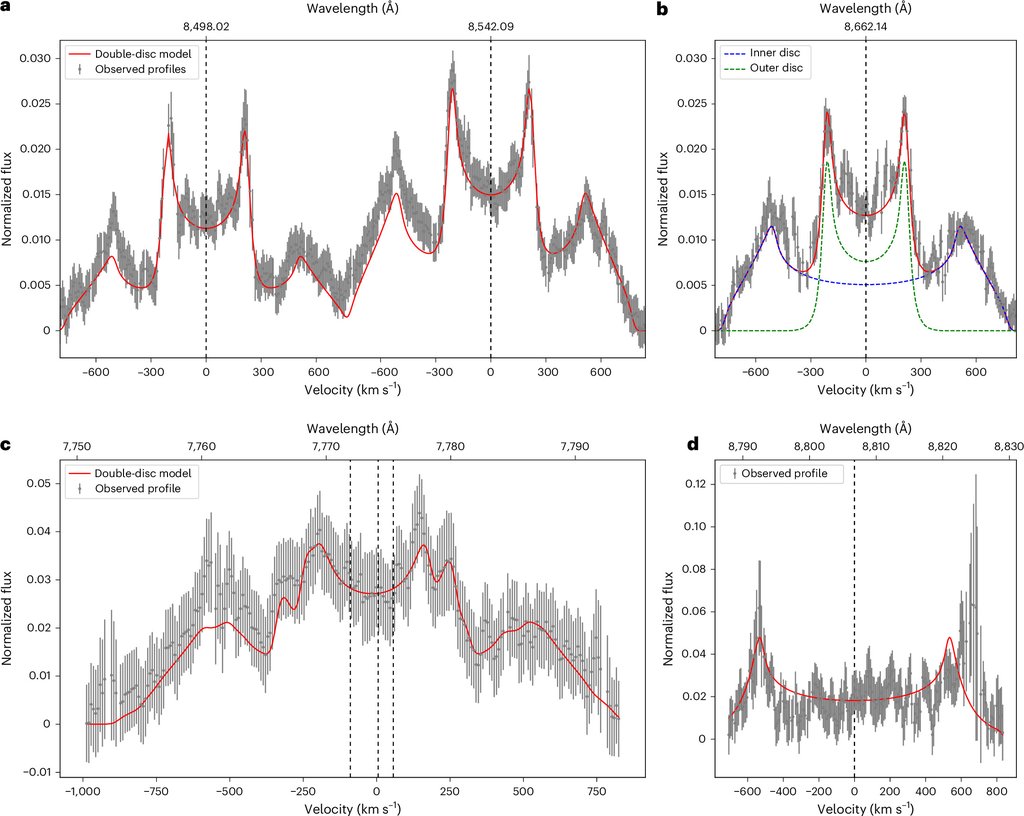
When a ring of gas circles a star, its light carries the shape of its orbit. One side of the ring sweeps toward us and its glow shifts blue; the other sweeps away and shifts red, and what reaches a spectrograph is one emission line split into two peaks. By the count of the team behind a new paper, 21 gas disks have been reported around white dwarfs, and every one of them looks like that. The calcium lines of a white dwarf called WD J1328-1450 have four peaks.
Nicola Pietro Gentile Fusillo, of the University of Trieste and INAF's Trieste Astronomical Observatory, and his colleagues reported those four peaks Oct. 26 in Nature Astronomy. The spectra behind the result are older than the paper. The X-shooter spectrograph on the Very Large Telescope in Chile recorded them in May, June and July 2021 and again in May 2023. The shape of the lines barely moved across that interval, which is part of why the team treats the structure as stable rather than as a passing clump. The star's own atmosphere holds calcium, magnesium and silicon in absorption, evidence that a white dwarf is accreting its own planetary debris.
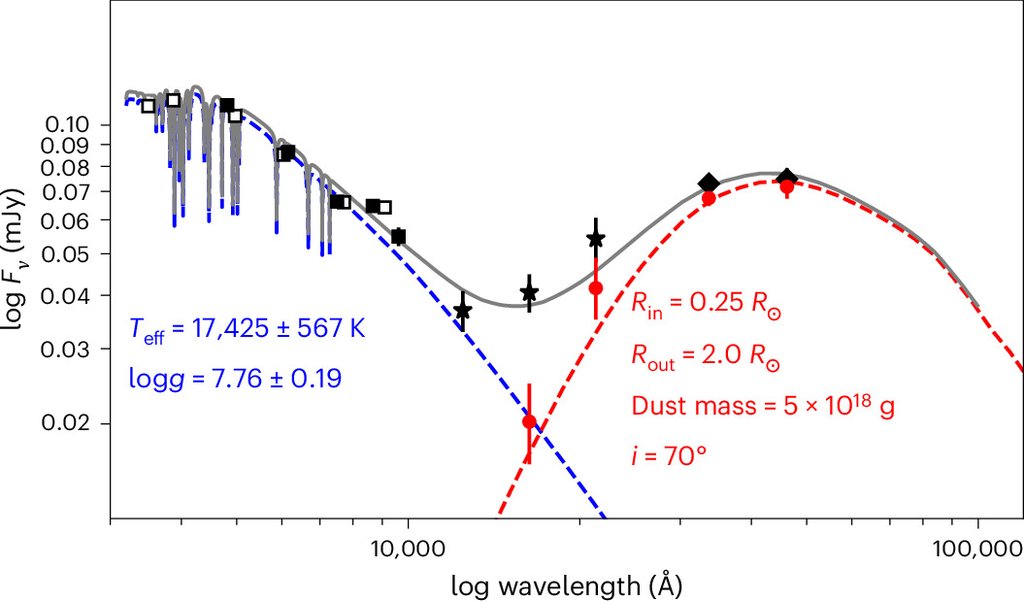
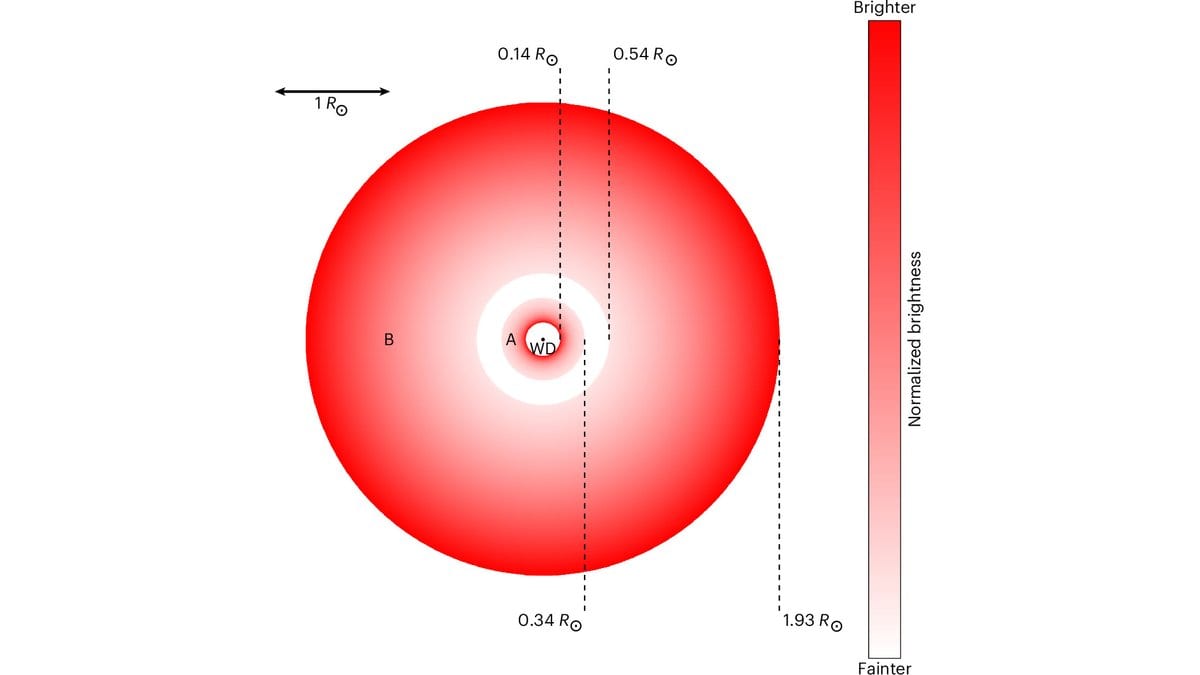
Four peaks are what two rings would look like. Fitting those calcium lines with a pair of flat, concentric rings puts the inner ring's gas out to about a third of the Sun's radius. The outer ring's gas does not begin again until roughly half of it, the loosest constraint in the whole fit, and then runs out to nearly twice. Between the two sits a gap with no detectable gas in it, and the gap, not the rings, is the hard part.
Gas around a white dwarf does not stay where it is made. It is produced somewhere, by dust vaporizing close to the star or by dust grains smashing into each other, and then it spreads outward on its own. Neither standard explanation easily accounts for a gap. Vaporizing at the disk's inner edge would fill the space continuously, and a cascade of collisions would need some unexplained reason to stop in one narrow band and nowhere else. What can confine gas, on the authors' account, is temperature: gas that drifts outward cools, condenses back into dust faster than it can spread, and so each ring stays pinned near whatever is feeding it.
One ring has magnesium and the other does not
The strongest concrete evidence for two separate reservoirs of gas is an absence. Calcium and oxygen glow from both rings; magnesium glows only from the inner one. The team worked out how bright the outer ring's magnesium should be if both rings held magnesium and calcium in the same proportion, and the predicted signal is about six times the measurement noise above the light actually recorded there. No magnesium signal is detected. The authors describe that as direct evidence independent of their disk model, and it is the one result in the paper that does not rest on the two-ring fit.
What the absence means is less settled. Different planetary materials carry magnesium and calcium in different ratios: stony meteorites are rich in magnesium, while Earth's crust is comparatively poor. So the two rings may have come from two separate parent bodies with different histories. Or, as the authors also allow, they may have come from two layers of a single body that had separated into a magnesium-rich interior and a magnesium-poor crust before the star's tides took it apart. That second reading accounts for the magnesium just as well and needs only one object.
What has to be in there, and what was not seen
Gentile Fusillo and his colleagues propose that each ring is fed by a surviving planetesimal, a leftover chunk of rock, grinding gas out of the dust it plows through. The proposal rests on eliminating alternatives and on one precedent. Nothing has been detected at WD J1328-1450 itself: no transit, no periodic signal, no direct trace of either body.
The precedent is SDSS J1228+1040, the system this whole inference is modeled on. A repeating signal in that star's emission lines, reported in Science in 2019 by Christopher J. Manser, now at Imperial College London and a co-author of the new paper, was interpreted as evidence for a dense solid body embedded in its disk. Two rings would then require two such bodies on concentric orbits. The paper calls them theorized planetesimals, and that is the right weight to give them.
The data do not force two rings either. The paper records one alternative that it cannot rule out from the line profiles: a single disk thickened enough in the middle to shadow its own midsection would produce much the same four-peaked profile. It is set aside for a reason that is not observational. No existing model of white dwarf debris disks predicts such a disk.
How big either body could be, at most
Nothing in the paper measures either body. What it sets instead is a ceiling, and the ceiling comes from tides. This close to a white dwarf, a large body held together only by its own gravity is pulled apart. One with no internal strength at all would have to be denser than any known material to survive where the inner ring is, so whatever sits there must hold itself together by its own material strength. Assuming the strengths of ordinary rocky bodies in the solar system and an iron-like density, the authors estimate the maximum size of an object that could survive: about 45 kilometers across at the inner ring's inner edge, about 172 kilometers at its outer edge. Tides are gentler farther out, so the outer ring's limits rise to about 346 kilometers and 2,340 kilometers, roughly Pluto's width. A rocky body of moderate strength rather than an iron-dense one could reach about 3,500 kilometers there, roughly the Moon's diameter. Every one of those figures is a maximum. The paper derives no lower limit at all, so the span it quotes, from a few kilometers upward, describes what would fit rather than what is there.
Rings and gaps are familiar from the other end of a star's life, in the disks of dust and gas around young stars, and the paper argues that whatever carves them there may also shape the wreckage left behind at the end. On either reading, one differentiated body or two separate ones, the structure around WD J1328-1450 is something the current models of these disks do not predict.
Sources
- Nature AstronomyPeer-reviewed
- Science