Gas Is Still Flowing Into the Dust Gaps Where Planets May Be Forming
Three young stars circled by dusty disks with wide, swept-out central holes still have gas reaching deep inside those holes, new ALMA observations show. A. A. Rota of Leiden Observatory and colleagues measured dust cavities 30–40 au in radius in all three disks (an au is the distance from Earth to the Sun), with carbon monoxide reaching well inside the cavity edge.
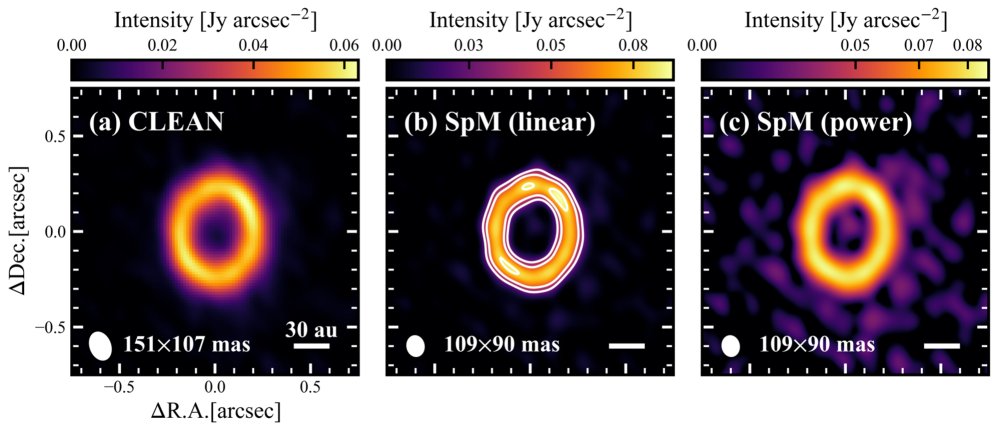
Holes like these are where giant planets are thought to be forming. Rota and colleagues call such disks promising targets for studying planet formation, since a massive companion is the usual explanation for a cleared cavity, and what is left inside sets how much material that companion has to grow on. The paper reports the gas and dust structure; it neither images nor confirms a companion.
The three systems in the new paper are Sz 111, in the Lupus star-forming region, and two others that it shortens to J1608 and J1633, all cool K- and M-type stars, less luminous than those most earlier work on these disks has targeted.
No inner dust disk showed up, matching the lack of warm dust in these stars' infrared light. Gas is still getting through: all three stars are still drawing in material, and from those accretion rates the team puts the inner disk at up to 100,000 times as much gas as dust at 1 au.
Neither the gas temperatures nor that gas-to-dust ratio came out any different from disks of the same kind around hotter, brighter stars, which the authors call contrary to expectations.
Fed through a published relation between cavity size and companion mass, all three cavities imply something heavier than 15 Jupiter masses, a brown dwarf rather than a planet. The team adds that the relation was never tested that high. Rota and colleagues conclude: "The observed disk structures could be explained by super-Jovian companions on eccentric orbits, but more detailed modeling is needed to confirm this conclusion."
The paper was posted Nov. 6, 2026, and has been accepted for publication in Astronomy & Astrophysics.
Sources
- arXivPreprint